
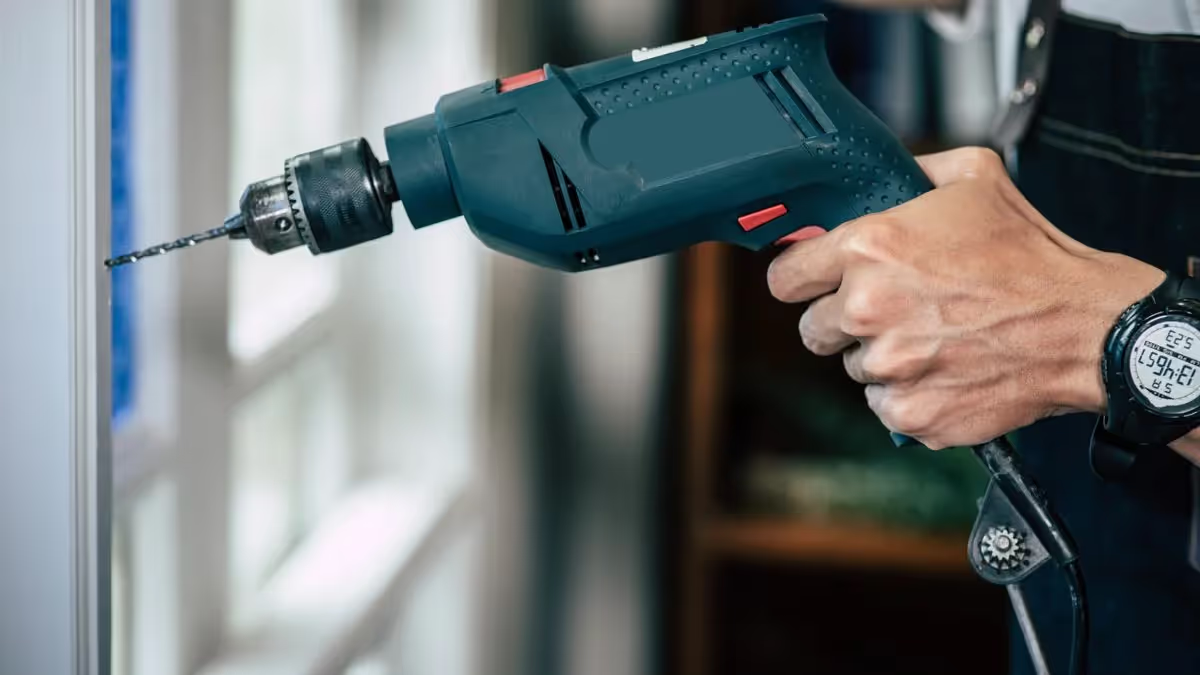
In the world of DIY, every drill has its moment of glory. From the unrivalled mobility of the cordless drill to the surgical precision of the pillar drill, by way of the agility of the angle drill, every tool has its speciality. Step into the heart of this world and discover how to choose the ideal equipment for each task. A world of possibilities opens up to you, whether you are a beginner or a DIY expert. Ready to drill down into the secrets? The drill, an essential in the DIYer's workshop, has established itself over the years as an indispensable ally for a multitude of tasks. But what makes this tool a pillar of the power tool range? Let us take this technical marvel apart together.
Anatomy of a drill
The drill, beyond its primary role, is an assembly of several crucial elements that give it its versatility. Every component has its importance and serves a precise function.
Chuck
At the heart of this tool lies the chuck. This is the metal fitting that holds the drill bits, turning the drill into a machine capable of tackling various materials, from soft wood to hard concrete. Add other accessories to that, and your drill will be able to handle mixing, milling and even brushing.
Handle and trigger
The handle, simple in appearance, is an essential element in guaranteeing grip and safety. It is closely linked to the trigger, which gives the starting signal for our work by activating the motor unit.
The drill models: choosing with full knowledge of the facts
There is a variety of drills, each suited to a specific need. Understanding these differences is crucial for any serious DIYer.
Corded drill
Unlike its cordless cousins, the corded drill depends on a constant power supply. Its power and its efficiency are its main strengths, making it ideal for intensive work. It is limited, however, by its dependence on a mains socket, which makes it less mobile.
Cordless drill
Freedom is the watchword of the cordless drill. Without being chained to a socket, this drill offers unrivalled mobility, albeit at the mercy of its battery life. Technological progress has not focused on batteries alone; it has also affected motors. Brushed motors, once the standard, were known for their efficiency but also for the regular maintenance caused by the wear of the brushes. Brushless motors, by contrast, are now at the cutting edge of technology. They offer a longer service life, greater efficiency and require less maintenance, because they eliminate the friction and wear typical of traditional motors. This advance also means less heat generated and better use of the battery's energy. Often used for driving and removing screws, the cordless drill, fitted with these advanced motors, is a prized tool for quick tasks such as assembling furniture and much more
Hammer drill
With the advent of hammer mode, drilling hard materials is no longer a challenge. Whether brick or concrete, the hammer drill uses a vibration system to make the job easier. It combines light weight with precision, making the heavier rotary hammer less necessary for certain jobs.
Pillar drill
The pillar drill, an essential in the workshop, is fixed to a bench or to the floor, guaranteeing stability and precision. Its design consists of a robust base, a vertical column and an adjustable carriage supporting the motor and the chuck. It allows consistent drilling, ideal for work requiring great precision. It takes a variety of bits, suited to a multitude of materials. Advanced models offer variable speed controls that adapt the rotation to the material. As well as its precision, it emphasises safety, reducing risks thanks to its stability
Angle drill
The angle drill, fitted with an offset chuck, is designed for narrow areas, making it possible to work in tight corners or behind obstacles. Ideal for joinery, plumbing and electrical work, it may not be essential for everyone, but it is an asset for projects requiring precision in confined spaces.
Air drill
Less common but just as useful, the air drill is powered by compressed air. Its light weight makes it ideal for drilling series of small holes.
One form, several offers.
- Two minutes, no account
- Direct, no middleman
- Your identity stays private
The power of corded drills
It should be pointed out that the power of a corded drill generally ranges between 500 and 1,300 watts. A high output means greater ease in drilling work. In short, the drill is a tool with many faces, suited to a plethora of situations. Choosing the right drill requires an understanding of its features and its possibilities. And now, fellow DIYers, you have everything you need to make the right choice.
The historical evolution of the drill
It is fascinating to note that the tool we take for granted today is the fruit of decades of innovation. The first drills were manual, requiring human strength to bore a hole. With the arrival of electricity in homes, the first electric drills appeared, revolutionising the world of DIY.
The battery: the heart of the cordless drill
Battery technology has evolved considerably, with lithium-ion batteries dominating today's market. They offer greater longevity, fast charging and constant power during use. It is crucial to understand their specifications: voltage (V), which determines the power, and capacity (Ah), which defines how long the tool can be used.
Advanced features of modern drills
Torque adjustment
Many modern drills offer torque adjustment, allowing the rotational force to be set. This is essential in order to avoid damaging delicate materials or breaking screws when driving them.
LED lighting
A small detail that makes a big difference, especially in poorly lit areas. The built-in LED lighting illuminates the working area, guaranteeing precision and safety.
Reversible operation
This function allows the user to change the direction of rotation of the drill, making driving and removing a screw child's play.
Maintenance and safety
In order to guarantee the longevity of your drill, regular maintenance is essential. Clean the vents to prevent dust from building up, and check the condition of the motor brushes regularly. Always use the tool with care, wearing suitable safety equipment such as goggles and gloves. The art of DIY lies as much in mastering the technique as in the choice of tools. Drills, whether angle, pillar or cordless, bear witness to the evolution and the specialisation of this field. They meet specific needs, turning once arduous tasks into mere formalities. But this is only the beginning. As technology advances, who knows what other revolutionary tools await us? Stay tuned, because the world of DIY is in perpetual ferment, and it is just waiting for you to explore its marvels!