

Waterproofing a flat roof prevents water from pooling, seeping in and damaging the structure. A flat roof is naturally exposed to bad weather and temperature variations, which requires a waterproofing system that is not only adapted to the substrate (concrete, wood), to the use (accessible or not) but also to the possible presence of insulation.
Bitumen, tar, resin, membranes or waterproofing paints,there are several materials and techniques to make a flat roof watertight. Their performance, lifespan and price per m² vary depending on the solution chosen. Do you have a flat roof waterproofing project and want to compare different solutions ? Woodpartners explains which technique to choose, which materials and what cost this entails so you can make the right choice.
-
Flat roof waterproofing in a nutshell
-
What is flat roof waterproofing ?
-
What materials are used for flat roof waterproofing ?
-
Why is flat roof waterproofing essential ?
-
What is the price per m2 for flat roof waterproofing ?
-
What are the steps to waterproof a flat roof ?
-
Regulations, subsidies and choosing the professional
-
Frequently asked questions
Flat roof waterproofing in a nutshell
-
Flat roof waterproofing relies on a multi-layer build-up combining the structure, vapour barrier, insulation, waterproof membrane and protection.
-
There are 4 main materials for waterproofing a flat roof : bitumen, EPDM, PVC/TPO or a liquid waterproofing system. Each solution offers different levels of durability, technical complexity and cost.
-
Effective waterproofing prevents leaks, protects the structure and thermal insulation, avoids energy losses and ensures occupant comfort. Conversely, poorly designed waterproofing leads to costly repairs and premature refurbishment.
-
Several factors in addition to the number of m2 influence the final price, such as the condition of the substrate, roof accessibility, the number of details/sensitive points, and the type of use, accessible or not.
What is flat roof waterproofing ?
Flat roof waterproofing is the set of measures that prevent water from penetrating the building structure. With a statistic showing that 1 in 3 flat roofs suffers infiltration after only 10 years, it is imperative to master this protection.
Unlike a pitched roof, water drains slowly on a flat roof and pooling areas are frequent. This is why flat roof waterproofing is based on a system of interdependent layers called the waterproofing build-up.
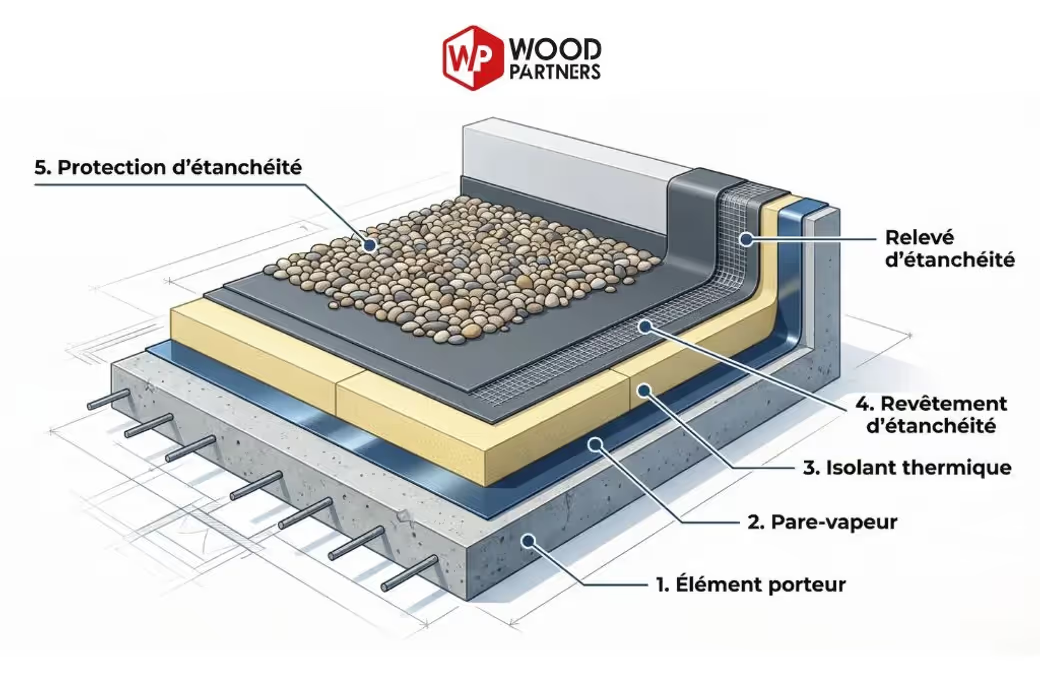
The 5 layers of the waterproofing build-up
A watertight flat roof always relies on a multi-layer system to function properly :
-
The load-bearing deck: it forms the structure of the flat roof. It can be a concrete slab, timber panels or a steel deck. Its flatness, stability and surface condition determine the quality of the waterproofing. A poorly prepared substrate leads to adhesion defects and weak points.
-
The vapour barrier : this is the layer installed directly on the load-bearing deck to block water vapour migration. Without a vapour barrier, moisture condenses in the insulation and weakens the waterproofing build-up.
-
Thermal insulation : this component ensures thermal comfort and limits energy losses. The most common solutions are polyurethane, expanded or extruded polystyrene, and mineral wool.
-
The waterproofing membrane : this is the most important layer, literally preventing water from entering the structure. The material must be chosen carefully based on its resistance, durability and cost.
-
Waterproofing protection : the protective layer preserves the waterproofing membrane from external aggressions such as UV, impacts and punctures. It can be heavy, such as gravel, paving slabs on pedestals or even a green roof system.
What materials are used for flat roof waterproofing ?
There are 4 types of covering materials to waterproof a flat roof :
-
Bitumen
-
EPDM membrane
-
PVC and TPO membranes
-
Liquid waterproofing system (LWS)
Bituminous waterproofing: the most widely used solution
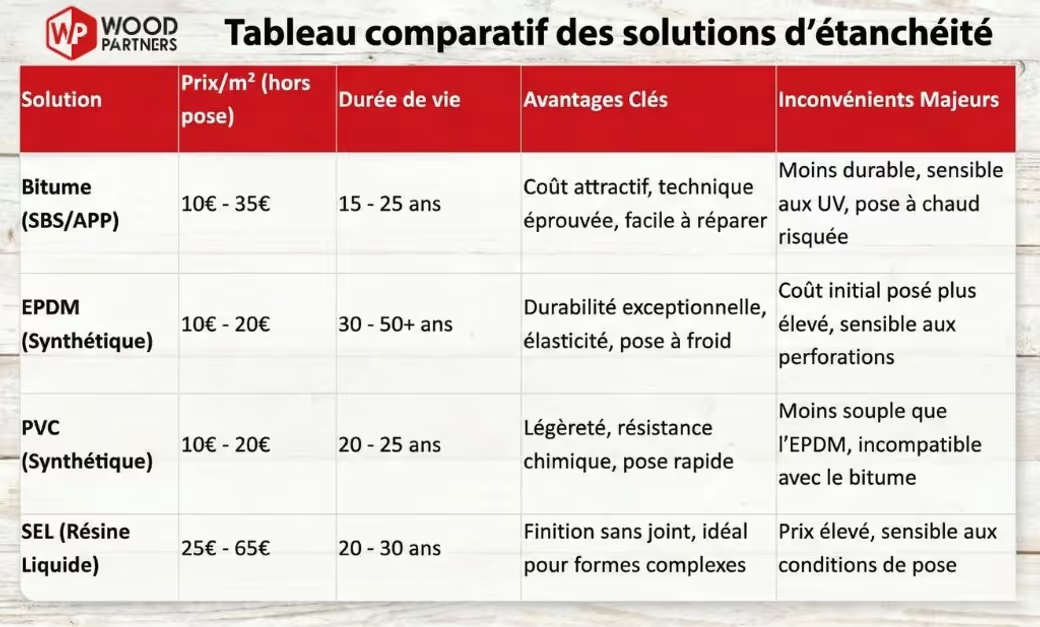
Bitumen flat roof waterproofingaccounts for 70% of the French market, making it one of the most commonly used materials. Bitumen is applied in the form of bituminous membranes that are torch-welded or self-adhesive. Tar, now less common, is based on the same principle. This solution is suitable for accessible roofs as well as inaccessible or technical terraces.
Advantages : the main strength of bitumen is its value for money and reliability. The installation technique requires know-how that is mastered by many professionals.
Disadvantages : bitumen’s service life is more limited than that of synthetic solutions.
EPDM membrane: the most durable solution
EPDM membrane is a synthetic rubber (Ethylene-Propylene-Diene-Monomer)known for its exceptional longevity, which can exceed 50 years. Highly elastic (up to 400%), EPDM absorbs structural movements without cracking and resists UV and extreme temperatures very well. EPDM is particularly suitable for flat roofs, both concrete flat roofs and timber structures.
Advantage : EPDM is a recyclable material offering excellent resistance and durability that can exceed 50 years.
Disadvantages : the price per m² is higher than bitumen. Installation requires rigorous technical expertise, specific products and accessories, which make the intervention of qualified professionals necessary.
PVC and TPO membranes: the lightweight and fast solution
Thermoplastic membranes, installed in a single layer, are lighter than bitumen and are hot-air welded, enabling quick and safe installation. PVC offers good chemical resistance, while TPO is a more eco-friendly alternative.
Advantage : they are an excellent option for large areas and modern lightweight roofs.
Disadvantages : their lifespan is shorter than EPDM, and PVC is sensitive to certain chemicals and to punctures.
Liquid waterproofing (LWS): the highly technical solution
The liquid waterproofing system (LWS) consists of applying liquid resins (often polyurethanes) which, when drying, form a continuous, elastic membrane without any joints. This solution is often used in renovation or on complex surfaces that are difficult to treat with traditional membranes.
Advantages : it is the ideal solution for roofs with complex shapes, balconies, or areas with many details/sensitive points (vents, upstands).
Disadvantages : It has the highest cost on the market and its application requires impeccable substrate preparation and strict weather conditions (temperature, humidity), making it very technical.
Comparison table of waterproofing solutions
Specific waterproofing for a timber flat roof
Timber flat roofs have structural specificitiesbecause unlike concrete, wood is a living material that reacts to changes in humidity and temperature. This sensitivity requires suitable waterproofing solutions toprevent rot, fungal growth and structural deformation.
A material sensitive to moisture
Wood is naturally hygroscopic, meaning it absorbs and releases moisture depending on surrounding conditions. This characteristic requires perfect waterproofing to avoid:
-
Rotting of structural timber elements
-
Growth of wood-decay fungi
-
Accelerated deterioration of the load-bearing structure
-
Deformations that compromise the integrity of the waterproofing system
Structural movements
Timber substrates are subject to greater movement than concrete, in particular:
-
Dimensional changes related to humidity
-
Deflection under load
-
Natural creep of wood over time
These movements require choosing waterproofing membranes that are flexible and elastic enough to follow the substrate without cracking.
The best choice of covering for a timber flat roof
-
EPDM membrane is the preferred choice for timber flat roofs thanks to its exceptional elasticity (up to 400%) which absorbs substrate movement without cracking.
-
PVC and TPO membranes are also a high-performing alternative, particularly suited to timber structures thanks to their reduced weight.
Wood’s advantages include its lightness (3 times lighter than concrete), its excellent carbon footprint and its natural insulating properties. However, it remains more vulnerable to water in the event of failure and requires regular monitoring.
Why is flat roof waterproofing essential ?
Flat roof waterproofing is essential to ensure :
-
Structural integrity
-
Occupant comfort
-
Overall energy performance
-
Avoiding costly works
Waterproofing to prevent structural damage
A flat roof is exposed to standing water, repeated rain and frost and can suffer significant damage if waterproofing is not optimal. If water penetrates the load-bearing materials, it can lead to rotting of timber frames and corrosion of reinforced concrete. A lack of waterproofing can be visible through the appearance of damp stains, blistering paint or mould.
Protecting use and occupants
Excessive humidity and mould caused by poor waterproofing can lead to unhealthy indoor air, potentially causing respiratory problems and allergies.
In the long term, structural weakening can lead to risks of partial or total roof collapse, directly endangering people’s safety.
Protecting thermal insulation
Failed waterproofing lets moisture infiltrate the insulation, causing it to lose much of its ability to regulate temperature. This creates thermal bridges and increased energy consumption.
Avoiding costly refurbishment works
Poor waterproofing often leads to a complete refurbishment of the flat roof. This work is heavy, expensive and sometimes complex to carry out on an occupied building. Investing from the outset in suitable waterproofing helps avoid repeated repairs and interruptions of use.
One form, several offers.
- Two minutes, no account
- Direct, no middleman
- Your identity stays private
What is the price per m2 for flat roof waterproofing ?
The price of flat roof waterproofing averages between €37 and €80 per square metre. But beyond the square metre, the cost of a waterproofing project depends on several factors :
-
The material chosen : this is the first price variable, with a hierarchy in ascending order : tar and bitumen, synthetic membranes, liquid waterproofing system.
-
Total area : the larger the surface, the more the price per m² tends to decrease. For example, the price per m² for a 100 m² flat roof will be proportionally lower than for a 20 m² terrace.
-
Condition of the substrate : a deteriorated substrate will require costly preparatory work: removal of the old covering, crack repair, levelling to ensure a flat surface.
-
Site accessibility : a roof that is difficult to access (high up, no direct access) generates additional costs related to logistics and safety equipment (scaffolding, crane).
-
Complexity : details/sensitive points represent a major cost item. Waterproofing upstands, rainwater outlets, stacks/vents, parapets. In practice, the majority of infiltrations come from these critical areas. Treating them requires time and genuine know-how.
-
Type of use : an accessible flat roof intended to be used requires heavy protection, such as paving slabs on pedestals. Conversely, an inaccessible roof, not intended to be used, can simply be protected with gravel and will therefore be more economical.
-
Insulation : adding or replacing thermal insulation is an additional cost, but it is often essential to comply with thermal regulations and is eligible for financial aid.
-
Geographic location : Labour rates vary from one region to another, with prices generally higher in large cities like Paris.
Indicative budget by project type (installation included)
The ranges below correspond to average observed prices, including the supply of materials and installation by a qualified professional.
-
Two-layer bituminous waterproofing : €37 to €60 / m²
-
Waterproofing with EPDM membrane : €40 to €65 / m²
-
Waterproofing with PVC membrane : €45 to €60 / m²
-
Liquid waterproofing system (LWS) : €40 to €80 / m²
Options and additional protections
Some configurations lead to additional costs:
-
Gravel protection: + €15 / m²
-
Paving slabs on pedestals: + €40 to €100 / m²
-
Wood decking protection (roof terrace) :
-
Composite wood decking protection (roof terrace):
-
Build-up with thermal insulation : + €60 to €100 / m²
-
Green roof (complete build-up) : + €80 to €150 / m²
What are the steps to waterproof a flat roof ?
There are 8 key steps to successfully waterproof a roof, based on a rigorous process :
-
Diagnosis and substrate preparation
-
Cleaning and repairing the substrate
-
Installing the vapour barrier
-
Installing thermal insulation
-
Installing the covering
-
Treating details/sensitive points
-
Installing the protective layer
-
Inspection and testing
Step 1 - Diagnosis and substrate preparation
Action : complete inspection of the existing substrate, checking flatness and slope, which must be 1 to 5% to ensure proper water runoff.
Average duration : 1 day.
Watch point : Insufficient slope is the main cause of standing water, which leads to premature ageing and infiltration.
Step 2 - Cleaning and repairing the substrate
Action : The old covering is removed if necessary. Cracks are repaired, deteriorated areas are made good and levelling is carried out to obtain a flat surface. The substrate is then cleaned and thoroughly dried.
Average duration : 1 to 2 days.
Watch point : The substrate must be perfectly clean, dry and sound to ensure adhesion of the following layers.
Step 3 – Installing the vapour barrier
Action : a primer is applied, then the vapour barrier is installed on the load-bearing deck. It prevents water vapour from inside the building from migrating into the insulation.
Average duration : 0.5 day.
Watch point : Material strips must be welded or bonded with sufficient overlap to ensure a continuous barrier against water vapour.
Step 4 – Installing thermal insulation
Action : insulation boards are installed by bonding or mechanical fastening, depending on the selected system.
Average duration : 1 day.
Watch point : It is essential to install boards with staggered joints, also called cross-laying, to avoid thermal bridging.
Step 5 - Installing the covering
Action : installation of the waterproofing membrane (bitumen, EPDM, PVC) or application of resin (LWS). The technique depends on the material: joint welding, full bonding, or application in successive coats.
Average duration : 1 to 2 days.
Watch point : the installation technique must be perfectly mastered, as it is the core of the work.
Step 6 – Treating details/sensitive points
Action : details/sensitive points are the vulnerable areas of a flat roof, where waterproofing is interrupted, turned up or penetrated. To treat these complex areas, waterproofing upstands must be formed on parapets (peripheral upstands) to a minimum height of 15 cm, and around penetrations: outlets, chimneys, vents.
Average duration : 1 day.
Watch point : this is the most critical step. 80% of leaks come from poor treatment of these areas.
Step 7 - Installing the protection
Action : installation of the final protection: wood, composite wood, gravel layer, laying of slabs on pedestals, installation of the green roof build-up.
Average duration : 1 to 3 days.
Watch point : the protection must be adapted to the future use of the roof and compatible with the waterproofing membrane.
Step 8 - Inspection and testing
Action : the waterproofing test can be carried out by a "flood test" (controlled flooding of the roof for 24h) and checking that outlets work properly.
Average duration : 0.5 day.
Watch point : always request a site handover report (PV). This document is essential to activate statutory warranties.
Regulations, subsidies and choosing the professional
A successful waterproofing project must imperatively fit within a strict regulatory framework and be entrusted to a competent, insured tradesperson.
Key standards and regulations
Flat roof waterproofing is governed by DTUs (Documents Techniques Unifiés), which define the installation rules. The DTU 43 and DTU 40 series are the absolute references your professional must comply with.
Before any fit-out, it is also necessary to check the Local Urban Plan (PLU), as some municipalities impose constraints on the use, height or exterior appearance of flat roofs.
Choosing the right tradesperson
A reliable professional must have a recognised certification, such as Qualibat, and provide valid 10-year liability insurance (decennial insurance) before work starts.
The quote must be clear, detailed and precise. It must mention the materials used, the installation steps, the treated areas and the associated guarantees.
Flat roof waterproofing is a key element in a building’s durability. The choice of material, consideration of the intended use and the quality of execution determine the system’s real performance. The price per m² should always be analysed in light of technical constraints and the expected service life. A suitable solution from the outset avoids costly refurbishments. A successful waterproofing project is based above all on rigorous design and a qualified professional.