
Here is the secret of absolute thermal comfort: floor insulation. Energy savings, warmth under your feet in winter and lasting well-being await you. Dive into our guide to choose the best insulating materials and to carry out your project with complete ease.
How to choose floor insulation: a complete guide
Insulating the floor is a crucial step in guaranteeing optimal energy efficiency and thermal comfort in your home. Whether for a new build or a renovation, choosing the right insulation for your ground floors is essential. In this article we will explore the different insulation options, the techniques, the recommended thicknesses and the regulations to follow in order to take informed decisions.
Insulation from below or under the screed: advantages and limits
When it comes to insulating the floor of your house, two main techniques are open to you: insulation from below and insulation under the screed (or at surface level). Each approach has its advantages and its limitations.
Insulating floors from below
Insulating from below is ideal when the underside of the ground floor is accessible. This method suits floors above a crawl space or an unheated room, such as a cellar or a garage. The insulation is placed under the floor, at ceiling level in the room below. This technique is accessible and relatively simple to carry out. It does not reduce the ceiling height of the room to be insulated and avoids having to empty the room completely during the work. Advice: if you opt for insulation from below, choose the method that best matches the access to your ground floor. You can use insulating panels or opt for blown insulation, depending on the configuration.
Insulating floors under the screed
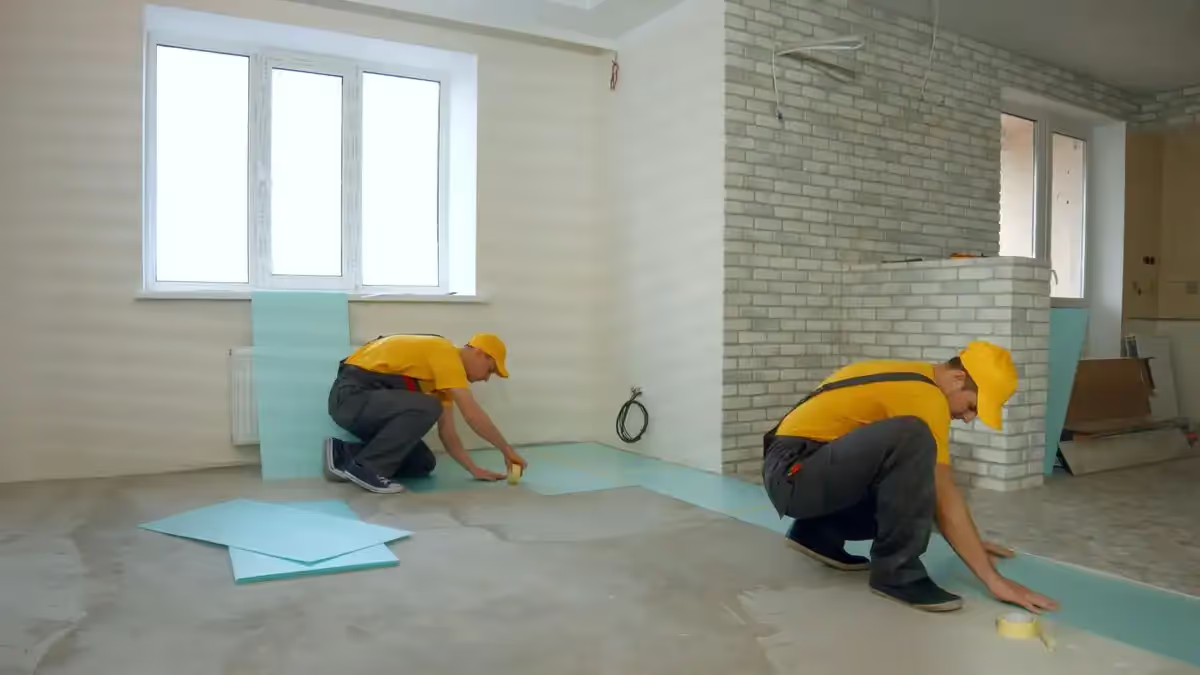
When your house is built on a slab on grade, with no basement or accessible crawl space, the floors must be insulated at surface level, above the slab. This approach, known as insulation under the screed, involves placing the insulation between the concrete floor and a thin layer of mortar called a floating screed. This technique is more complex, as it requires the ground floor rooms to be emptied completely. Advice: when insulating under the screed, favour higher-performance insulation in a reduced thickness in order to minimise the loss of ceiling height. Insulating panels are often a recommended option.
Insulation thickness: the key to performance
The thickness of the insulation plays a crucial role in its effectiveness. In general, an insulation thickness of between 90 and 120 mm is recommended in order to guarantee adequate floor insulation. Keep in mind, however, that the performance of each insulating material is determined by its thermal resistance (R) and its thermal conductivity (λ). Advice: choose an insulating material according to its thermal resistance and its conductivity, taking the space available into account. A thermal resistance of around 4 m².K/W is generally recommended for floors.
Selecting suitable insulation: mineral, synthetic or bio-based
The choice of insulation is crucial to the effectiveness of the insulating work. Three main types of insulation are commonly used: mineral, synthetic and bio-based.
- Mineral insulation such as glass wool or rock wool: economical and offering good acoustic insulation, it is available in panels, loose fill or spray applied.
- Synthetic insulation: often in the form of polystyrene panels, it is less effective for acoustic insulation.
- Bio-based insulation: made from natural materials such as flax, hemp or cotton, it offers performance similar to mineral insulation. It can come as loose fill, as panels or as cork boards.
Advice: for insulation from below, the range of insulating materials is wide. For insulation under the screed, on the other hand, favour higher-performance materials in a reduced thickness.
Financial assistance and regulations
Insulating floors is not only a matter of energy efficiency, it can also be a financially advantageous step. Various forms of financial assistance are available to support your energy renovation work. Grants from the Anah, the Prime Énergie, the zero-interest eco-loan and a reduced VAT rate of 5.5% are some of the options to explore. Advice: to benefit from this assistance, make sure your work is carried out by a tradesperson holding RGE certification (Reconnu Garant de l'Environnement) and that the performance criteria are met.
Floor insulation: warmth under your feet and savings in your pocket
Insulating the floor is an essential step in optimising the energy efficiency and the comfort of your home. By choosing between insulation from below or under the screed, by selecting the right insulation for your situation and by complying with the regulations in force, you can create a comfortable and economical interior environment. Take the time to understand the different options properly and do not hesitate to explore the financial assistance available in order to make your floor insulation project even more worthwhile. Do not forget: the key to successful insulation lies in in-depth expertise and an understanding of the specific needs of your house. Be sure to do your research and to call on qualified professionals in order to obtain the best possible results.
One form, several offers.
- Two minutes, no account
- Direct, no middleman
- Your identity stays private
Floor insulation: thermal comfort within reach
Floor insulation is a key element in guaranteeing the thermal and energy comfort of your home. With up to 10% of heat loss occurring through ground floors, neglecting this part of the insulation would be a costly mistake. In this article we will dive deeper into the advantages of floor insulation, the materials to favour and the steps to follow in order to carry out your project successfully.
Warm feet and energy savings
Besides the energy aspects, floor insulation brings tangible comfort to your home. No more freezing tiles underfoot in winter! Thanks to well-designed insulation, you can create a pleasant and warm interior environment where you need not dread putting your feet on the floor. Tip: besides thermal comfort, do not forget that floor insulation can help reduce heating costs, which is good for your wallet and for the environment.
Choosing materials: suitability and performance
When choosing materials for floor insulation, it is essential to strike a balance between suitability and performance. The materials must not only meet the thermal requirements but also suit the configuration of your house.
Mineral insulation
Mineral insulation, such as glass wool and rock wool, offers a combination of thermal and acoustic insulation. It is flexible and suits different installation techniques, whether in panels, in rolls or as loose fill.
Synthetic insulation
Synthetic insulation, such as polystyrene panels, is known for its light weight and its resistance to moisture. It is particularly suited to insulation under the screed, where the thickness must be kept to a minimum.
Bio-based insulation
Bio-based insulation, made from natural materials such as hemp or flax, is an ecological option. It offers performance comparable to mineral insulation and is often available in panels or as loose fill. Advice: choose a material that matches the insulation method you have chosen (from below or under the screed) and that meets the performance criteria required.
The steps to a successful insulation project
A successful floor insulation project calls for careful planning and meticulous execution. Here are the key steps to follow in order to carry out your project successfully:
- Assessing the needs: analyse the characteristics of your house, the structural constraints and the thermal requirements in order to determine the insulation needed.
- Choosing the insulation: select the insulating materials suited to your situation and to the insulation method chosen (from below or under the screed).
- Preparing the site: make sure the surface is clean, dry and free of any obstruction before installing the insulation.
- Installing the insulation: follow the manufacturer's instructions to install the insulation correctly, taking care to cover the whole surface without leaving gaps.
- Sealing: be sure to seal all the joints and cracks properly in order to prevent air and moisture from getting in.
- Finishing: complete the installation by laying the floor covering of your choice, whether tiles, wood flooring or other materials.
Advice: if you are not familiar with insulation techniques, it is advisable to call on a professional in order to guarantee correct and effective execution.
Insulated floors, comfort assured: invest in insulation for a cosy future
Floor insulation is far more than a simple energy efficiency measure. It is a way of improving the comfort of your home, reducing heating costs and helping to preserve the environment. By choosing the right insulating materials, by following the project steps and by calling on experts where necessary, you can create a pleasant and lasting interior environment for you and your family. Investing in floor insulation means investing in the well-being and the future of your home.