
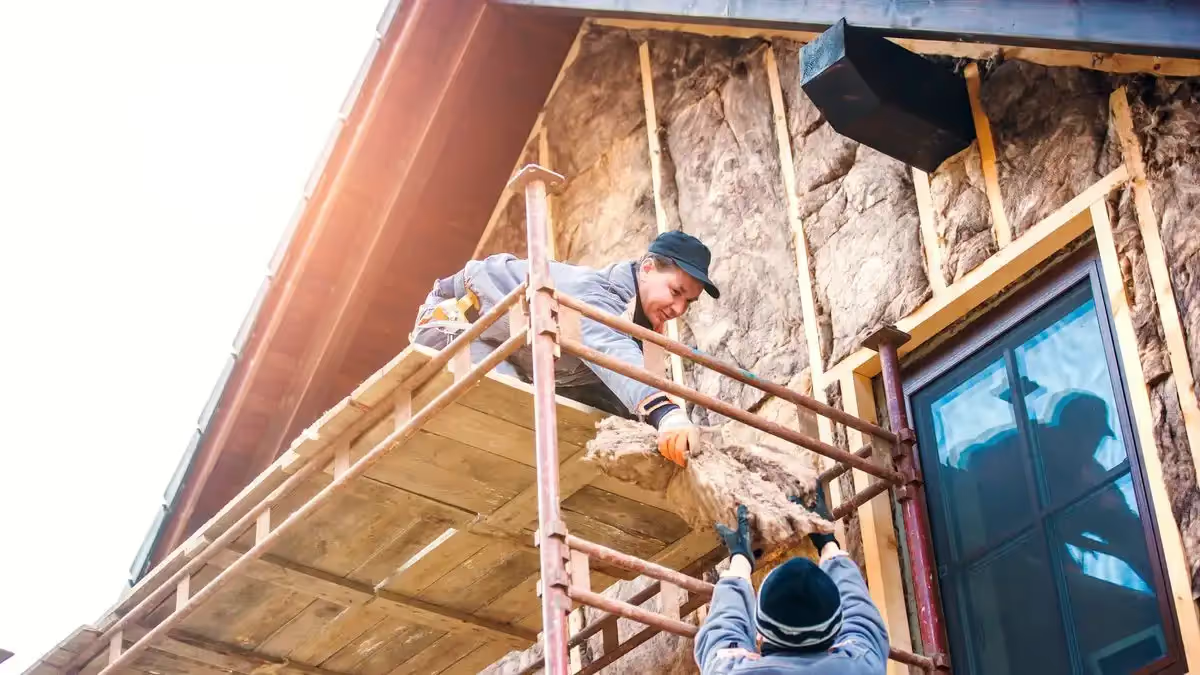
Here are the advantages and disadvantages of each insulating material, and learn how to select the one that perfectly matches your construction or renovation project. Obtain optimal insulation and improve the comfort of your space.
Insulating with glass wool or rock wool: comparison and the best choice
Advantages and disadvantages of glass wool
Glass wool ranks as the most commonly used insulation in France, present in 75% of homes. It is made from sand or recycled glass, also known as cullet.
Thermal performance and uses
This mineral wool finds its application in insulating uninhabited and converted lofts, walls, partitions and floors. Its properties allow substantial energy savings, while providing thermal and acoustic insulation between 0.030 and 0.040 W/mK.
Strengths:
- Affordability and economy: competitive price on the market.
- Excellent thermal and sound insulation: thermal conductivity between 0.030 and 0.040 W/mK.
- Non-combustible and fire-retardant: fire resistance and no toxic fumes.
- Durability: service life of up to 50 years.
- Adaptability: suits various environments thanks to its different forms.
Weaknesses:
- Lower acoustic insulation: effective but not excellent in terms of acoustic insulation.
- Negative environmental record: non-renewable raw materials.
- Vulnerability to water vapour: a kraft paper or foil vapour barrier is needed.
- Careful handling: risk of fibrous dust, calling for precautions when handling.
Advantages and disadvantages of rock wool
Rock wool stands out as a mineral insulation made from basalt, a black volcanic rock. It may or may not be faced with a glass or aluminium veil.
Versatile performance
This insulating material adapts to all types of building and is effective in summer as well as in winter. It is used for insulating walls, uninhabited lofts, and cavity walls by blowing. The forms available include rolls, rigid panels, pipe sections and loose fill.
Strengths:
- Balanced insulation: effective for hot and cold seasons alike.
- Fire resistance: non-combustible and gives off no toxic fumes.
- Durability: service life of around 50 years.
- Adaptability: available in different forms, suiting various environments.
- Comfort in use: does not cause itching compared with glass wool.
Weaknesses:
- Higher cost: more expensive than glass wool.
- Drawbacks similar to glass wool: care is needed during installation.
- Improved environmental record, but still a point to watch
Telling the mineral wools apart
Glass wool and rock wool are among the best insulating materials available. Although their thermal and sound performance is comparable, they show significant differences.
Comparing the two wools
These two insulating materials belong to the family of mineral insulation, the most popular in France. They are often used in the thermal insulation of homes, notably uninhabited lofts thanks to the blowing method.
- Rock wool : denser, ideal for superior insulation in summer, especially on a timber floor.
- Glass wool: cheaper, effective for insulating the inside of brick walls.
Each has specific advantages in terms of resistance to insects, termites and rodents. In terms of thermal insulation, glass wool has a slight lead, except where acoustic insulation is concerned. In choosing between glass wool and rock wool, the nature of the project and the specific needs will play a major role. In short, choosing between glass wool and rock wool depends on your preferences and on the specifics of your project. Do not hesitate to call on a professional to guide you towards the best decision.
One form, several offers.
- Two minutes, no account
- Direct, no middleman
- Your identity stays private
For which type of construction should you choose glass wool or rock wool?
Selecting the right insulation for your project
When it comes to choosing between glass wool and rock wool, it is important to take into account the specifics of your construction or renovation project. Each insulating material has its advantages and disadvantages, as well as characteristics that may better suit certain types of construction.
Glass wool
Glass wool is ideal for several types of project:
Insulating uninhabited lofts
Thanks to how easy it is to handle and its availability in different forms, glass wool is often used to insulate uninhabited lofts. Whether in rolls or as loose fill, it can be laid quickly, guaranteeing effective thermal insulation.
Insulating the inside of walls
If you are planning to insulate the inside of your walls, particularly during a renovation, glass wool can be an attractive option. Its affordable price and its effective insulating properties make it suited to this type of project.
Insulating partitions and floors
Glass wool is also appropriate for insulating partitions and floors. It can be used in different spaces of the house, guaranteeing effective thermal and acoustic insulation.
Rock wool
Rock wool is particularly suited to certain specific projects:
Insulating exterior walls
If you wish to insulate the exterior walls of your building, for example external insulation under cladding, rock wool can be an excellent choice. Its thermal properties and its fire resistance make it a material well suited to improving the energy efficiency of your structure.
Insulating converted lofts
If you are planning to convert your loft into living space, rock wool can offer quality thermal and acoustic insulation. Its versatility and its durability make it an appropriate insulating material for this use.
Demanding environments
Rock wool is also recommended for demanding environments, such as industrial buildings or spaces subject to extreme temperature variations. Its high thermal resistance makes it a solid choice for these contexts.
Choosing according to your needs
When choosing between glass wool and rock wool, it is essential to take into account the characteristics of your project and your priorities where insulation is concerned. Always consult a professional for personalised advice and to make sure the insulation chosen meets the specific requirements of your construction or renovation. Ultimately, selecting the right insulating material will help improve the thermal and acoustic comfort of your space while helping you make significant energy savings.