
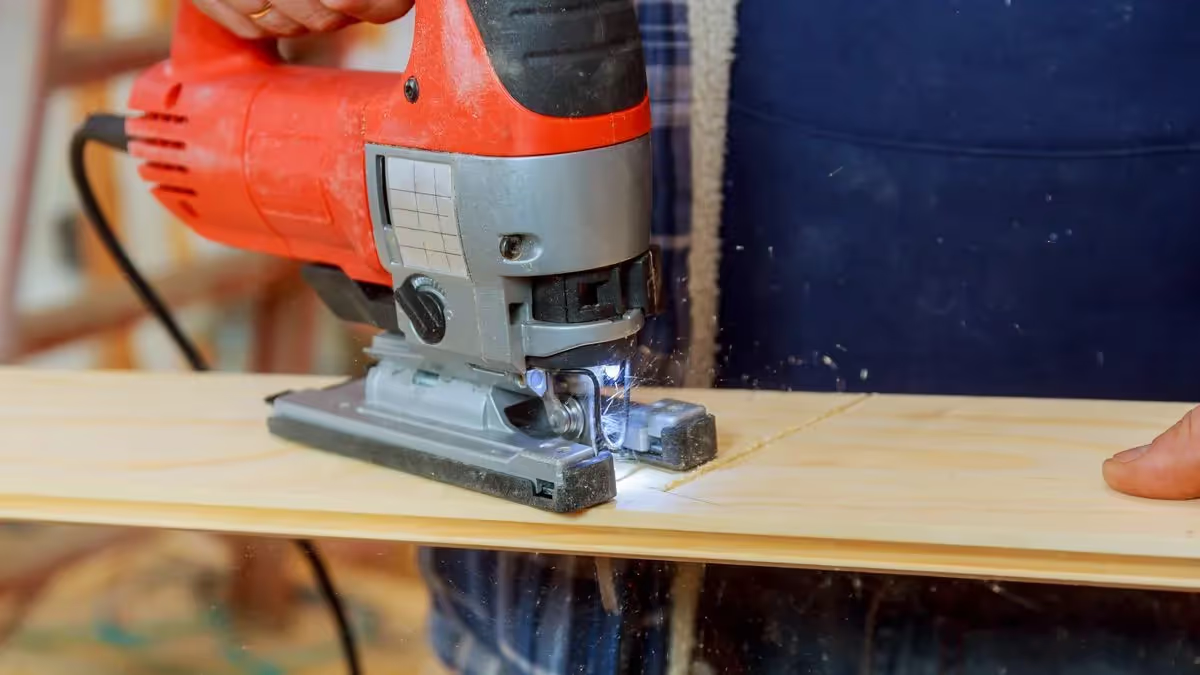
The jigsaw, an essential tool for every DIYer, comes in countless models. While its versatility is widely praised, it can hide a few pitfalls for the newcomer. How do you pick out the gem that will perfectly meet your needs from this vast range? Discover the subtleties and tips you need in order to make an informed choice and optimise every cut, whether straight or curved. Step into this cutting-edge world and shape your expertise!
The jigsaw, a power tool valued by everyone, whether novice or seasoned DIYers, holds a place of honour in every workshop. It is prized for its versatility and its precision. With the impressive number of models available on the market, however, how do you work out which one best suits your needs? This article will take you into the fascinating world of jigsaws, while shedding light on the various criteria to consider when buying.
What is a jigsaw?
The jigsaw is essentially a machine tool fitted with a thin, toothed blade connected directly to a motor. When it is switched on, the blade makes repeated vertical movements, making it possible to cut various materials precisely. Most jigsaws weigh no more than 2.5 kg, which makes them particularly manageable and easy to handle. It is without doubt an indispensable tool that will get you out of trouble in a multitude of situations.
Selecting the ideal jigsaw according to the material
All jigsaws are capable of cutting materials such as wood, chipboard, particleboard, non-ferrous metal and PVC with remarkable cleanness. The cutting capacity varies, however. A standard jigsaw, for example, can handle a wooden board up to 100 mm thick and metal up to 10 mm thick. If your needs exceed these dimensions, it would be wise to turn to other types of saw better suited to the task. Note: for specific materials such as plaster, concrete blocks or brick, a reciprocating saw would be more appropriate. For tiles or glass, a diamond saw is recommended.
Jigsaw power: which one to choose?
The power needed depends greatly on the use you intend to make of it. If you plan to cut relatively thin materials, a jigsaw with an output of no more than 350 W would be enough. For medium to thick materials, however, consider models offering between 400 and 750 W, or even more. A jigsaw fitted with variable speed control is also a major asset, particularly if you work on a range of materials.
Orbital action: why is it essential?
Besides the usual vertical movement of the blade, some jigsaws have an orbital function that mimics the movement of a hand saw. The main advantage lies in improved clearing of the sawdust, guaranteeing an even cleaner and more precise cut. It also has the considerable advantage of reducing wear on the blade.
One form, several offers.
- Two minutes, no account
- Direct, no middleman
- Your identity stays private
Other features to consider
-
- Limited depth of cut: unlike other types of saw, the depth of cut of the jigsaw is limited. For large cutting jobs, it may not be the ideal tool.
- Precision: although the jigsaw is perfect for curved cuts, it is not always the best option for straight, precise cuts over long distances.
- Vibration: some cheap or poor-quality models can generate excessive vibration, which can make them uncomfortable to use and reduce the precision of the cut.
- Changing the blade: make sure the blade-change system is easy and safe. Some models need tools to change the blade, which can be tedious.
- Battery life (for cordless models): cordless jigsaws offer great mobility, but their running time is limited. Make sure the battery lasts long enough for your needs, or consider having spare batteries.
- Weight: excessive weight can make the tool hard to manoeuvre, especially for delicate cutting work.
- Options and features: some cheap models may not offer features such as orbital action, variable speed or other functions that are useful for certain tasks.
- Ventilation and dust extraction: sawdust can obscure your cutting line and make the work messy. A good dust extraction system is essential in keeping the working area clean.
- Price: although this is not directly a drawback, it is important to compare the price against the features and the quality of the tool. Do not be seduced by a low price without checking the quality and the user reviews.
- Warranty and after-sales service: make sure the brand or the manufacturer offers good after-sales service and a satisfactory warranty.
La table de scie sauteuse, un incontournable dans votre atelier ! Pour + d'infos, rendez-vous ici 👉 https://t.co/I6m9zZK1s6 👉 Référence 6197000 👈 #coupe #scie #coupe #bricolage #pratique #incontournable #bois #robuste #facile #sansefforts pic.twitter.com/OXoFnNtfjm
— wolfcraft France (@wolfcraftFrance) February 18, 2023
Future trends in jigsaws
Constant evolution:
The power tool industry never stops evolving. Jigsaws are no exception to that rule. With the advent of battery technology, we can expect to see cordless jigsaws that are even more powerful and longer-lasting.
Connectivity and IoT:
The trend is towards connectivity. It would not be surprising to see connected jigsaws in the near future, offering features such as blade wear tracking, automatic diagnostics or even interactive tutorials through mobile apps.
In short, whether you are an amateur or a professional, it is crucial to choose a jigsaw suited to your needs and requirements. Armed with the knowledge provided by this article, you are now in a position to make an informed choice. The jigsaw, far from being a simple cutting tool, is the beating heart of every DIY workshop. Choosing it, with all the technical care and attention that involves, reflects every craftsman's ambition to carry out their projects with precision.
While every model has its subtleties, getting hold of the perfect jigsaw opens the door to a world of limitless creativity. Do not let the variety intimidate you. Arm yourself with knowledge, and every cut will become a symphony of perfection. The journey is only beginning, and the future looks sharp!