
Introduction and origin of Scots pine
Scots pine is a tree species of the Pinaceae family, native to Eurasia, ranging from western Europe to eastern Siberia, south to the Caucasus mountains and Anatolia, and north into the Arctic Circle in Fennoscandia. It is easily identified by the combination of its fairly short, blue-green needles and its red-orange bark.
Appearance of Scots pine
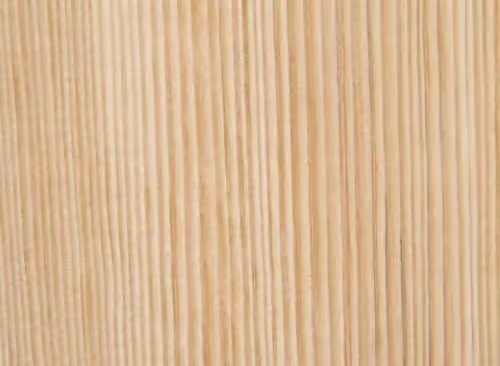
Scots pine has clearly differentiated sapwood and heartwood. The colour of the heartwood ranges from pinkish red to brownish red. The sapwood is distinct, yellowish white, with less pronounced figure.
The grain is generally straight and well aligned. The texture varies somewhat with origin and is rather fine. The growth rings are usually visible thanks to clearly differentiated bands of latewood, much darker, which stand out sharply against the earlywood.
Main characteristics of Scots pine
The heartwood of Scots pine is naturally resistant to attack by wood-decay fungi and insects. When freshly cut, the sapwood is very prone to blue stain and has very little durability.
On the other hand, it is very easy to impregnate, unlike other species. Use class IV can indeed be achieved through pressure treatment in an autoclave. Like most softwoods, Scots pine is fairly prone to splitting.
Moderately stiff, it is easy to work. Finally, it has high mechanical strength in compression, in bending and under impact — among the best of the softwoods.
One form, several offers.
- Two minutes, no account
- Direct, no middleman
- Your identity stays private
Applications of Scots pine
Scots pine can be used for all types of application. Indoors as well as outdoors, thanks to the natural durability of its heartwood, the applications are numerous.
Its very good treatability allows it to be used regularly in outdoor landscaping: orchard stakes, decking and so on. Thanks to excellent mechanical properties and its consistency, Scots pine is well suited to structural framing, timber frame construction and joinery.
In the same way, panelling, mouldings, windows, shutters and cladding are all possible uses once properly finished and treated.
Advice on use and finishing of Scots pine
Kiln drying is fairly straightforward. Scots pine dries easily and quickly. Nevertheless, the drying schedule must begin at fairly high temperatures. A moisture content of around 16–18% is recommended in order to reduce the risk of blue stain. This moisture content is sufficient for most applications, but in certain cases it will need to be reduced further. Easy to work, it does also contain hard knots. Drilling, machining and sanding are all easy.
Planing requires well-sharpened tools and produces excellent joinery-grade surfaces. Screw and nail withdrawal resistance is adequate. Any type of adhesive can be used provided drying has been carried out above 70°C, which stabilises the resin. Surface finishing poses no problem, but the presence of resin must be taken into account.
Dimensions and commercial grades of Scots pine
| Machining | Resistance to splitting when nailing/screwing | Gluing | Hardness |
|---|---|---|---|
| Good | Medium | Good | Soft to medium-hard |
Physical properties of Scots pine
- Average density: 530 kg/m3 at MC = 12%
- Stability in service: moderately stable
- Average volumetric shrinkage: 14.1%
- Average tangential shrinkage: 9%
- Average radial shrinkage: 5.1%
Mechanical properties at MC = 12% of Scots pine
- Average compressive strength at rupture: 50 MPa
- Average bending strength at rupture: 90 MPa
- Average tensile strength at rupture: 102 MPa
- Average modulus of elasticity: 1