
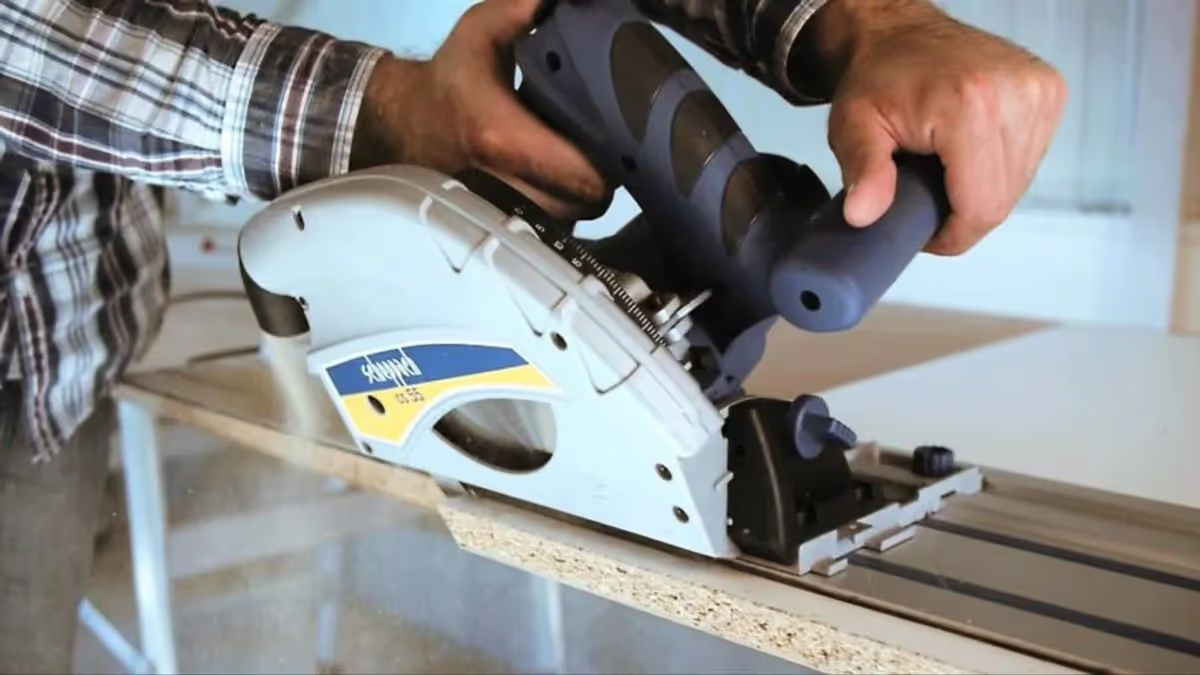
The plunge saw: when precision meets innovation. Dive into the fascinating world of this revolutionary tool, essential for every joiner. Discover its unique advantages, the tips for getting the most out of it, and the criteria for making the perfect choice. Between enhanced safety and flawless cuts, let yourself be guided through the world of the plunge saw and reinvent your joinery work!
The plunge saw, often taken for a simple circular saw, in fact conceals a myriad of technical features and advantages that few people really know about. In this article we will not only demystify this tool but also highlight its relevance for anyone working with wood.
What is a plunge saw?
The plunge saw is first and foremost a circular saw. What sets it apart from its counterparts is its unique mechanism: a spring that allows the blade to plunge and rise at will. It is rather like comparing a laminate trimmer with a router. The laminate trimmer has a fixed height, while the router, thanks to a depth stop system, can adjust its height according to need.
Why opt for a plunge saw? Its advantages
Enhanced safety
One of the major strengths of this tool is the safety it offers. Unlike a standard circular saw, where the blade is constantly exposed, the blade of a plunge saw is concealed at start-up, thereby preventing unexpected accidents.
Cuts in the middle of a panel
Experienced joiners manage to make cuts in the middle of a panel with a standard circular saw, but it is a hazardous task. The plunge saw offers a solution for clean and precise cuts, ideal for recesses.
Pairing with a guide rail
The power of the plunge saw is fully revealed when it is used with a guide rail. It guarantees straight cuts, easier set-up and optimal dust extraction when handling wood species such as red cedar, birch or wenge.
The limitations of the plunge saw
Although it has many strengths, the plunge saw also has its limits.
Versatility
The plunge saw is a specialised tool. By focusing on precision and control, it offers considerable advantages for certain tasks, but also shows limits for other applications:
- Where it excels: the ability of the plunge saw to make clean, straight and precise cuts, notably in the middle of a panel or a board, makes it the tool of choice for tasks such as cutting worktops, forming notches or breaking down large panels.
- Limits in terms of manoeuvrability: compared with a standard circular saw, the plunge saw is bulkier, especially when used with a guide rail. This can make it trickier to use in confined spaces or for cuts calling for great manoeuvrability.
- Curved cuts: the plunge saw is not the ideal tool for curved cuts. Although it can be used to start a curved cut, its design and its mechanics are not suited to this type of work, unlike a jigsaw, for example.
- Bevel cuts: while some top-of-the-range plunge saws allow bevel cuts, they are generally neither as versatile nor as easy to use for this task as other types of saw.
- Thick cuts: the depth of cut of a plunge saw is generally less than that of a standard circular saw. For particularly thick materials, this can be a problem.
In conclusion, although the plunge saw is an exceptional tool for certain applications, it is not an all-in-one solution for every cutting need. Before investing in such a machine, it is essential to assess your real needs and to determine whether this tool is the best suited to the majority of your projects.
One form, several offers.
- Two minutes, no account
- Direct, no middleman
- Your identity stays private
The need for a guide rail
The plunge saw is unquestionably one of the most precise tools for cutting materials, but that precision is often closely linked to the quality and the reliability of the guide rail that goes with it. Without its guide rail, the plunge saw loses much of its effectiveness. Here is why:
- Greater precision: the guide rail is essential in guaranteeing straight and even cuts. By clamping it to your material, you have a clear reference line that guarantees the saw will follow exactly the path you intended. This avoids deviations and errors, thereby guaranteeing high-quality results every time.
- Angle guides: for precise angled cuts, specific angle guides can be used with the plunge saw. These guides make it possible to cut at specific angles, thereby offering a greater variety of cutting possibilities. Whether bevel cuts, chamfers or complex angles, angle guides ensure that every cut is accurate to the degree.
- Enhanced safety: a solid guide rail minimises the risk of the blade slipping or wandering. This reduces not only the chances of costly mistakes but also the potential risks to the user.
- Improved efficiency: using a guide rail also reduces set-up and adjustment time. You can quickly position your rail, make your cut, then move on to the next one. This is particularly beneficial for professionals looking to maximise their efficiency on site.
- Dependence on the guide rail: that efficiency comes at a cost, however. As mentioned earlier, without its guide rail the plunge saw can be considerably less useful. That is why it is crucial to look after your guide rail, to keep it maintained and to make sure it is always to hand. It is also wise to invest in replacement rails or additional parts if necessary.
The absence of a riving knife
Wood is a living, complex and uneven material. Its fibres, which form its basic structure, can behave unpredictably when cut, especially when working with rough timber. One of the most common phenomena is tension in the wood fibres, which can pose serious challenges during cutting. Here is how it shows itself and why the riving knife is a key element in dealing with it.
- Understanding tension in wood fibre: as a tree grows, it develops internal stresses caused by factors such as wind, gravity or even uneven growth. When the wood is cut into boards, some of these stresses are released, but others remain trapped in the timber. During cutting, these stresses can be released unexpectedly, causing the saw blade to become "trapped" between the fibres.
- The associated risks: the sudden release of these stresses can cause kickback or unexpected movement of the material. This can not only damage the workpiece but also present a serious risk to the user, as the saw can wander or jam, increasing the risk of an accident.
- The saving role of the riving knife: that is where the riving knife comes in. Located just behind the main blade, this thin piece of metal sits in the cut, preventing the wood from closing on the blade. It acts as a barrier, ensuring that the kerf stays open and that the blade can move freely.
- Plunge saws and the riving knife: unfortunately, not all plunge saws are fitted with this device. Because of their plunge mechanism, incorporating a riving knife can be complex. The absence of this component means that the user must be particularly attentive when cutting rough timber or timber with notable tension.
- Advice for safe cutting: if you are using a plunge saw without a riving knife, it is essential to take additional precautions. Make sure the wood is well supported on both sides of the cut, advance at a steady speed without forcing, and always watch for signs of tension or unexpected movement in the material.
The scoring blade on a plunge saw: precision and finish
Pricing
The precision and the complexity of this tool are often reflected in its price. For those on a limited budget, the investment deserves careful thought.
Common uses of the plunge saw
Remarkably precise, the plunge saw is particularly suited to cutting panels, whether plywood, melamine-faced board, laminate or MDF. Thanks to its precise settings, it allows cuts at the ideal depth and angle.
The market leaders
The market is full of plunge saw models, but three stand out in particular according to experts in the field. Corded models are recommended here in order to guarantee optimal power and dust extraction.
The plunge saw, although it has certain specific features to take into account, has established itself as an essential pillar in the joiner's arsenal. Combining remarkable precision with enhanced safety, it meets the expectations of demanding professionals and amateurs alike. Before any investment, however, it is fundamental to define your needs clearly, to find out about the various characteristics and functions on offer, and of course to consider the budget available. In short, well chosen, the plunge saw becomes a faithful and effective working companion, the guarantee of flawless results.