
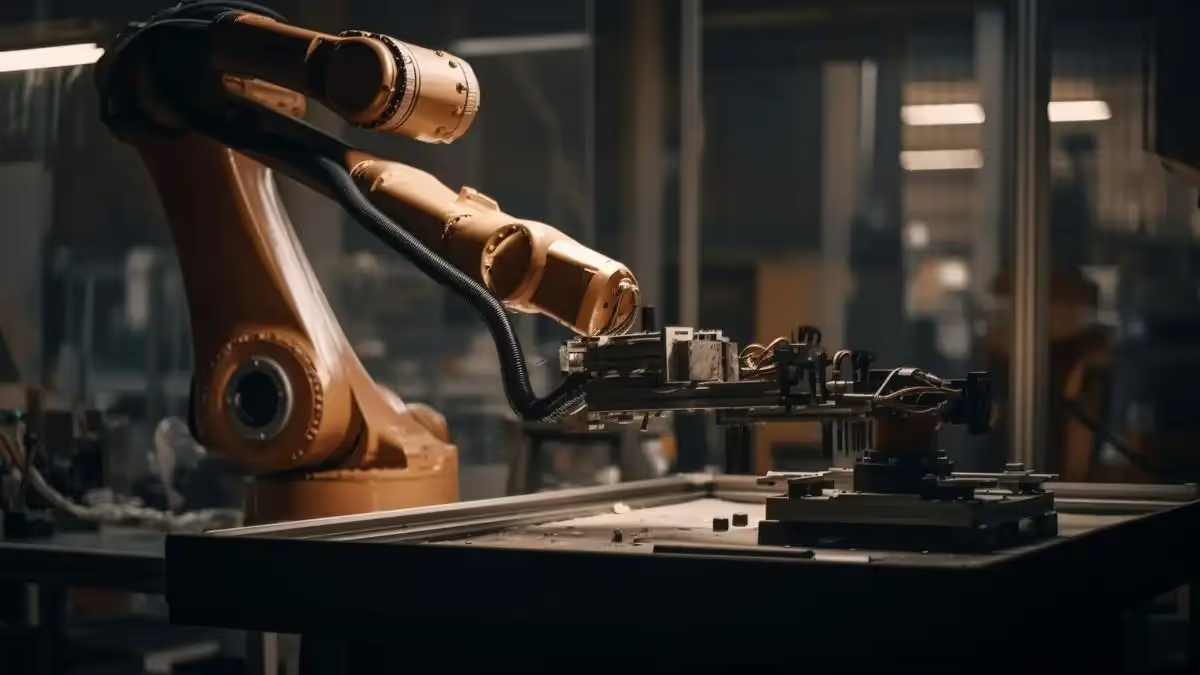
Welcome to the world of robotic arms: versatile partners for industry, education and everyday life. Explore their varied applications, from learning kits to advanced industrial robots, and step into a future where human-machine collaboration opens up exciting new possibilities.
Robotic arms for every use: how to choose the right system?
More than 2.7 million robots are currently at work in factories around the world. That is the highest figure to date, according to the International Federation of Robotics (IFR). Articulated-arm robots account for the largest share of traditional industrial robots. These mobile robotic arms are reminiscent of the human arm; they can carry out a wide variety of tasks in an equally versatile way. Robotic arms lift heavy components effortlessly, assist with production and assembly, and palletise goods. Demand for robotic arms is also growing in the pharmaceutical and cosmetics industries, where they are used not only in production but also in the laboratory. This is because they offer the advantage of systems that can be quickly adapted to changing needs. That allows companies to react flexibly to shifts in demand and to ever smaller batch sizes.
The potential and the benefits are many
Thanks to constant technological development, the price of robotic arms has fallen considerably in recent years. Multi-purpose robots are available for under 1,000 euros. Small and medium-sized businesses benefit from this trend in particular, because modern robotics now allows them to automate even high-precision manufacturing tasks cost-effectively. At the same time, it is becoming easier and easier to implement professional robotics and to programme robotic arms. Today you do not need to be a programming expert to "train" a robot to do its job. Robots are winning over more and more fields of application, from healthcare to agriculture. Robots are even contributing to climate protection: to meet ambitious climate targets, renewable energy and environmental technologies are being produced on an unprecedented scale. According to the IFR, the components required for this can be produced efficiently even by small and medium-sized businesses thanks to robotics and automation. These include fuel cells for hydrogen cars, batteries for the transport sector and solar cells in the energy sector. What is more, modern robots operate in an energy-efficient way and are used to reduce energy consumption in production directly. Thanks to their precision work, less scrap and fewer defective products are produced, which has a positive effect on the use of resources and on output.
Robots are leaving the factory
Whereas the first robots were permanently installed and secured behind safety barriers, doing their work relentlessly, today they can also move about freely as mobile robots. For this, industrial robots are equipped with artificial intelligence, vision kits and other sensor systems. In the near future they will act as mobile assistants informing customers as they shop, delivering room-service orders in hotels or helping with police duties, for example by patrolling parks. Pilot projects to that effect already exist around the world. There is also strong demand for disinfection robots, logistics robots in factories and warehouses, and robots for delivering goods to the front door. At the same time, the integration of workstations with human-robot collaboration is accelerating. So-called cobots increasingly work hand in hand with humans, without any protective barrier.
Meanwhile, there are even inexpensive robot kits with which school or university students can gain their first experience in the field of robotics. This means that computing, science, technology, engineering and maths lessons are leaving theory behind. Education can begin from the age of four using screen-free learning concepts. The degree of complexity can be increased steadily and consistently up to highly complex robotic systems that navigate and act autonomously in space using artificial intelligence and modern vision sensors.
One form, several offers.
- Two minutes, no account
- Direct, no middleman
- Your identity stays private
Intelligent industrial robot arms for digital factory production technology and the automated manufacturing process
Selection criteria for a robotic arm
The structure of robotic arms is based on the human arm. They have a high degree of mobility and flexibility, so they can be used in many applications, for example as palletising, gripping, testing or welding robots in industry. They are available in different designs. The most important characteristic is the number of degrees of freedom, that is to say the axes of movement. Four to six axes are common. In order to achieve a greater reach, robotic arms can also be mounted on a linear axis. Seven-axis robots most closely resemble the human arm. They are so agile that they can reach practically into corners.
Towards a robotic future
The development of robotic arms has driven a dramatic expansion in their use, whether in industry, education or professional settings. The options are varied, ranging from entry-level models intended for learning and experimentation to sophisticated robotic arms designed for cutting-edge industrial production. Using a range of selection criteria such as the task, the reach, the payload and the speed, it is possible to choose a robotic arm that meets the precise needs of each application.