
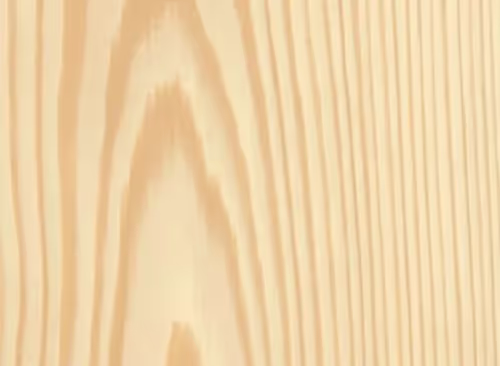
Abies pectinata or Abies alba in Latin, also called white fir, comb fir or silver fir, common fir, Vosges fir in French. It is a fir growing at altitudes ranging from 400 to 1,800 metres, from the Pyrenees to the mountains of Central Europe. In France, Vosges silver fir covers 4% of the forested area. Whatever the nature of the soil, provided it is fresh, well drained and not too compact, the fir can take root. Vosges silver fir needs humid, fairly cold air and abundant rainfall.
Introduction and origin: Vosges silver fir
Vosges silver fir belongs to the Pinaceae family. Its botanical name is Abies alba but it is also called white fir, comb fir or silver fir. The natural range of this native species extends across the Vosges at altitudes between 400 and 1,100 metres, as well as the Jura, the Alps, the Massif Central, the Pyrenees and Corsica.
The fir favours damp, deep soils where its growth is fast and optimal. These conditions are found in dense forests where competition between individual trees outweighs climate and other factors.
The stands are mostly managed as even-aged and selection high forest, which makes the Vosges forest one of the most productive.
Vosges silver fir can reach more than 50 metres in height, with diameters of 1.2 m to 1.80 m, making it one of the tallest trees in Europe. Its straight trunk is cylindrical and single, and its branches are arranged in very regular whorls.
It has a pyramidal habit which may flatten out in the oldest specimens. The branches are likewise particularly regular, while the bark, grey and thin at first, thickens and cracks, peeling off in plates.
Vosges silver fir has evergreen foliage and a lifespan that can reach two to three centuries.
Appearance: Vosges silver fir
Vosges silver fir has matt white to slightly pinkish wood, with no distinct sapwood and no resin canals. The earlywood is white in colour while the latewood tends towards red or purplish brown, which gives strongly marked annual rings.
The wood yellows slightly in the light, but less than other softwoods. It is a soft, even wood with a medium texture and straight grain, with little figure. Wood pulp (notably for newsprint, which requires white wood) is another of its important outlets.
Finally, the exceptional-quality wood from old, slow-growing specimens is used to make the best violin backs and tonewood for pianos. Its lightness is valued in the manufacture of gliders.
Lastly, mention can be made of the Vosges fir honey with its renowned AOC status and of the many virtues of needle distillates, or of Vosges turpentine, obtained by tapping and used in the treatment of respiratory complaints.
One form, several offers.
- Two minutes, no account
- Direct, no middleman
- Your identity stays private
Main characteristics: Vosges silver fir
Moderately to barely treatable, it is easily brought up to hazard class II by an insecticide and fungicide treatment. It is practically free from blue stain.
Vosges silver fir is listed among the softwoods and has a volumetric shrinkage coefficient of 12 to 15%, slightly lower than that of its counterpart the spruce. It has little movement, is light, fairly elastic and stable in service.
Finally, its mechanical properties relative to its weight are very good. It should be pointed out that in the Vosges, above 400 m of altitude, the rings are close together and the texture fine, which further increases its mechanical properties.
Applications: Vosges silver fir
Vosges silver fir is used above all as structural and joinery timber. Traditional and industrial roof structures are prime fields for this species, in which long lengths and large sections are available (up to 15 metres, and sections of 300 x 300 mm).
It is also used in joinery for door and window frames, in fit-out work and for making furniture, veneers, skirting boards, flooring and even toys. Its light tone and its evenness are indeed highly valued.
In addition, fir allows knot-free battens and mouldings to be produced. It is used in the crate-making and packaging industry for its lightness and its great length. Particleboard is also made from this species using sawmill co-products. Wood pulp (notably for newsprint, which requires white wood) is another of its important outlets.
Advice on use and finishing: Vosges silver fir
Drying is moderately fast and the wood has a slight tendency to distort. It should be noted that the drying schedule differs from that of spruce. Some black knots may fall out. This soft wood is easy to work.
Slicing and sawing are carried out without difficulty provided feed speeds are not too fast. Planing requires well-sharpened tools. The finishing stages pose no problem because of the absence of resin canals, which allows all surface treatments (paint, varnish) and gluing on flat-sawn faces.
In the green state it has a marked characteristic smell. The average density of Vosges silver fir is 0.40 to 0.55 at 12% moisture content.
Dimensions and commercial grades
| MACHINING | RESISTANCE TO SPLITTING WHEN NAILING/SCREWING | GLUING | HARDNESS |
|---|---|---|---|
| Good | Medium | Good | Soft |