
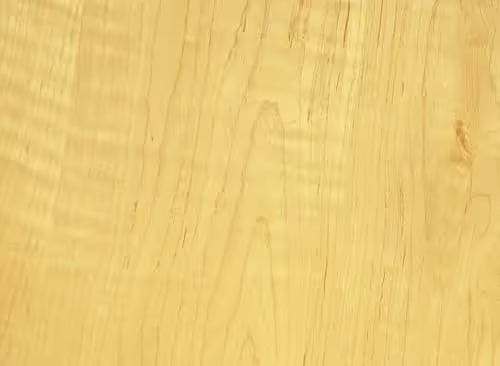
Soft maple
Soft maple, of the Aceraceae family, is also known as red or silver maple. The trade name in fact covers two distinct species whose botanical names are Acer rubrum and Acer saccharinum respectively.
Its French name comes from the fact that the underside of its leaves is silver-white. It is found along the east coast of North America and, to a lesser extent, on the west coast. Its range thus extends over a broad band, from New Brunswick to northern Georgia.
In the Appalachians it is found up to 600 metres above sea level. This species is very widespread and has characteristics similar to hard maple (see BOISmag no. 10).
Appearance: soft maple
The texture of soft maple is reminiscent of hard maple, but with a slightly greyish colour and some variations in tone tending towards a more or less dark brown. The distinction between the heartwood and the sapwood zone is not always clear. The grain of the wood is generally straight. Note that colour is not a criterion in the marketing of sawn timber.
It should also be noted that the wood is more matt and the rings less distinct than in hard maple. The average density of soft maple is 0.54 to 0.60 at 12% moisture content depending on the species (red or silver maple). Its texture is even and its grain described as medium to fine. Finally, silver maple sometimes shows speckled figure.
Main characteristics: soft maple
Easy to dry and to work, soft maple takes a fine finish. It bends readily. Its regular grain and light tones are appreciated, particularly because it is easy to stain. It is often used as a substitute for beech, given its comparable mechanical properties.
With a density 25% lower than that of hard maple, it is less resistant to indentation. It is nevertheless suitable for furniture and for flooring where traffic is not heavy.
Soft maple does not resist attack by wood-destroying fungi or by wood-boring insects. The sapwood is easy to treat, while the heartwood is moderately resistant to this type of treatment. It is a wood to be reserved for interior use.
One form, several offers.
- Two minutes, no account
- Direct, no middleman
- Your identity stays private
Applications: soft maple
Soft maple is suitable for making furniture, interior joinery, turned components and cabinetmaking products. It is used to produce kitchen cabinets, doors, mouldings and also musical instruments (particularly wind instruments, and notably certain organs).
It is often substituted for hard maple in floors and parquet, although it is softer. Easy to stain, it frequently replaces cherry for furniture interiors and sides. Its fields of application are therefore close to those of beech. Silver maple, moreover, can be tapped for maple syrup.
Advice on use and finishing: soft maple
Drying presents no apparent difficulty: soft maple dries slowly and degradation or fluctuations in performance are rare. Shrinkage can, however, be relatively high. Care must also be taken to prevent the wood from developing blue stain, as it is particularly susceptible to this type of fungus.
Machining poses no specific problems. It is easy to turn. Sanding and polishing give excellent results. Assembly with adhesive and the use of nails or screws are satisfactory. It is a wood that takes stain particularly well because of its colour and its evenness.
Many advantages: soft maple
Soft maple is the American hardwood with the fastest natural regeneration. Its price is more attractive than that of hard maple. Its success keeps growing. It is even becoming very fashionable in Europe, where consumers increasingly appreciate light-coloured woods: designers value it for how easy it is to machine and favour it for furniture manufacture and fit-out work.
The fact that it is readily available in veneer form is a further advantage. It is also establishing itself on the markets as an excellent substitute for American cherry or beech, because of its similar technical characteristics (almost identical density and hardness) and because it is easy to stain.
Dimensions and commercial grades: soft maple
Soft maple is graded according to NHLA rules. The available grades are based on the yield of clear, knot-free wood obtained after conversion. For long lengths or wide pieces, the FAS (or prime) grade should be chosen. For pieces of around 60 cm, #1 Common is the grade to go for.
Finally, for smaller pieces, #2 Common can be used. Standard thicknesses, measured in inches, correspond to 27, 32, 41, 52 and 65 mm. Mixed widths run from 105 mm to 255 mm and above. Deliveries are made in packs of fixed lengths from 1.22 m to 5 m.
It is possible to order pieces sorted by width, but also strips in fixed lengths and blanks cut to predefined lengths and widths. The timber is always delivered dry at 12–14%.