
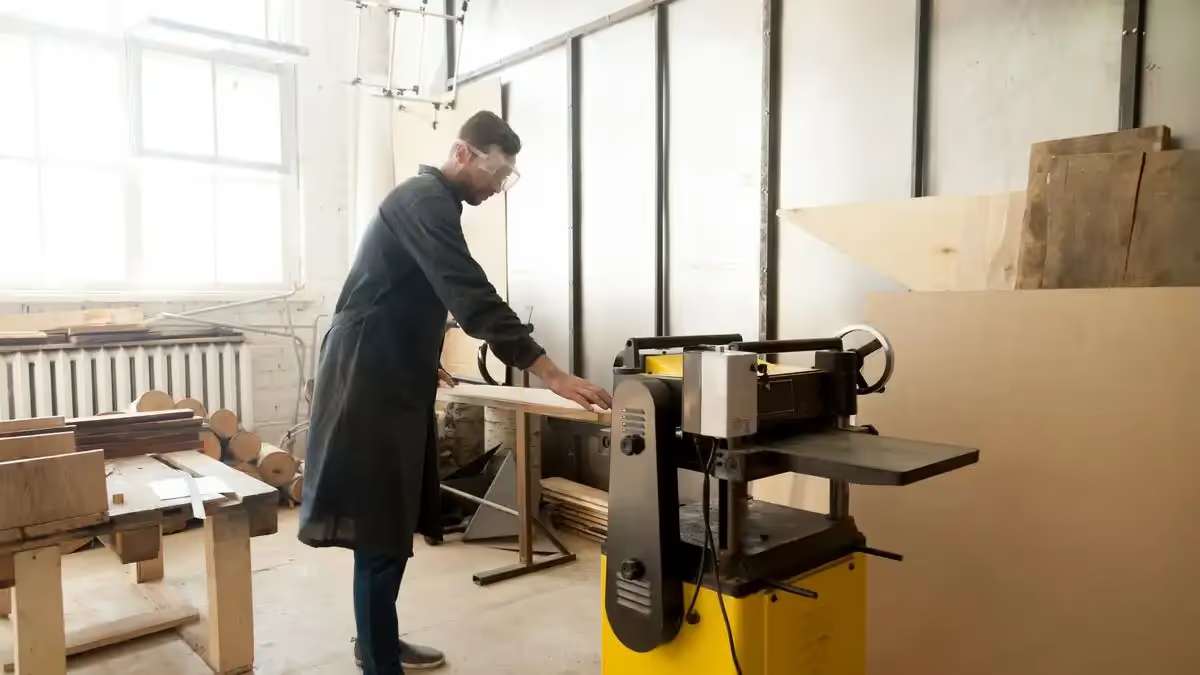
Here is the craft of joinery taken to a higher level with the planer thicknesser. This versatile machine redefines precision and creativity, bringing masterpieces to life from rough timber. Dive into the fascinating world of perfect woodwork!
Surface planer: master this indispensable woodworking machine
What is it and what is it for?
If you work in the field of joinery, you are surely familiar with classic tools such as the drill, the saw and the hand plane. But have you ever heard of the surface planer or the planer thicknesser? These terms may seem strange to some, but let me take you into the world of the surface planer and show you why it is an indispensable machine for woodworking projects.
What is a surface planer and how does it work?
The surface planer is an essential machine tool in joinery, used to turn pieces of rough timber into perfectly flat boards. Picture a rough wooden surface, full of rough spots and irregularities. That is where the surface planer comes in. It acts like a wizard of wood, turning those rough pieces into smooth and even surfaces.
To understand how it works, picture this: place a piece of rough timber on the infeed table of the surface planer, lengthways. Adjust the height to obtain the thickness you want. As you push the wood gently towards the outfeed table, the cutter block comes into action, flattening the wood as it passes. The end result? A perfectly flat piece of timber, ready to be used in your projects.
The importance of the surface planer in woodworking
When you get a board of timber straight from the sawmill, it is not ready to use. The surfaces may be irregular and uneven. That is where the surface planer comes into play. It makes it possible to true the surfaces of the timber, to make them perfectly flat and to obtain right angles between the edges. While the thicknesser can carry out part of this work, the surface planer offers greater precision, making it possible to reach levels of fineness that are impossible to achieve otherwise.
The difference between surface planer and thicknesser: complementary machines
Some might confuse the surface planer with the thicknesser, but there is a crucial distinction between the two. The surface planer focuses on straightening the surfaces on two sides of a piece of timber. It does not, however, make it possible to create parallel surfaces. That is where the thicknesser comes in. The thicknesser, rather like a large hand plane, is used to obtain perfectly parallel surfaces. By combining the actions of the surface planer and of the thicknesser, exceptional results are achieved. Certain machines on the market, such as the planer thicknesser, therefore bring together the best of both worlds.
Choosing the right planer thicknesser: crucial points to consider
To select the ideal planer thicknesser, you must take several crucial factors into account. Here are a few things to keep in mind:
Power and depth of cut per pass
The power of the machine depends on your level of expertise and on the types of timber you plan to work with. Amateur DIYers will find an output of 1,200 to 1,600 W sufficient, while professionals will opt for outputs above 2,200 W in order to handle hardwoods and softwoods on a daily basis. The depth of cut per pass is also something to consider in order to obtain the result you want.
Width of the planing table
The width of the planing table determines the types of project you will be able to carry out. The wider it is, the larger the pieces of timber you will be able to handle. Choose the width according to your specific needs.
Type of cutter block
The choice between the Tersa and Xylent cutter block systems depends on your preferences and on your work. The Tersa cutter block system allows the knives to be changed quickly, which is ideal for craft carpentry, while the Xylent cutter block system suits industrial production environments.
Budget
The price of a planer thicknesser varies according to the power, the model and the features. Affordable options are available, but do not forget that quality has a price. Favour a machine that meets your needs while offering lasting performance. The surface planer is far more than a simple tool for joiners. It is a key element in the quest for perfect woodwork. Whether you are a keen amateur or a seasoned professional, a well-chosen planer thicknesser can make all the difference to the quality of your woodworking projects. So explore the options, make your wise choices and immerse yourself in the captivating world of precise and careful joinery.
The planer thicknesser represents far more than a simple tool in a joiner's arsenal. For genuine woodworking enthusiasts, it is a strategic investment that opens the door to endless creative possibilities. Here is why this machine should be at the heart of your workshop.
Unmatched versatility
One of the most appealing characteristics of the planer thicknesser is its versatility. In a single machine, you get the functions of the surface planer and of the thicknesser, allowing you to carry out an impressive variety of tasks. From dressing rough surfaces to obtaining perfectly parallel edges, this machine does it all with surgical precision.
An asset for precision
If precision is your obsession, the planer thicknesser is the machine that will meet your expectations. Its meticulous design and its fine adjustments allow you to reach levels of precision that are hard to obtain with other methods. Both faces of a piece of timber can be flattened with astonishing consistency, thereby creating a solid basis for your most demanding projects.
Save time and energy
When you use traditional methods to flatten and true timber, it can take a considerable amount of time and enormous energy. The planer thicknesser considerably reduces that burden. In a few well-adjusted passes, it turns rough pieces of timber into surfaces ready to be used. You thereby gain time to concentrate on the creative aspects of your work.
One form, several offers.
- Two minutes, no account
- Direct, no middleman
- Your identity stays private
Advice for choosing your planer thicknesser
When considering the purchase of a planer thicknesser, it is essential to take several factors into account. This advice will help you choose the machine that best meets your needs and your ambitions:
Assess your projects
First of all, assess the type of projects you carry out regularly. This will determine the power and the capacity of the machine you need. Occasional craftspeople can opt for lighter models, while professionals will need more robust performance.
Think about versatility
Choose a planer thicknesser that offers a range of settings for maximum versatility. Precise adjustments in terms of depth of cut, speed and other parameters will allow you to tailor your work to each specific project.
Build quality
Invest in a high-quality machine, built with durable materials. A sturdy planer thicknesser will withstand intensive use and will stay accurate over time.
Safety options
Safety is paramount when working with powered machines. Look for models fitted with safety features such as emergency stop switches and protection against accidental starting.
Read the reviews
Before buying, read other users' reviews. This can give you valuable information about the real-world performance of the machine and about customer satisfaction.
Raising the craft of joinery
Ultimately, the planer thicknesser is far more than a simple tool. It embodies the evolution of modern joinery, offering a precision and a versatility that go beyond traditional methods. Whatever your level of woodworking expertise, this machine can raise your skills to new heights and inspire you to take on more ambitious projects. So make the planer thicknesser an indispensable partner in your workshop and turn your ideas into exceptional work, one perfectly flattened board at a time.