
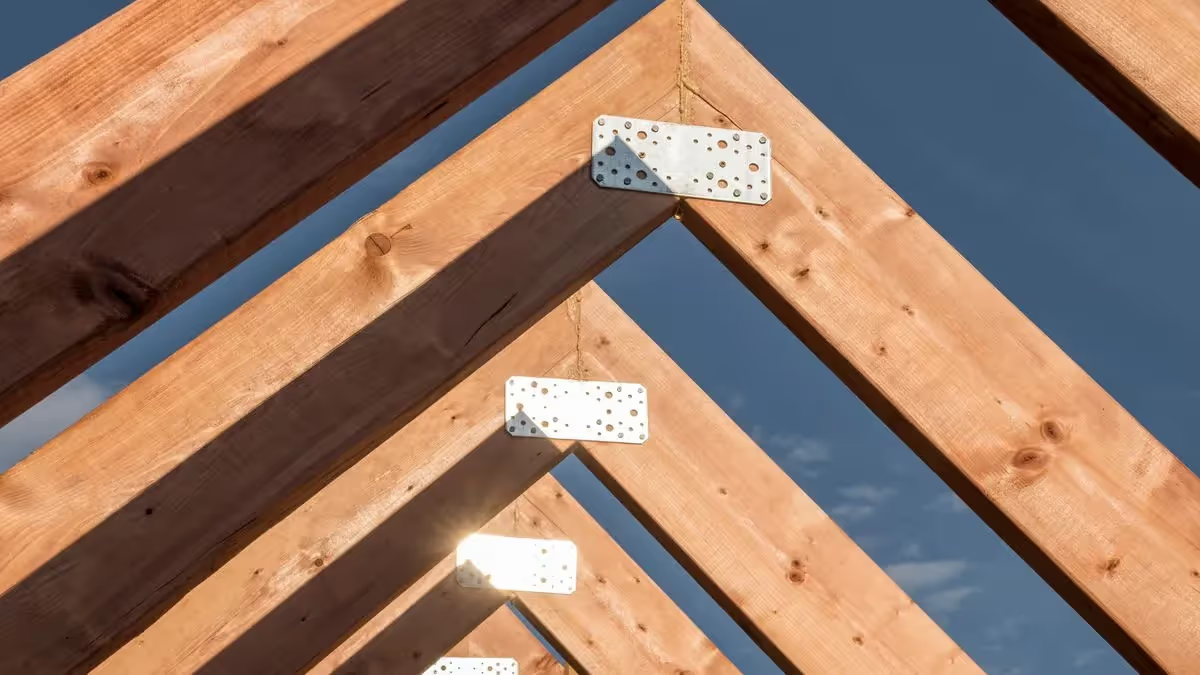
Timber frames: the importance of connectors in assembly The world of timber framing is vast and complex. It is not simply a matter of placing pieces of wood side by side. Every element plays an essential role in the robustness and the longevity of the structure. Among these elements, structural connectors are paramount. They provide a solid link between the different pieces of wood, guaranteeing the stability and the durability of the structure.
Timber frames: the role of connectors
Connectors in timber framing are not mere accessories. Their presence and a judicious choice of them are decisive in the quality of a structure. They provide a solid and efficient solution for joining the different sections of wood, taking their varied shapes and dimensions into account.
Properties of a good joint
An efficient joint is defined by several criteria. It must offer optimal mechanical strength, rigidity and ductility. These characteristics determine the ability of the structure to withstand the various forces applied to it, whether static or dynamic. What is more, the dimensional stability and the resistance to degradation of the joints are essential to guarantee the longevity of the structure. Another crucial aspect is how the joint reacts to fire. Finally, factors such as appearance, cost and ease of installation also guide the choice of connectors.
How do you use connectors for a timber frame?
Once you have chosen your connectors wisely, using them correctly is essential to guaranteeing a perfect timber frame. Here are a few steps and tips for optimal use:
- Planning and drawing: First of all, draw up a detailed plan of your frame, indicating where each connector must be placed. This will give you a clear view of the project and will guarantee a precise installation.
- The right tools: Make sure you have the tools needed to fit your connectors. This may include specific nails, screws or other fixings recommended by the connector manufacturer.
- Preparing the wood: Before installing the connectors, check that the wood is thoroughly dry and free of major defects. Imperfections or excessive moisture can affect the strength of the joint.
- Precise positioning: Position each connector carefully according to your plan, making sure they are perfectly aligned and level. Poor positioning can reduce the load capacity of the frame.
- Secure fixing: Follow the manufacturer's recommendations regarding the type and the quantity of fixings to use. Insufficient or inappropriate fixing can compromise the integrity of the frame.
- Regular inspection: Once your frame is assembled, carry out periodic inspections to check the condition of the connectors and of the connection points. Extreme weather conditions or excessive loads can affect their performance over time.
- Protection from the elements: To extend the service life of your connectors and preserve the integrity of your frame, make sure they are protected from the weather, particularly in areas prone to damp or to large temperature variations.
- Maintenance: If you notice signs of wear or corrosion on your connectors, replace them immediately. Even a small defect can have a significant impact on the stability of the whole structure.
- Consulting experts: If you have any doubts or concerns about the use of your connectors, do not hesitate to consult a timber framing professional. Their expertise can be invaluable in ensuring the safety and the longevity of your building.
Using connectors effectively is just as important as selecting them. Good positioning, adequate fixing and regular maintenance are essential to guaranteeing a strong and durable timber frame.
The different types of connector for timber frames
The diversity of connectors available meets the many technical requirements of carpenters. They generally fall into two categories: dowel-type connectors and surface connectors.
Traditional connectors
Dowel-type connectors, such as bolts, coach screws, nails, screws, dowels and so on, transfer the force across the thickness of the wooden element. As for surface connectors such as split rings, shear plates and metal connectors, they distribute the force over the contact surface.
Metal "connector plate" fasteners
These plates are obtained by punching thin galvanised steel sheets. Mainly used to join the pieces of wood in prefabricated roof trusses, they offer excellent resistance to rust. The variety of dimensions on offer meets different construction needs.
Galvanised sheet steel joist hangers
Offering great diversity, joist hangers are suited to different types of timber joint. They are essentially made of galvanised steel, guaranteeing protection against corrosion. Their load transfer capacity is assessed according to strict standards, guaranteeing the safety of the structure.
Angle brackets (angles)
Perfect for connecting two elements at right angles, angle brackets are a common choice for many carpenters. They are available in different materials and dimensions, thereby offering great flexibility during assembly.
How do you choose your connectors wisely?
Connectors play a crucial role in the stability, the safety and the durability of timber frames. Their choice and their installation must therefore be carried out with the greatest care, taking into account the constraints specific to each project. It is by combining expertise and quality materials that the success and the longevity of a structure can be guaranteed. The timber frame is the backbone of many buildings, guaranteeing the strength and longevity of the structure. Connectors play a paramount role in this mechanism. Here are a few tips for choosing your frame connectors wisely:
- Type of wood used: It is crucial to choose connectors suited to the type of wood in your frame. Hardwoods and softwoods have different properties, and the connectors must be compatible to ensure an effective joint.
- Load and stresses: Consider the loads to which the frame will be subjected. Depending on whether you are building a loft, a garden shed or a dwelling, the connectors will have to bear different loads.
- Environmental conditions: If the building is located in a damp or marine area, or one prone to large temperature variations, opt for corrosion-resistant or heat-treated connectors.
- Design and appearance: Although connectors are often hidden, there are attractive options for projects where they will be visible.
- Installation: Some connectors require specific tools or particular skills to install. Make sure you have the right tools and the right expertise, or choose connectors that are simpler to fit.
- Standards and regulations: Before finalising your choice, check that the connectors meet the standards in force in your country or region. This guarantees the safety and the durability of your building.
- Budget: While the most expensive connectors are not always the best, never sacrifice quality for cost. Opt for the best value for money, taking all the requirements of your project into account.
- Reviews and recommendations: Before taking a decision, consult the opinions of professionals and of other users. Their experience can shed light on the reliability and the performance of the connectors you are considering.
The choice of frame connectors should not be taken lightly. A judicious selection will guarantee the strength, the safety and the longevity of your building. Be sure to assess your needs carefully, to research thoroughly and, if possible, to consult experts in the field.
One form, several offers.
- Two minutes, no account
- Direct, no middleman
- Your identity stays private
Timber frame connectors: the keystone of durable construction
Timber framing is a field that calls for expertise and precision. Connectors are at the heart of this precision, guaranteeing strong and durable structures. Although this article covers only a few of the many types available, they represent the most commonly used ones. Since every project is unique, it is paramount to gather good information and to consult experts before any work is carried out.
Timber frames: understanding the central role of connectors
Timber framing is an ancestral art that has evolved with technological progress and the changing needs of modern construction. One of the fundamental elements of this evolution is the use of connectors to ensure the stability and the durability of timber structures.
The characteristics of an effective joint
An effective timber frame joint rests on several key factors:
- Mechanical strength: It guarantees that the joint can bear the forces to which it is subjected.
- Dimensional stability: It ensures that the structure keeps its shape under different types of load.
- Durability: The fixings and the connectors must resist degradation, particularly in the face of the weather.
- Behaviour in a fire: It is essential to ensure that the joint does not help the fire to spread.
The choice of connectors therefore plays a crucial role in meeting these requirements.
The diversity of connectors for timber frames
The world of connectors for timber frames is vast. They vary not only in terms of materials but also of function.
Traditional connectors
These connectors have been used for centuries to assemble timber structures. They can be classified as:
- Dowel-type connectors: These connectors, such as bolts, coach screws, nails, screws and dowels, act by transferring the force across the thickness of the wooden element.
- Surface connectors: They distribute the force over the contact surface, as in the case of split rings, shear plates and metal connectors.
Metal connectors of the "connector plate" type
Specially designed for prefabricated structures, these connectors are characterised by their resistance to rust, thanks to their galvanisation, and by their ability to join pieces of wood effectively.
Galvanised sheet steel joist hangers
These joist hangers, often used for specific joints such as those in lightweight frames, offer the advantage of flexibility, suited to the varied needs of timber structures.
Angle brackets (angles)
Providing a 90-degree angle, angle brackets are ideal for connecting beams, binders or joists at right angles. Their unique design makes them essential for many types of joint.
The judicious choice of connectors is crucial
The choice of the appropriate connector depends on the type of timber structure, on the load it has to bear, on its location and on many other factors. Connectors guarantee not only the strength of the joint, but also its longevity. With the evolution of techniques and materials, it is crucial to keep gathering information and training in order to ensure the best quality of construction. Finally, for those who wish to deepen their knowledge of timber framing and assembly techniques, specialist resources such as UsiHome offer a wealth of valuable information and expertise.