
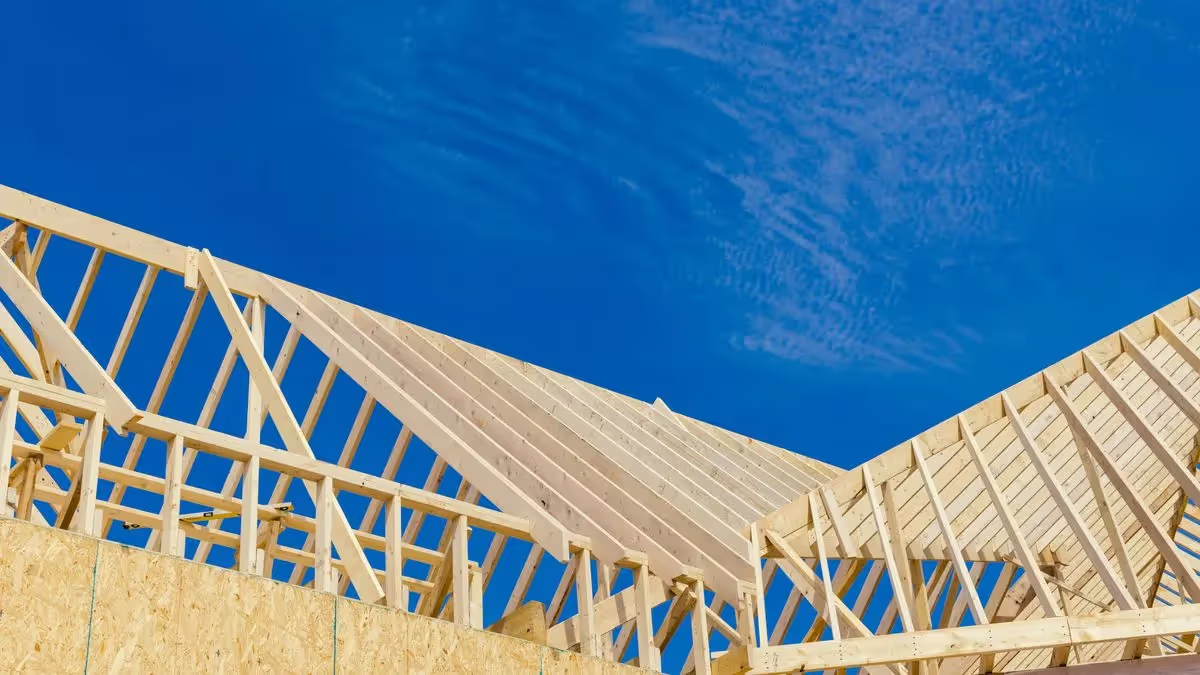
Here is the fascinating craft of assembling timber roof structures with connectors. Step into a world of expertise, explore advanced techniques and learn how to create strong, durable structures. Whether you are an enthusiast or a professional, our guide takes you to the heart of timber construction with originality and quality. Do not miss the chance to master this essential craft and bring your projects to life with confidence.
Assembling a timber roof structure with connectors: the art of strength
A roof structure, whether traditional or metal, needs far more than simply putting it in place. It has to be supported, but above all expertly tied together. That is where truss connectors come in, components that, in the language of the trade, make all the difference.
Truss connectors: the foundations of strength
Truss connectors, the often overlooked keystone of timber construction, play a vital role in assembling the elements. These parts, mostly in metal, are the backbone of roof structures, both traditional and industrial. The latter, also known as connector-plated trusses, are the fruit of an expert marriage between age-old craft and modern techniques.
The range of possibilities: an array of connectors
The world of truss connectors is a complex web in which every thread links strength and function. These varied metal components form a symphony of assembly. Perforated plates, true Swiss army knives, join posts and beams together, while hip hangers orchestrate the elegance of a hipped roof by assembling the hip half-trusses and jack rafters.
Combining form and function: ingenious connectors
The 45° connectors come into play to tie together joists, half-trusses and hip rafters. Reinforced angle brackets, for their part, become the maestros of assembly by fixing trussed rafters and cladding rails. This technical ballet does not stop there, with connecting straps weaving invisible links between the half-trusses. Straight hangers, functional chameleons, are the sidekicks of suspended ceilings and ducts.
Engineering in action: made-to-measure connectors
These connectors are more than metal parts, they are feats of engineering. Made of sheet steel or aluminium alloy, they are designed to withstand the elements, ensuring strength and durability. Connectors are meticulously sized to transmit loads, while their anti-corrosion treatment guarantees a long and reliable life.
Standards and rules: the foundations of compliance
Truss connectors do not comply only with aesthetics, but also with standards. Standard EN-14545 lays down the fundamental rules. A permissible displacement, a controlled gap: these connectors are subject to strict criteria. Their precision must be exemplary, with a maximum gap of 10 mm and a contact surface accurate to 1 mm over 25% of the plate.
The verdict on assembly: essential connectors
In the end, truss connectors are not simply mechanical components but the master builders of a strong and functional roof structure. They deserve sustained attention, because they are the quiet heroes of architecture. Whether you have the eye of the curious DIYer or the gaze of the professional, the art of assembly with connectors offers a fresh perspective on construction. A well-connected roof structure is a well-built roof structure.
One form, several offers.
- Two minutes, no account
- Direct, no middleman
- Your identity stays private
The informed choice: a world of possibilities
Now that we have dived into the heart of truss connectors, it is time to explore in depth the different options open to you. Every choice you make in this field will influence the strength, durability and function of your timber roof structure. Let us discover the subtleties of some of the most commonly used connectors.
Perforated plates: structural versatility
Perforated plates, worthy representatives of versatility in the world of connectors, find use in a variety of tasks. Tying posts together, reinforcing beams or carrying out complex assemblies after repairs, these connectors are an essential tool. Their perforated structure allows a strong fixing, while their variety of sizes makes them adaptable to a range of needs.
Hip hangers: curves in harmony
Curved roof structures are not the preserve of metal construction. Hip hangers take on the task of creating elegant arcs by assembling the hip half-trusses and jack rafters. With their role that is both visual and functional, they prove that the timber roof structure can play just as well with shapes and curves.
Reinforced angle brackets: guarantors of stability
When stability is paramount, reinforced angle brackets come into play. Their role is wide-ranging, from fixing trussed rafters to fixing cladding rails, by way of studs and rafters. The variety of configurations allows a myriad of needs to be met, offering strong and durable solutions for resilient roof structures.
From twisted straps to rafter feet: functional specialisation
Every connector has its own mission. Twisted straps, discreet and functional, take care of concealing ducts, guaranteeing a neat appearance. Rafter feet, specific to rafter fixings, make sure that every element of the roof structure is firmly in place, thereby contributing to the overall integrity of the structure.
Precision mechanics: beyond appearances
The role of truss connectors goes well beyond their appearance. These meticulously manufactured metal parts, whether in steel or aluminium alloy, are designed to withstand the elements and to transmit loads effectively. Their anti-corrosion treatment guarantees their longevity, while their careful sizing ensures a perfect match with the structural requirements.
Complying with standards: certified strength
Strong roof structures begin with connectors that comply with the standards. Standard EN-14545 is the guide that lays down the key parameters. A permissible displacement of 10 mm, a controlled gap of 1 mm over 25% of the plate: these connectors are subject to strict rules in order to guarantee their performance and their safety.
The stuff of hidden heroes
While carpenters skilfully handle connectors to shape strong structures, these components often remain in the shadows. Yet every timber roof structure that stands is the result of their ingenuity. Connectors, the quiet heroes of the construction world, ensure the strength and longevity of every building, making it possible to erect durable and functional creations.
The art of the perfect assembly
The art of assembling a timber roof structure with connectors is not just about pieces of metal. It is a symphony of engineering, aesthetics and function. Every carefully made choice, every judiciously placed connector, contributes to the harmony of a strong and resilient roof structure. As you contemplate a well-built roof structure, remember that every connector has its own story to tell, a story of precision, performance and durability.