
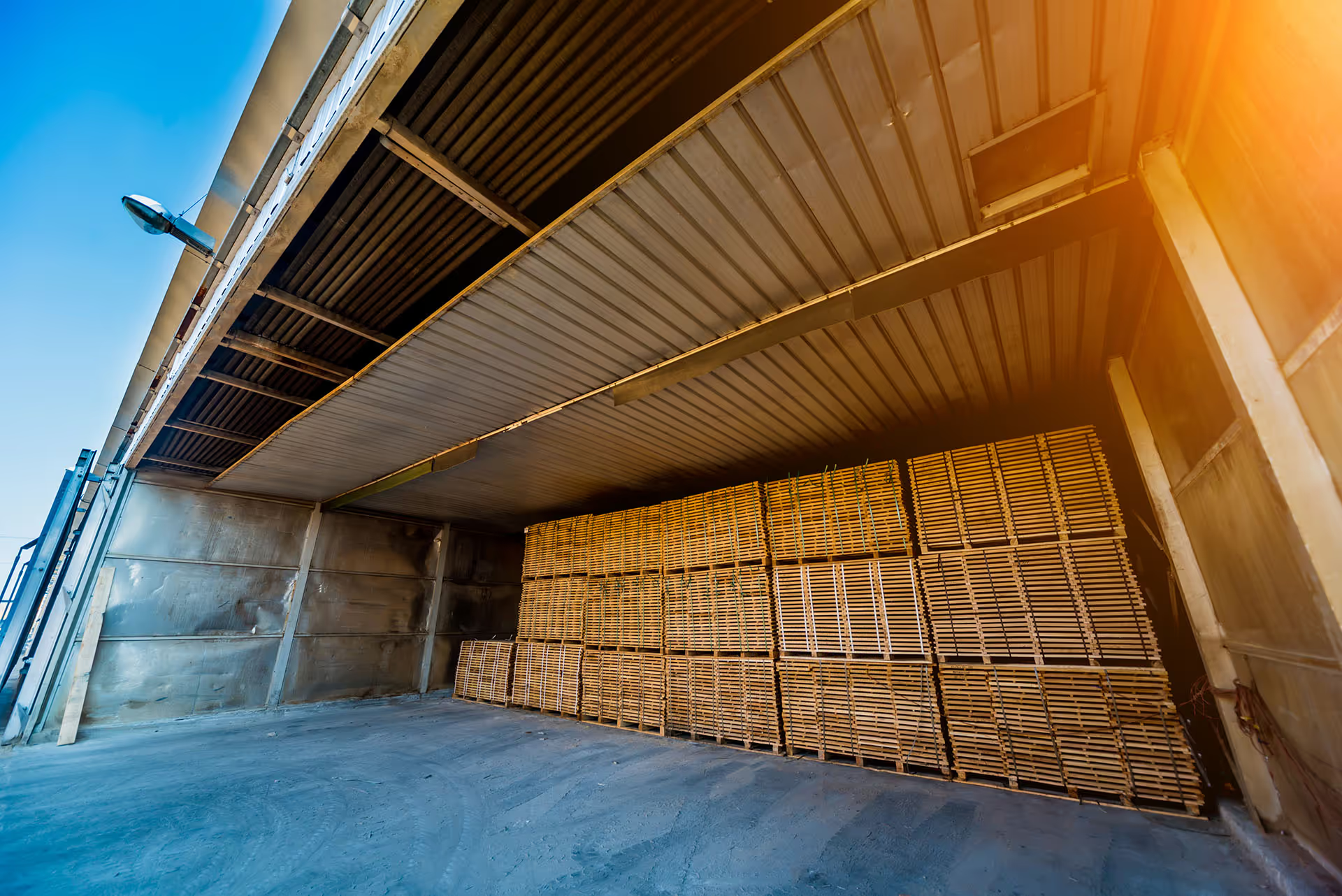
The wood drying kiln is an industrial piece of equipment designed to speed up the wood drying process by blowing hot air through an enclosed space where the wood is stored.
The wood drying kiln has revolutionised wood drying, offering an enormous saving in time compared with simply drying wood outdoors, by blowing hot air through the wood. Thanks to this method, removing the moisture from any type of wood becomes far faster and more efficient.
To choose the right wood drying kiln for your business, Woodpartners explains everything about this revolutionary method, which offers advantages in terms of quality as well as profitability:
- The wood drying kiln in brief
- How does a wood drying kiln work?
- What are the advantages of using a wood drying kiln?
- What are the different types of wood drying kiln?
- What are the different energy sources for a wood drying kiln?

The wood drying kiln in brief
- The wood drying kiln dries the wood by blowing hot air over and around it in an enclosed space,
- The kiln makes it possible to dry the wood faster and more efficiently, offering timber businesses a major saving in time,
- There are several supply resources: propane, natural gas, electricity, biomass.
How does a wood drying kiln work?
The wood drying kiln blows hot air through the wood, via a thermal energy source, in order to remove its moisture. This "artificial" wood drying technique is far faster than "natural" drying in the open air, and it also makes it possible to obtain drier, more consistent wood, with fewer cracks.

To ensure optimal operation, however, this drying operation in a wood kiln requires sharp know-how and expertise if the flow of hot air is to be controlled and adjusted precisely throughout the process, for every type of wood and every wood species. Parameters such as temperature, relative humidity and drying time must be carefully regulated to ensure even drying and to avoid defects such as cracks or distortion.
The most modern wood drying kilns incorporate a microcomputer and automated systems with advanced sensors that adjust the drying conditions in real time, thereby optimising energy efficiency and the quality of the wood processed. Some models also make it possible to programme specific cycles according to the wood species and the thickness of the pieces. Manual intervention is greatly reduced (semi-automatic system), as is the margin for error.
What are the differences between natural drying and kiln drying?
Natural drying consists of leaving the wood to dry in the open air, generally under cover, for several months or even years, depending on the thickness and the species of the wood. This method is inexpensive but has drawbacks such as the time needed, the storage space required and the risk of distortion or of mould developing.
Kiln drying, on the other hand, makes it possible to control the drying and humidity conditions precisely, thereby reducing the time needed to a few days or weeks. This method offers better wood quality, with fewer defects, and allows more predictable and efficient production.

One form, several offers.
- Two minutes, no account
- Direct, no middleman
- Your identity stays private
What are the advantages of using a wood drying kiln?
There are several advantages to using a wood drying kiln:
- Speed of wood drying: drying is far faster than natural drying, allowing stock to be turned over more quickly, which saves time and storage space.
- Optimal and even drying, which avoids distortion or cracking of the dried wood,
- Flexibility : the possibility of drying different wood species and of adapting to the specific requirements of customers.
- Drying efficiency, making it possible to dry very thick or very wet wood.
- Multiple thermal energy sources available: propane, natural gas, biomass.
- Energy efficiency : modern kilns are designed to minimise energy consumption, in particular through the use of renewable sources such as biomass.
- Compliance with standards : some kilns make it possible to carry out heat treatments that comply with international phytosanitary standards, such as ISPM 15.

What are the different types of wood drying kiln?
There are several types of wood drying kiln, each suited to specific needs:
- Traditional conditioned hot air kilns : they use heated air to dry the wood, with precise control of temperature and humidity.
- Compact kilns : designed for small capacities, ideal for drying in workshops or small businesses.
- Condensation kilns (heat pump) : they use a heat pump to recover the energy from the humid air, offering an energy-efficient solution.
- Direct-fired kilns (gas burner) : the air is heated directly by a gas burner, allowing fast drying.
- Tunnel-type kilns : the wood is moved through a tunnel where it is exposed to controlled drying conditions.
- High-capacity kilns and pre-dryers : designed to handle large quantities of wood, often used in the wood processing industries.
- Steam chambers and combined steam chamber-kilns : they use steam to modify the properties of the wood, often used for heat treatment.
- Bark and sawdust dryers : specially designed to dry wood by-products such as bark and sawdust.
- Installations for phytosanitary heat treatment (ISPM 15 standard) : they make it possible to treat wood intended for export in accordance with international standards.
- Kilns for the heat treatment of wood (up to 250°C) : they modify the properties of the wood to improve its durability and its resistance to the weather.
What are the different energy sources for a wood drying kiln?
To dry the wood, the wood drying kiln is supplied with thermal energy. Among the energy sources commonly used are propane, natural gas, electricity, oil, heating and biomass, the last of these offering an environmentally responsible solution.
Using biomass to power wood drying kilns: an environmentally responsible solution
Biomass, an abundant resource in the industry, consists of wood residues (straw, bark, sawdust and so on) used as fuel to become an energy source. Initially reserved for large factories, biomass has become an environmentally responsible option for powering wood drying kilns, and even heating equipment, as with biomass boilers.
Using biomass as an energy solution for wood drying kilns is of great interest, but care must be taken over the moisture content of the inputs (the wood residues used), which must not exceed a moisture content of more than 35%, in particular so as to avoid the biomass fuel freezing in the silo. Wood chip dryers generally guarantee an optimal moisture content.
Biomass wood drying kilns, an energy-efficient revolution for the sawn timber industry
The ingenious use of biomass in wood drying kilns has revolutionised the sawn timber industry by allowing sawmills to meet drying needs while following an energy-efficient approach. Sawmills can thus not only optimise their operating costs, but also contribute to environmental sustainability.
This development reflects how compatible it is to make use of an abundant and underestimated resource such as biomass, while meeting the requirements of a demanding drying process.
From the ingenious use of biomass to know-how and advances in automation, the future of the wood drying kiln is promising, driven by innovation, sustainability and human expertise. Woodpartners offers you the best models of wood drying kiln for impeccable results, according to the needs and the technologies you are looking for.