
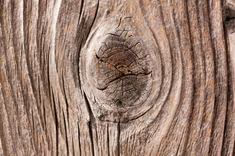
Oak is a varied species that has always been grown for its cork, its bark, its acorns and its timber. Used in joinery or cabinetmaking, for various structures such as roof frames, oak wood dominates the European market and is renowned for its looks, its hardness and its durability.
You will find all the answers to your questions about oak wood in the following sections:
- What is oak wood?
- What are the characteristics of oak?
- Oak wood: what is it used for?
- How do you maintain oak wood?
- Other questions about oak

What is oak wood?
Oak wood belongs to the Fagaceae family; it comes mainly from Europe and North America. Its botanical names are Quercus petraea, which means sessile oak, and Quercus robur, meaning pedunculate oak.
Oak wood is one of the most widely used and the most harvested hardwood in France, ahead of poplar. Its production is mainly in Europe, with France and Belgium at the top of the list. It likes temperate regions, sunshine and open areas.
Recognised and sought after for its durability and its ability to adapt, oak wood has several names depending on the country:
- In France: Chêne, Chêne blanc européen;
- In Germany: Eiche;
- In Spain: Roble;
- In Italy: Quercia;
- In the United Kingdom: Oak.

What are the characteristics of oak?
Oak benefits from many characteristics, such as natural durability, considerable strength, slow growth and a colour ranging from light brown to dark brown. Indeed, whether we speak of dark oak or light oak, it is one and the same species.
Description of oak
- Colour of oak wood : light brown to dark brown according to origin;
- Sapwood (the soft, light-coloured part of the wood that forms each year under the bark): clearly distinct;
- Grain : variable according to origin, fine to coarse;
- Grain direction or fibre orientation : straight;
- Interlocked grain or direction contrary to the axis : absent.
Description of the oak log
- Diameter of the oak tree : between 40 and 80 cm;
- Thickness of the sapwood : from 1 to 4 cm;
- Preservation in the forest : average, treatment is recommended.
The physical properties of oak
- Density of oak : 0.74;
- Hardness (at 12% moisture content with 1 MPa = 1 N/mm²) : 4.2;
- Growth : fast;
- Volumetric shrinkage coefficient : 0.44%;
- Total tangential shrinkage (TS): 9.7%;
- Total radial shrinkage (RS): 4.5%;
- Ratio between TS and RS : 2.2;
- Fibre saturation point : 31%;
- Stability in service : moderately to slightly stable.
The natural durability and treatability of oak wood
- Resistance to fungi: class 2, durable;
- Resistance to dry wood insects : class D, durable;
- Resistance to termites : class M, moderately durable;
- Treatability : class 4, not treatable;
- Wood class: durability class 3, for outdoor use out of contact with the ground.
Drying oak
- Drying speed: slow;
- Risk of distortion : high;
- Risk of case-hardening (accidental hardening): no known risk;
- Risk of checks (splits): high;
- Risk of collapse (waviness, separation of the wood): present.
Sawing and machining oak wood
- Blunting effect: normal;
- Sawing teeth : stellite-tipped teeth;
- Machining tools : tungsten carbide;
- Suitability for peeling : good;
- Suitability for slicing : good.
Assembling oak
The assembly of oak wood is done in two steps:
- Nailing and screwing: good holding, pilot holes required;
- Gluing : oak wood is dense, slightly acidic, rich in tannin and liable to stain, which must be taken into account when gluing.

One form, several offers.
- Two minutes, no account
- Direct, no middleman
- Your identity stays private
Oak wood: what is it used for?
Oak wood is very widespread in interior and exterior joinery, for cabinetmaking, the building of heavy timber frames, cooperage and hydraulic works, thanks to its qualities. Oak has a certain visual appeal and very good durability, which help to ensure that the structures built with it last.
Let us come back to the various uses of oak:
- Interior and exterior joinery: oak wood proves ideal for building staircases and floors thanks to its long service life.
- Cabinetmaking: oak wood is very hard and hard-wearing, which makes it an essential for the interior woodwork of prestigious buildings. Its visual appeal is no longer up for debate and it was even chosen to rebuild parts of Notre-Dame Cathedral in Paris.
- Heavy timber frames: oak is highly valued for building roof frames because of its natural durability and its strength.
- Cooperage : the oak casks or barrels in which wines and spirits are kept are indeed made with this material. The strength and the workability of oak wood make it possible to give these barrels their rounded shape.
- Hydraulic works and boat building: oak wood resists water and does not distort. It was long a favoured resource for boat building and remains an asset for carrying out hydraulic works.

How do you maintain oak wood?
Oak wood needs little or no maintenance. The tannin it contains naturally protects it against the weather, insects and fungi. It therefore requires no pressure treatment, unlike some species.
As it ages, however, oak wood loses some of its tannin concentration. It may therefore be necessary to use suitable products to preserve it.
For this, WoodPartners recommends certain items:
- Natural cleaners, to preserve the oak;
- Finishing products, to protect the oak wood;
- Stainless steel fixings, to avoid any blackening caused by contact between the tannin and water.
