
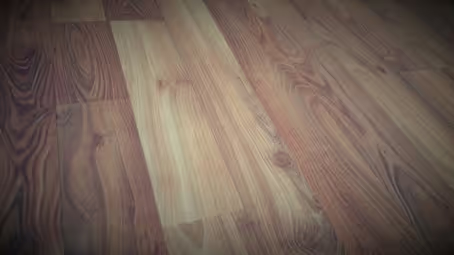
Douglas fir is a wood species widely used in the construction field; it is recognised for its mechanical characteristics. Douglas fir wood combines natural durability and mechanical strength. This softwood is therefore valued for different types of construction, indoors as well as outdoors.
Here are the points we will cover in this article:
- What is Douglas fir wood?
- What are the characteristics of Douglas fir?
- Douglas fir: what is it used for?
- How do you maintain Douglas fir wood?
- Other questions about Douglas fir
What is Douglas fir wood?
Douglas fir wood, or Oregon pine, is a softwood, like larch, native to the west coast of the North American continent. Its distribution stretches over a coastal strip more than 2,000 km long, from British Columbia to California. It is also found in Europe under the name Douglas pine. However, Douglas fir is neither a pine nor a fir, contrary to what these names might suggest. This "Pseudotsuga menziesii" is from the Pinaceae family.
Here are its different names depending on the country:
- In Germany : Douglasie, Douglastanne;
- In the United States : Douglas fir;
- In France : Douglas, Pin d’oregon, Sapin de Douglas.
The national supply of Douglas fir wood is the fruit of a process two centuries old, which began in 1792 when the British naturalist Archibald Menzies identified Douglas fir on the Pacific coast of the North American continent. Thirty years later, the botanist David Douglas collected a few seeds and seedlings in Washington and Oregon, and convinced the English scientific community of its interest.
It was in 1842 that the Douglas fir tree was introduced into Europe. It subsequently arrived in France to serve as an ornament in gardens and parks, and was the subject of the first reforestation work at the end of the 19th century.
In the second half of the 20th century, Douglas fir wood was used on a massive scale to reforest French uplands such as the Massif Central, the Morvan, the Vosges and Brittany. Douglas fir tolerates cold, damp climatic conditions, which makes it a major asset for mid-mountain territories.
Today, Douglas fir has become an essential local species. It represents the main source of reforestation in France thanks to its accelerated growth and its high availability. France thus ranks first in Europe among Douglas fir producing countries.
What are the characteristics of Douglas fir?

Douglas fir has many characteristics, such as durability and strength. This makes Douglas fir wood a firmly established species in the construction field.
Description of Douglas fir
- Colour of Douglas fir wood : from pinkish brown to orange-pink;
- Sapwood (the soft, light-coloured part of the wood that forms each year under the bark): clearly distinct;
- Grain of Douglas fir : medium;
- Grain direction or fibre orientation of Douglas fir wood : straight;
- Interlocked grain or direction contrary to the axis : absent.
Description of the Douglas fir log
- Diameter of the tree : between 50 and 80 cm;
- Thickness of the sapwood : between 5 and 10 cm;
- Preservation in the forest : poor, treatment is necessary.
The physical properties of Douglas fir
- Density of Douglas fir : 540 kg/m3;
- Hardness (at 12% moisture content with 1 MPa = 1 N/mm²) : 3.2 .
- Growth : fast;
- Volumetric shrinkage coefficient : 0.46%;
- Total tangential shrinkage (TS): 6.9%;
- Total radial shrinkage (RS):4.7%;
- Ratio between TS and RS : 1.5;
- Fibre saturation point : 27%;
- Stability in service of Douglas fir wood : good.
The natural durability and treatability of Douglas fir wood
- Durability : good;
- Resistance to fungi : class 3-4, moderately to slightly durable;
- Resistance to dry wood insects : class D, durable;
- Resistance to termites : class S, susceptible;
- Treatability of Douglas fir : class 4, not treatable;
- Wood class of Douglas fir : wood class 3, for use out of direct contact with the ground.
Drying Douglas fir
- Drying speed : fast to normal;
- Risk of distortion : low;
- Risk of case-hardening (accidental hardening): no particular known risk;
- Risk of checks (splits): low;
- Risk of collapse (waviness, separation of the wood): no particular known risk.
Sawing and machining Douglas fir wood
- Blunting effect : normal;
- Sawing teeth : ordinary or alloy steel;
- Machining tools : ordinary;
- Suitability for peeling : good;
- Suitability for slicing : good.
Douglas fir wood can contain resin pockets. The blades and tools used can therefore get dirty more easily because of the resin that builds up. You should pay attention to this.
Assembling Douglas fir
The assembly of Douglas fir is done in two steps:
- Nailing and screwing : good holding;
- Gluing : satisfactory.
Douglas fir wood is nevertheless slightly acidic. There is therefore a risk of the nails and screws corroding in damp conditions.
One form, several offers.
- Two minutes, no account
- Direct, no middleman
- Your identity stays private
Douglas fir: what is it used for?

Douglas fir lends itself to various uses such as boat building, roof frames, interior and exterior joinery, veneer and plywood, panelling, glued laminated timber, flooring, poles, house frames and external cladding. However, its favourite field remains construction. Its ability to be sawn in large sections makes it possible to assemble major structures in Douglas fir wood.
- Roof frames : Douglas fir wood is hard-wearing and durable, which gives it essential advantages for building roof frames or Douglas fir roof boarding, for example.
- Boat building with Douglas fir : the strength of Douglas fir wood is also recognised in the field of boat building, in which it is often used. The leading species in 19th-century boat building, Douglas fir owes its fame to the masts of British sailing ships.
- Interior and exterior joinery : Douglas fir also has a certain raw, natural visual appeal that makes it possible to fit out your outdoor space as well as your interior, to build a Douglas fir wood deck, for example.
- House frames in Douglas fir wood : since Douglas fir wood is rigid and solid, it makes it possible to build good frames for your houses.
- External cladding in Douglas fir : cladding in Douglas fir wood is very often used thanks to the mechanical properties and the good durability of this wood species.
How do you maintain Douglas fir wood?
Douglas fir wood is recognised for its durability, but certain tips make it easier to preserve:
- Apply a finish : in order to protect Douglas fir wood from moisture and from external attack such as UV, you can opt for a finish such as a saturator or a transparent wood protector.
- Limit exposure to the sun : to avoid colour changes or the fading of Douglas fir, we advise you to avoid strong exposure to sunlight or to heat sources. Otherwise, you will have to maintain it regularly.
- Carry out the right finishing work : when you use Douglas fir wood for joinery or for structural purposes, you should remember to carry out the necessary work such as milling and sanding so as to obtain a smooth, even finish.
Other questions about Douglas fir

What is the price of Douglas fir wood per m3?
The price of Douglas fir wood per m3 is, on average, 87 euros per m3. This nevertheless varies from year to year and according to the size of the Douglas fir tree felled.