
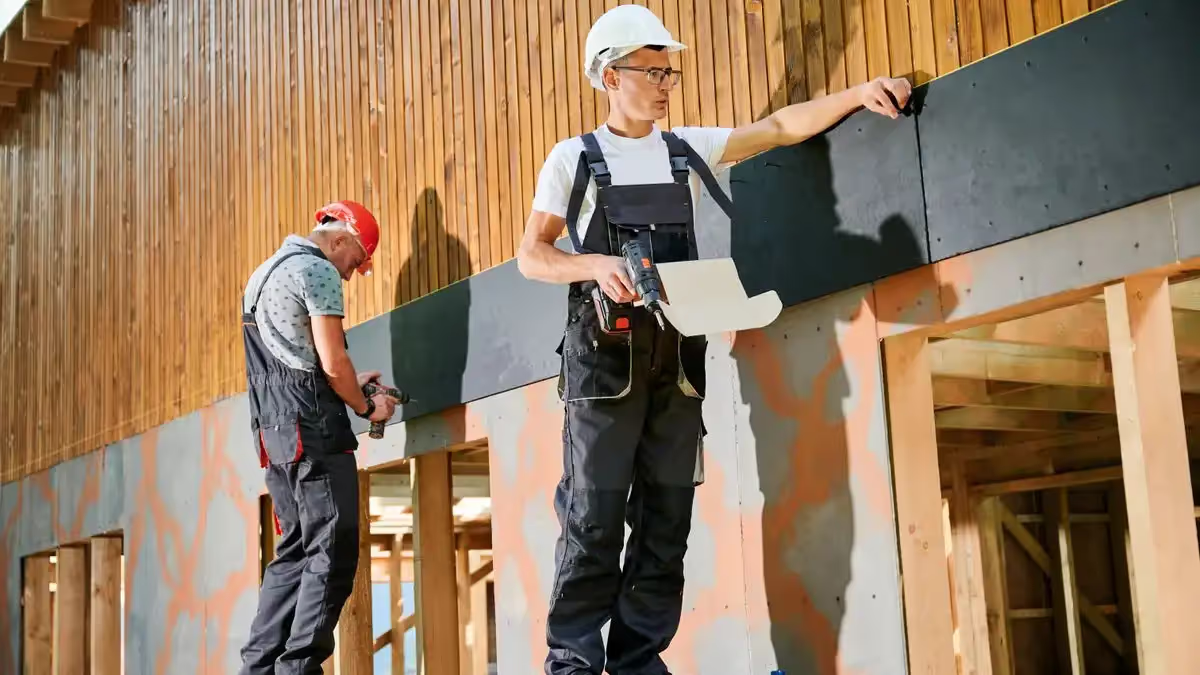
Reveal the transformation of your home with external cladding. Discover how to combine good looks and performance, explore the materials in fashion and decode the prices for a lasting investment. Do not miss our tips for obtaining financial support and making your façade shine with elegance.
Complete guide to external cladding prices
External cladding is far more than a simple layer of covering. It in fact offers a multitude of functions that are essential to a house. This covering, laid on the framework of the building, transforms the appearance of the house while protecting it against the weather. It also reinforces thermal and acoustic insulation, thereby contributing to the overall energy performance of the building.
The different functions of cladding
External cladding, a visual transformation. External cladding is not limited to a simple improvement in appearance. It has the ability to give a new, modern look to an older building, or to discreetly conceal the imperfections of the façade. That is where the whole art of choosing the cladding material lies, a decision that greatly influences the final price.
A protective shield against the elements
Faced with the elements, external cladding proves to be a robust shield. Weather-resistant, it defies the assaults of rain, frost and sun. By reinforcing the weatherproofing of the façade, it protects the structure of the building from water infiltration, damage and premature wear. For greater resistance to the weather, you can adjust the thickness of your cladding.
Built-in thermal and acoustic insulation
The harmony between appearance and functionality reaches its height when external cladding is combined with an insulating layer. This union creates a thermal barrier, carefully retaining the heat produced inside. The impact on the energy bill should not be underestimated, and acoustic comfort is also improved, making cladding a long-term investment.
Insulation through cladding: methods and materials
Different types of mounting
The choice of mounting method for external cladding defines its main role: appearance, insulation or both at once.
- Single-skin cladding: appearance above all
Single-skin cladding, aimed mainly at the visual aspect, simply beautifies the façade. By fixing it to the framework, it gives the house a facelift, without claiming to improve insulation.
- Insulated cladding: appearance and insulation combined
When insulation is an essential criterion, insulated cladding is the solution. An insulating layer is inserted between the façade and the cladding, forming an effective thermal barrier.
- Double-skin cladding: sandwich insulation
Double-skin cladding creates an insulating envelope sandwiched between two coverings. Although more expensive, it offers an exceptional level of insulation, ideal for houses with high energy performance.
Cladding: materials for every taste
- Wood: warmth and natural charm
Wooden cladding, whether in boards or panels, keeps its natural, warm charm. The choice of wood must, however, take account of its resistance to moisture in order to guarantee its durability. Its price varies according to the species and the maintenance required.
- Composite: performance and ease of maintenance
Composite cladding combines wood fibres and polymer resins to offer excellent resistance to the weather, to UV and to impact. Easy to maintain, it needs no particular treatment. Its wood-look appearance appeals to modern projects in search of durability and visual consistency. Wooden or composite cladding is often a difficult choice, as both materials are attractive and high-performing.
- Metal: modernity and versatility
Metal cladding, perfect for double-skin cladding, brings a touch of modernity to contemporary buildings. Its versatility suits varied designs. Beware of its sensitivity to oxidation in marine environments.
- PVC: simplicity and durability
PVC cladding appeals through how easy it is to install and maintain. Its strength and its visual diversity make it a practical choice. It also offers excellent thermal and acoustic insulation.
- Stone: elegance and insulation
Stone cladding, although complex to install, guarantees high-performing thermal insulation and undeniable decorative charm. The variety of finishes makes it possible to adapt it to various architectural styles.
- Zinc: appearance and durability
Zinc cladding, prized for its appearance and its longevity, needs little maintenance. It offers fire resistance and an ability to adapt to different architectural styles.
One form, several offers.
- Two minutes, no account
- Direct, no middleman
- Your identity stays private
Demystifying external cladding prices
External cladding price per m²: what are the figures?
Deciding on the ideal cladding requires a thorough understanding of the costs. Prices vary according to the material and the full set of services included. Average price per m²: €160 Low price per m²: €75 High price per m²: €250 These amounts nevertheless remain a general indication. The key lies in comparing the costs specific to the different materials.
An informed choice: opting for external cladding
The choice of external cladding goes far beyond simple appearance. It is a decision that affects the insulation, the protection and the character of your home. The various materials offer distinct advantages, and the price covers far more than the raw material. Appearance, protection, insulation: these three pillars guide the selection of the ideal cladding. The price, reflecting the quality and the usefulness, should be regarded as an investment in the longevity and the comfort of your home. Do not hesitate to estimate the cost of your project according to your location and your specific needs. This will help you to take an informed decision, thereby shaping the appearance and the performance of your home for years to come.
Estimate and financial support for your external cladding project
External cladding: a new shine for your façade
External cladding, far more than a simple visual option, offers your home a complete transformation. Perfect for renovation, it also serves as part of External Thermal Insulation (ITE). This method makes it possible not only to beautify the façade, but also to protect and insulate your home in the best possible way.
External cladding price: an essential overview
When it comes to estimating the costs of external cladding, several factors must be taken into account. The different cladding materials have varying prices, which influences the total cost. Here is a list of average prices per square metre for various types of cladding:
- Natural wood cladding: 100 to 150 euros
- Composite cladding: 130 to 250 euros
- Fibre-cement cladding: 150 to 200 euros
- PVC cladding: 75 to 125 euros
- Metal-steel cladding: 100 to 180 euros
- Zinc cladding: 190 to 240 euros
- Stone cladding: 150 to 250 euros
- Brick cladding: 150 to 190 euros
- Slate cladding (natural or synthetic): 75 to 125 euros
Understanding the price variations
The diversity of prices reflects the differences inherent in cladding materials. Natural wood cladding, for example, offers natural, warm charm, but requires regular maintenance. Composite cladding, on the other hand, has increased durability, which explains its higher cost. When you are considering cladding on the basis of its price, it is essential to keep its long-term advantages in mind. Cheaper materials may require constant maintenance, whereas more expensive options can reduce maintenance costs in the long term.
Choices in keeping with your budget
The choice of cladding material depends not only on the appearance you want, but also on your budget. Comparing the prices and the advantages of each material is essential to taking an informed decision. You can opt for a material that offers the right balance between the initial cost and long-term savings.
External insulation: financial support within your reach
A worthwhile investment
Beyond the price of external cladding, it is important to take long-term energy savings into account. Well-insulated cladding improves the energy efficiency of your home, thereby reducing heating and air-conditioning costs. What is more, a great deal of financial support is available to support your External Thermal Insulation (ITE) project.
Financial support: a helping hand
If your home is more than two years old and you are considering an energy renovation with external cladding, you can benefit from significant financial support. Among the schemes available:
- CEE bonuses: financial support offered by energy suppliers to encourage energy efficiency.
- MaPrimeRénov’: support intended to reduce the cost of energy renovation work.
- The eco-PTZ: a zero-interest loan to finance energy-saving work.
The informed choice: investing in the future
Choosing the ideal external cladding requires a thorough understanding of the costs, the advantages and the long-term implications. By bringing your aesthetic preferences into harmony with thermal and acoustic performance, you will create a home that embodies comfort, efficiency and style. Estimating the costs precisely and looking into financial support can make this project accessible to a greater number of people. External Thermal Insulation, coupled with carefully chosen cladding, can turn your home into a haven of durability and beauty. Make the informed choice and create a home that shines from every angle.