
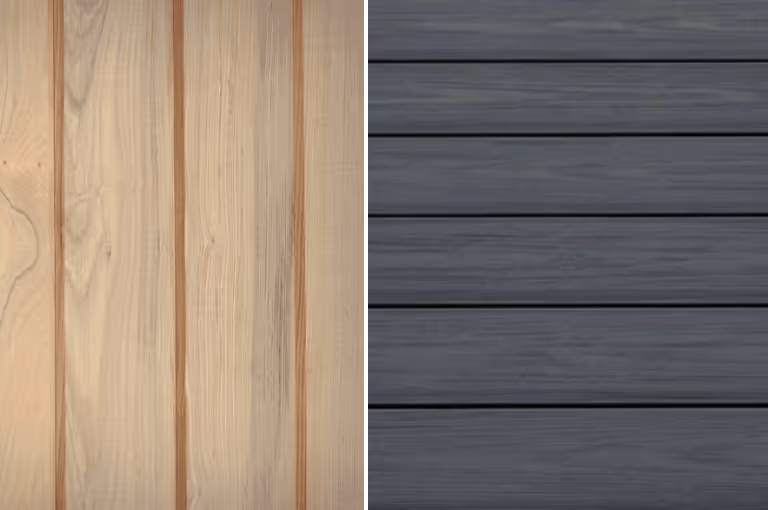
The choice of façade covering for a house is often a difficult one, both for appearance and for performance and durability. Two main options are open to you: natural wood cladding, authentic and warm, or composite cladding, modern and free of constraints. Each solution has its advantages and its limits.
In this article, WoodPartners offers you a complete comparison to help you make the right choice between wooden cladding and composite wood cladding, according to your needs.
In brief: what to remember
-
🏆 Overall winner: composite cladding, thanks to its strength, its long life without maintenance, how easy it is to look after and its suitability for every climate. It is the most practical and durable choice in the majority of cases.
-
Composite cladding stands out particularly for how simple it is to maintain (no treatment required), its great resistance to the weather and to extreme climates, and its stability over time. It also performs better in terms of fire resistance and proves more cost-effective in the long term thanks to the absence of maintenance costs.
-
Wooden cladding, for its part, keeps the advantage in terms of appearance, with a warm and authentic result that is hard to match. It is also more environmentally friendly, being biodegradable and able to store CO₂. It can offer superior durability provided it is well maintained, and generally remains more affordable to buy than composite.
Wooden or composite cladding: summary table
Here is a summary table comparing natural wooden cladding and composite wood cladding, according to the essential criteria.
|
Criteria |
Natural wooden cladding |
Composite cladding |
|---|---|---|
|
Appearance |
Natural, warm, unique |
Uniform, varied choice of colours, realistic |
|
Maintenance |
Regular (every 2-3 years) |
Minimal (cleaning with water) |
|
Durability |
30-50 years with maintenance |
25-30 years without maintenance |
|
Initial cost |
30-90 €/m² |
50-120 €/m² |
|
Installation |
Fairly simple to lay; visible or hidden fixings on a timber framework |
More technical installation; hidden clips, careful management of expansion |
|
Long-term maintenance cost |
High |
Very low |
|
Resistance to the weather |
Sensitive (distortion, rot) |
Very resistant, dimensionally stable |
|
Environmental impact |
Biodegradable, stores CO₂ |
Sometimes recycled, not biodegradable |
|
Suitability for climates |
Less suited to extreme climates |
Suits every type of climate |
|
Fire resistance |
Flammable (treatment required) |
Self-extinguishing, better resistance classes |
|
Thermal performance |
Good natural insulation (especially in solid wood or Douglas fir) |
Varies according to the product; often slightly less insulating than wood |
|
Possibility of repair |
Easy to repair or replace (standard wood available) |
More complex to repair (specific material, replacement of whole panels) |
Wooden cladding: advantages and disadvantages
Wooden cladding appeals above all through its natural, warm appearance. Every board of wood is unique, which gives the façade an authentic character that is hard to reproduce. Wood is also an environmentally friendly material, renewable and able to store carbon, which makes it a choice that respects the environment. Well maintained, it can offer a remarkable service life, of up to 50 years for some wood species. You can adjust the thickness of the wooden cladding according to your needs.
This charm comes at a price, however: wood needs regular maintenance, with woodstains or saturators applied every two to three years to preserve its appearance and its durability. It is also more vulnerable to extreme weather conditions, and can distort or deteriorate under the effect of moisture, frost or UV. Flammable by nature, it needs specific treatments to meet fire safety standards. Finally, while the initial cost is often reasonable, the long-term maintenance cost can prove considerable.
Composite cladding: advantages and disadvantages
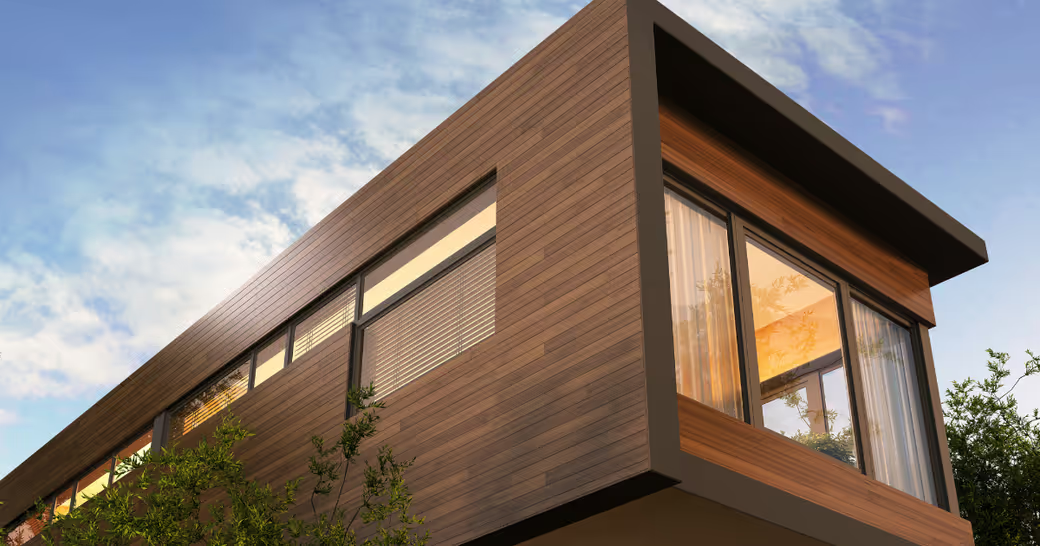
Composite cladding stands out for how easy it is to maintain: a simple clean with water is enough to restore its shine, with no treatment or specific protection. It offers excellent resistance to the weather, to UV, to impact and to temperature variations, which makes it a material particularly well suited to extreme climates. On the safety side, some models have very good fire resistance performance, with a self-extinguishing capability. Finally, composite cladding faithfully reproduces the look of wood, with a consistent and realistic result, without the defects linked to natural variations.
Despite these qualities, composite cladding remains visually less authentic than natural wood, which can be a drawback for those looking for a traditional, living appearance. It is also not biodegradable, even though some manufacturers incorporate recycled materials into their composition. Finally, its purchase cost per m² is generally higher than that of wood, which can represent a larger initial investment.
One form, several offers.
- Two minutes, no account
- Direct, no middleman
- Your identity stays private
The opinion of Yves, wood expert at WoodPartners
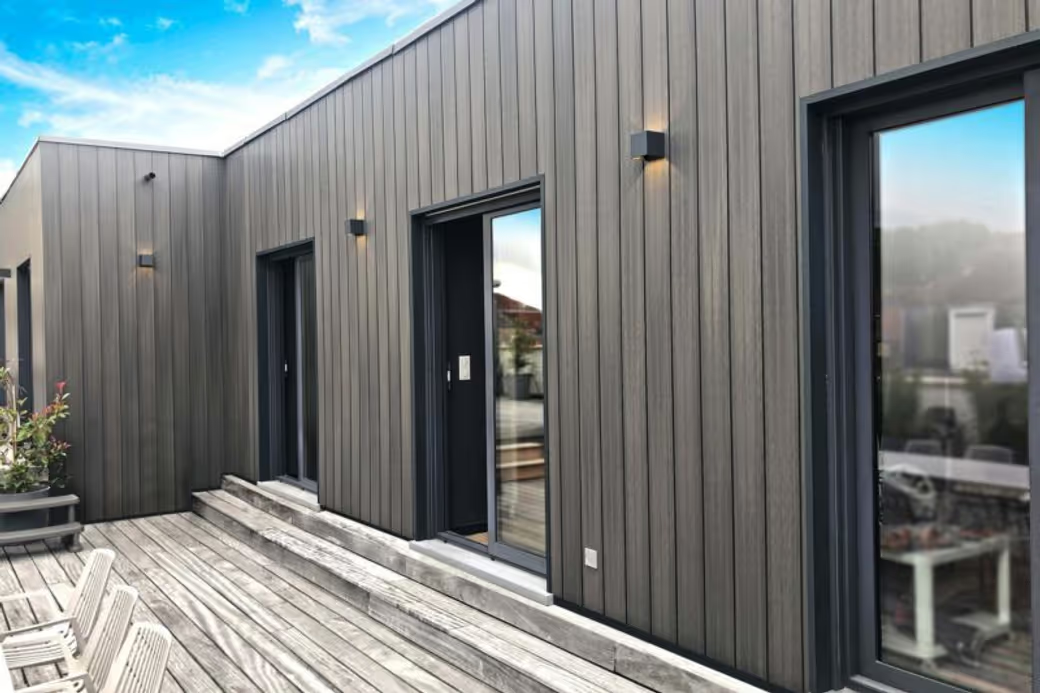
At WoodPartners, we have a particular affection for wooden cladding, an authentic, noble and living material, which passes through time with elegance. It is a choice of the heart for those looking for character and a real natural presence on the façade of a home. Open-jointed cladding on a renovated house gives an elegant look that we particularly appreciate.
But if we have to make the most objective choice, taking every parameter into account, then composite wins on overall performance by meeting almost every criterion: very high quality, more stable, more durable with no maintenance, and perfectly suited to modern, durable façade projects.
FAQ: frequently asked questions
Is the installation process the same for both types of cladding?
The general installation principle is similar: both types of cladding are laid on a framework with a ventilated air gap behind. The technical details differ, however: wood can be nailed or screwed, with visible or hidden fixings, whereas composite often requires specific fixing clips and precise management of expansion gaps. Composite cladding therefore calls for a slightly more technical and rigorous installation.
Does a breather membrane need to go under both types of cladding?
Yes, a breather membrane is indispensable under cladding, whether in wood or in composite. It protects the structure of the wall against water infiltration while allowing water vapour to escape.
Which cladding lasts the longest?
Wood can last longer (up to 50 years) than composite wood, but only with rigorous maintenance. Composite wood cladding lasts 25 to 30 years with no maintenance.
Which cladding is the most economical?
To buy, wooden cladding can be cheaper. In the long term, however, composite wood cladding becomes more cost-effective thanks to its absence of maintenance.
Is composite wood cladding environmentally friendly?
That depends on its composition. Some contain recycled fibres. Unlike wood, however, it is not biodegradable.