
Maintaining wooden cladding involves cleaning and treating the cladding regularly to preserve the integrity of the wood, maintain its appearance, and extend its lifespan. As it is a living material, wood reacts to UV rays, humidity, and pollution, which degrade the cladding of a façade.
Without proper maintenance, wooden cladding ages prematurely, and this can be costly to fix if it needs to be repaired, renovated, or replaced. Want to know how to maintain wooden cladding so it stays attractive and lasts as long as possible? WoodPartners details best practices and each maintenance step: choosing the product, treatment, cleaning, and specifics depending on wood species.
Wooden cladding maintenance at a glance
-
Unmaintained wood cladding turns grey, cracks, and can structurally deteriorate within a few years.
-
Maintenance takes place in 4 key steps: cleaning, de-greying, curative treatment if necessary, then application of a finish (saturator, stain, oil, or paint).
-
The saturator is the most suitable product for most wood claddings, because it never flakes and does not require sanding during touch-ups.
-
De-greying wood that has darkened or greyed is simple with a chemical de-greying agent: the wood returns to its original shade in under 30 minutes.
-
Maintenance frequency varies depending on exposure : a South-West-facing façade needs a touch-up twice as often as a North-facing façade.
Why is maintaining wood cladding essential?
Maintaining wood cladding is essential because, without preventive protection, this natural material may turn grey, crack, get damaged by moisture, and be attacked by fungi or wood-boring insects. Maintaining wood cladding means preventing the risks of deterioration it may be exposed to :
-
UV radiation : ultraviolet rays destroy lignin, the natural polymer that binds wood fibers together. This process causes greying, visible on all wood claddings left unprotected. This greying is not only aesthetic; it weakens the board.
-
Moisture and hygrometric cycles : wood absorbs rainwater, then dries quickly in the sun. These alternations generate internal stresses that cause cracks and splitting. Water then seeps into the cracks, promoting rot and mold growth.
-
Air pollution and micro-organisms : darkened wood cladding is often the result of an accumulation of fine particles and the development of surface fungi or bacteria. In cities as well as in the countryside, this colonization progresses as soon as the wood is no longer protected.
Regular care helps extend its lifespan and avoid complex and costly renovations. Preventive maintenance costs on average 60 to 70% less than major renovation.
What are the signs of wear on wood cladding?
Before deciding what type of maintenance to apply, you need to diagnose the different signs of wear on wood cladding :
-
Uniform greying : this is a sign that the finish is exhausted and the surface lignin is degrading. The wood is still sound, and de-greying is enough before re-protecting.
-
Darkened or stained boards : this is a sign of fungal colonization or pollution buildup. A thorough cleaning and a biocide treatment are required.
-
Longitudinal cracks : this is often the result of climate variation (freeze/thaw cycles, alternating humidity/drying) that causes physical damage. If they are superficial, a saturation touch-up is sufficient. If the cracks are deep, the affected boards must be replaced.
-
Flaking of the finish : this is the characteristic sign of a stain or paint at end of life. The finish no longer acts as a barrier against water and moisture, so mechanical stripping is necessary before applying a new finish.
|
Good to know To quickly test the condition of your cladding, pour a few drops of water on the boards. If the water beads up: your finish is still active. If it spreads and soaks in: it’s time to act. |
What are the maintenance solutions for wood cladding ?
There are many maintenance solutions to preserve or restore wood cladding :
-
Cleaning
-
Curative treatments
-
De-greying the wood
-
Protective finishes
Cleaning wood cladding
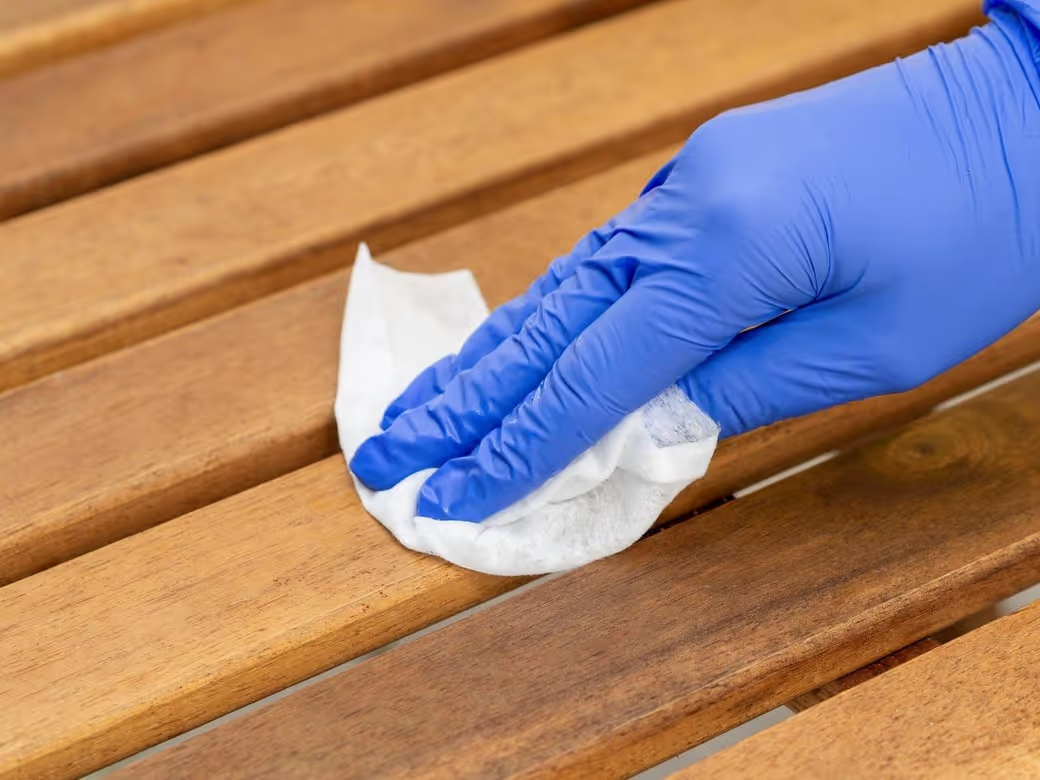
Cleaning wood cladding consists of mechanically and chemically removing pollutants, organic deposits, and micro-organisms present on the surface, without damaging the wood fibers. It is the essential preliminary step before any treatment or finish touch-up, because applying a saturator on dirty cladding is like painting on dust.
Step-by-step cleaning method :
-
Dry dusting : start by brushing the boards using a soft-bristle brush to remove non-adherent dirt, spider webs, and dried vegetation.
-
Applying the concentrated cleaner : dilute a concentrated cleaner or black soap (SN800) according to the manufacturer’s instructions. Apply with a brush or roller, working in shaded areas to prevent the product from drying before it acts.
-
Contact time : leave for 15 to 30 minutes. The surface must remain damp. Never let the product dry on the wood.
-
Brushing and rinsing : scrub with a nylon brush in the direction of the grain, then rinse thoroughly with clean water.
|
⚠️ WoodPartners warning Cleaning with a pressure washer is a risky operation on wood cladding. Above 50 bar or with a nozzle too close (less than 40 cm), you risk "defibering" the boards, meaning the soft fibers may be torn out, creating a porous and rough surface that increases exposure area to mold. If you use a Karcher, always choose a fan jet (never rotary), a pressure below 40 bar, and always move in the direction of the grain. |
Curative treatments
Curative treatments aim to treat wood already attacked by pests or micro-organisms. They involve applying specific chemical or natural products to eradicate these threats before applying a finish :
-
Fungicidal action : applying fungicidal products eradicates moss, fungi, and greenish traces that proliferate due to moisture. It is often recommended to rinse the wood thoroughly with clean water after applying this type of product.
-
Insecticidal action : used to eliminate wood-boring insects (such as termites or woodworm) that drill holes and destroy wood fibers. There are highly concentrated insecticides specifically dedicated to this curative action.
De-greying the wood
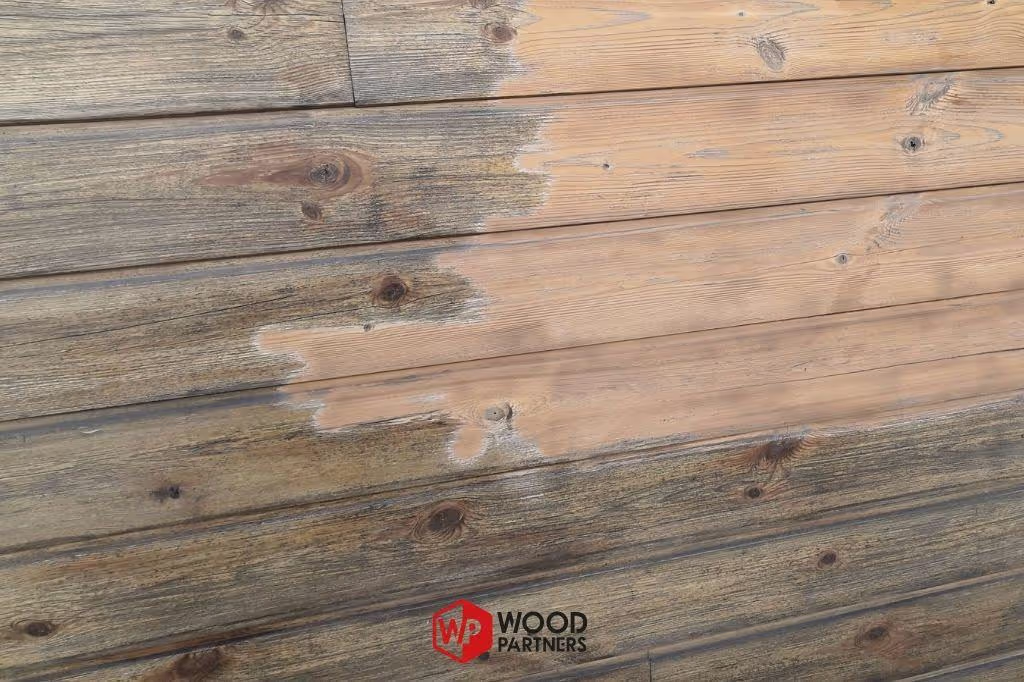
De-greying wood consists of applying a slightly acidic chemical product that dissolves oxidized lignin cells and neutralizes deposits of microscopic fungi responsible for greying. De-greying revives and restores the original natural color of wood that has greyedor dulled under prolonged exposure to UV rays and weathering.
The chemical action of a de-greying agent plays no protective role for the wood and requires subsequent application of a protective finish, such as a saturator
De-greying protocol :
-
Wet the cladding with clean waterto open the wood pores and promote penetration of the de-greying agent.
-
Apply the de-greying agent generously with a rolleror brush, covering the entire surface.
-
Leave for 15 to 20 minutes. You will observe the color change in real time: the wood warms up and regains its natural pigments.
-
Brush with a nylon brushfocusing on the most marked areas.
-
Rinse thoroughly with clean water and let dry completely before applying a finish (at least 48 to 72 hours depending on weather conditions).
One form, several offers.
- Two minutes, no account
- Direct, no middleman
- Your identity stays private
Protective finishes
A finish is applied to provide long-lasting protection for wood cladding against climatic aggressions in order to limit the natural degradation of the material, avoid splitting, and prevent greying.
Protective finishes are divided into:
-
Those that impregnate the wood deeply
-
Those that are film-forming, i.e., they create a protective film on the surface.
The saturator: the reference finish
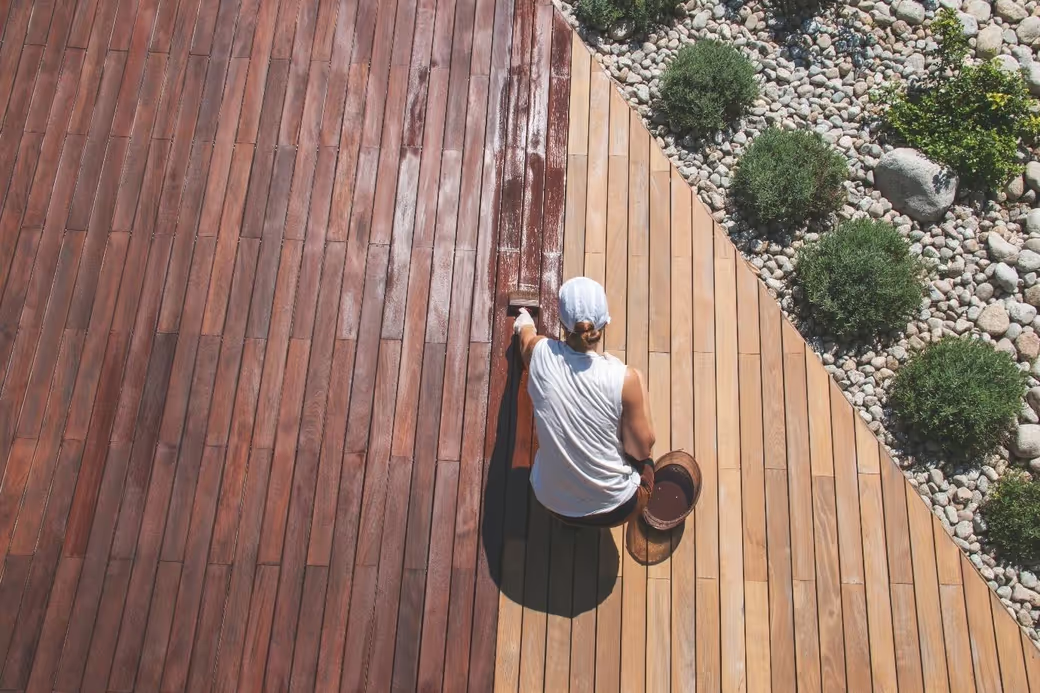
Wood saturatoris a fluid product based on natural oils or synthetic resins that penetrate into the heart of the wood fibers to nourish it, without creating a surface film. That is, it protects the wood from weather and UV by saturating the fibers.
This is the product WoodPartners primarily recommends for the vast majority of claddings, because it never flakes, and a simple cleaning is sufficient before applying a new coat, with no prior sanding.
There are different types of saturators :
-
Solvent-based : excellent penetration into dense woods, amber finish, ideal for Douglas fir and Larch.
-
Water-based : more eco-friendly, fast drying, very natural matte finish. Recommended for exposed areas.
-
Tinted saturators : pigments act as physical UV filters, providing enhanced protection on façades with high sun exposure.
It is recommended to apply a saturator every 2 to 5 years depending on cladding exposure.
Oil: natural elegance for noble species
Cladding oil works on the same impregnation principle as a saturator, but it is particularly prized for exotic woods (Ipe, Teak) and noble species such as Red Cedar, providing a matte, oiled look. It requires more frequent renewal (every 1 to 2 years).
Stains: the film-forming barrier for harsh climates
Stains are film-forming products that form a thin and flexible film on the wood surface, offering a waterproof protection to the cladding. It is particularly suitable for seaside or high-altitude façades and its protection is long-lasting (3 to 8 years on average)
However, their maintenance is more demanding because when this film eventually starts to crack, moisture infiltrates and becomes trapped behind the residual layer. Then sanding or stripping of the old layer is required before any new application.
Opaque paint: maximum durability
Opaque paint is a fully covering film-forming solution that offers the longest durability against weathering, reaching 10 to 15 years. Maintaining painted wood cladding is limited to gentle cleaning as long as the paint holds, but requires chemical stripping or heavy mechanical stripping as soon as signs of flaking appear. It is the least constraining finish day-to-day, but the most demanding to renovate.
Comparison table of finishes for wood cladding
|
Product |
Type |
Durability |
Maintenance |
Visual finish |
|
Saturator |
Impregnation |
2–5 years |
Low |
Natural, matte |
|
Stain |
Film-forming |
3–8 years |
Medium (sanding) |
Satin, visible grain |
|
Opaque paint |
Film-forming |
10–15 years |
High (stripping) |
Solid color, opaque |
|
Oil |
Impregnation |
1–3 years |
Low |
Matte, amber |
How to apply the finish to wood cladding ?
Whatever product you choose, conditions and application quality determine the durability of the protection. Indeed, the lifespan of wood cladding can reach 30 to 80 years depending on the species and the quality of installation :
Environmental conditions :
-
Wood moisture: it must be below 18% because wood that is too moist traps water under the finish, causing premature blistering and peeling.
-
Temperature: it must be between 8°C and 25°C. Avoid direct sunlight (which evaporates solvents too quickly) and strong winds.
-
Weather: no rain in the 24 to 48 hours following application. Check the 3-day forecast before starting.
The "wet-on-wet" application technique :
For saturators, WoodPartners systematically recommends applying two coats "wet-on-wet":
-
Apply the first coat, wait 15 to 30 minutes (until the glossy appearance disappears)
-
Apply the second coatbefore the first is completely dry. This technique ensures maximum penetration of protective agents into the wood fibers.
|
Good to know The best period to treat wood cladding is spring (April–May) or early autumn (September). In midsummer, heat evaporates solvents too quickly and prevents good penetration. In winter, wood is often too damp and temperatures are insufficient for proper curing of the finish. |

What are the maintenance needs of cladding by wood species ?
Maintenance needs for wood cladding vary directly depending on the species used, because each wood has its own density, hygroscopy, and natural resistance. Maintaining cladding by species means adapting the right product, the right frequency, and the right technique to each type of wood.
-
Softwoods (Fir, Pine, Spruce) : These woods require more regular maintenance than harder species; however, they are more sensitive. When cleaning the façade, using a pressure washer is strongly discouraged because, as these woods are soft, the jet power may damage their fibers.
-
Naturally durable woods (Douglas, Larch, Red Cedar) : these are noble and very resistant woods whose maintenance frequency is lower than for soft softwoods. However, this natural durability does not prevent them from greying, developing bacteria, or dulling under the effects of UV and rain, just like other species. A spring de-greying followed by saturation will restore all the shine to Larch or Douglas.
-
Exotic woods (Ipe, Teak) : these species are considered rot-proof (they do not rot) and are extremely resistant to aggressions. Nevertheless, they are not immune to greying, pollution, or the appearance of fungi. Applying a protective finish, such as a saturator specifically for exotic woods, is always preferable. Unlike soft softwoods, exotic woods such as Ipe or Teak, are hard enough to withstand pressure washing, provided a safety distance of at least 40 cm is maintained from the surface.
-
Charred wood (Shou Sugi Ban) : charred wood is an ancestral technique consisting of deeply burning the surface of boards (generally cedar originally) to create a thick layer of carbon that naturally protects the wood against insects and UV. Maintenance consists of applying a specific oil every 2 to 4 years to prevent the carbonized layer from crumbling under the action of weathering.
Table: maintenance by wood cladding species
|
Species |
Recommended finish type |
Maintenance frequency |
Specificity |
|
Douglas |
Tinted saturator |
Every 2–3 years |
Heterogeneous greying, resin bleed |
|
Larch |
Saturator or stain |
Every 3–5 years |
Silver patina appreciated if left unfinished |
|
Red Cedar |
Oil or clear saturator |
Every 1–2 years |
Soft wood, no mechanical aggression |
|
Treated pine |
Stain or saturator |
Every 2–3 years |
Monitor knots and cut ends |
|
THT / Charred wood |
Specific oil |
Every 2–4 years |
More fragile surface fibers |
You now have all the elements you need to maintain your wood cladding effectively, whatever the species or the condition of your façade. Each step—cleaning, de-greying, treatment, and finishing—has its importance and its logic in the durability of the work.
If you want to go further and benefit from personalized advice, WoodPartners, the digital wood platform, connects you in just a few clicks with professionals in the sector. Whether you are at the diagnostic stage or about to start a full renovation, they are there to guide you toward the products and solutions best suited to your situation.