
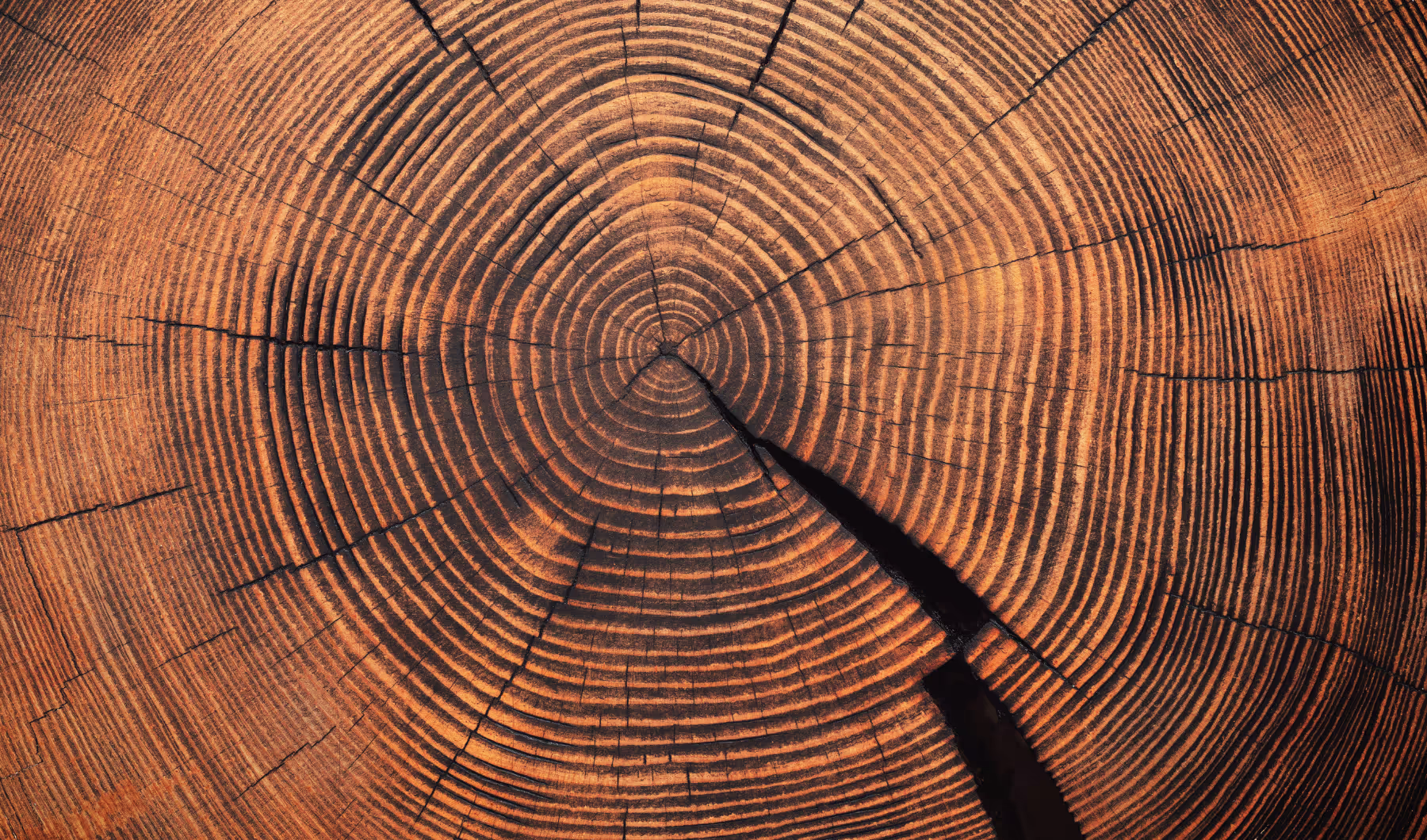
Ipe wood is an exotic wood recognised in the world of construction for its strength. This wood species is widely used for outdoor applications thanks to its high resistance to external attack. Ipe can also be used for interior fitting-out thanks to its visual appeal and its durability.
To tell you everything about Ipe, we will answer the following questions in this guide:
- What is Ipe wood?
-
What are the characteristics of Ipe?
-
Ipe: what is it used for?
-
How do you maintain Ipe wood?
-
How can the Ipe wood species be made to last?
-
Other questions about Ipe wood
What is Ipe wood?
Ipe wood is an exotic wood species that has its origins in South America.
Ipe is found mainly in tropical regions such as Brazil and takes different names according to its country of origin.
In Brazil : Ipé, Ipé Roxo, Pau d’arco;
In Argentina : Lapacho;
In Colombia : Canaguate, Polivillo, Roble Morado;
In Bolivia : Ipé, Lapacho, Tajibo;
In French Guiana : Green ebony;
In Guyana : Hakia, Ironwood;
In Peru : Ebano verde, Tahuari;
In Venezuela : Acapro, Araguaney, Puy;
In Paraguay : Lapacho Negro;
In Trinidad and Tobago : Puy, Yellow Poui.
Ipe comes from several species of the Tabebuia genus and is renowned for its durability, which can exceed 25 years, without requiring any particular treatment (no need for pressure treatment). This exotic wood species is also recognised for its natural resistance to insects, mould and rot.
What is more, Ipe wood has a distinctive shade ranging from olive brown to reddish brown. Over time, Ipe tends to develop a silvery patina that gives it extra, natural charm for outdoor applications.

What are the characteristics of Ipe wood?
Ipe is a type of wood with varied characteristics, generally classed in the hardwood category. Hardwoods are characterised by their high density, their strength and their remarkable durability.
Description of Ipe
- Colour of Ipe wood : brown with little colour variation;
-
Sapwood : clearly distinct;
-
Grain of Ipe : fine, or even medium for some species;
-
Grain direction : interlocked;
-
Interlocked grain : pronounced.
Description of the Ipe log
- Diameter of the tree : between 50 and 100 cm;
-
Thickness of the sapwood : between 3 and 9 cm;
-
Buoyancy : does not float;
-
Preservation in the forest : good.
The physical properties of Ipe
-
Density of Ipe wood : greater than 1000 kg/m3;
-
Hardness : 14.6;
-
Volumetric shrinkage coefficient : 0.68%;
-
Total tangential shrinkage : 6.4%;
-
Total radial shrinkage : 5.1%;
-
Ratio between TS and RS : 1.3;
-
Fibre saturation point : 20%;
-
Stability in service : moderately stable.
The natural durability and treatability of Ipe wood
- Service life : between 25 and 40 years;
-
Resistance to fungi : class 1 – very durable;
-
Resistance to dry wood insects : durable – distinct sapwood, so limited risk;
-
Resistance to termites : class D – durable;
-
Treatability of Ipe : class 4 – not treatable;
-
Use class of Ipe wood : use class 4 and 5; it can be used in direct contact with fresh, salt or chlorinated water.
Drying Ipe
The most recommended way of drying Ipe is slow kiln drying, because it reduces the defects that can be present in the wood. What is more, the use of KD Ipe is recommended when building a wooden deck. The mention KD means that the wood has been dried in a kiln. As a result, KD Ipe wood has a very low moisture content, increasing its stability.
-
Drying speed : slow;
-
Risk of distortion : low;
-
Risk of case-hardening : none;
-
Risk of checks : low;
-
Risk of collapse : none.
Sawing and machining Ipe wood
Sawing and machining Ipe wood can generate dust and cause skin conditions. Care must therefore be taken.
-
Blunting effect : fairly considerable;
-
Sawing teeth : stellite-tipped teeth;
-
Machining tools : tungsten carbide;
-
Suitability for peeling : not recommended, as it serves no purpose;
-
Suitability for slicing : good.
Assembling Ipe
For the assembly of Ipe, we proceed in two steps:
- Nailing and screwing : good holding, pre-drilling is required;
-
Gluing : satisfactory indoors; this step requires particular care because of the high density of Ipe wood.

One form, several offers.
- Two minutes, no account
- Direct, no middleman
- Your identity stays private
Ipe: what is it used for?
Ipe is widely used in the construction industry, particularly for outdoor applications such as Ipe wood decks, pergolas, bridges, boat building, the external cladding of a house, fences and garden furniture.
Its class 4 and its natural resistance to the weather make it very popular for this type of use. It effectively withstands the damage that can be caused by constant exposure to the sun, the rain or the wind.
What is more, its durability and its natural appearance give it major assets for building fences or for cladding your house, for example.
The high density of Ipe wood makes it resistant to distortion and cracking, ensuring a solid structure. That is why it is used in boat building and the making of bridges.
Ipe wood can, however, also be used indoors for flooring or staircases, for example. Its visual appeal and its durability make this exotic wood an essential in the construction field.
How do you maintain Ipe wood?
Ipe wood can be maintained through various processes such as regular cleaning, periodic sealing, the choice of gentle products and the repair of scratches. If the maintenance is right, Ipe can see its service life extended beyond 25 years. No antifungal treatment is needed because of its natural resistance to insects and fungi.
Let us come back to the maintenance advice for Ipe:
- Regular cleaning : It is recommended that Ipe surfaces be cleaned regularly to remove dirt, debris and any growth of mould. A simple wash with soapy water can be enough.
- Periodic sealing : Regularly applying a sealer specific to outdoor wood can help to anticipate the greying of the wood and to maintain its original colour.
-
Choosing to avoid harsh chemical products : When cleaning Ipe wood, it is better to avoid using harsh chemical products that could damage the surface of the wood.
-
Repairing scratches and chips : It is recommended that any chips or scratches be repaired quickly to avoid further deterioration.

How can the Ipe wood species be made to last in the forests?
To make the Ipe wood species last, several sustainable harvesting practices are put in place, such as responsible forest management, selective felling, rotation of felling, respect for protected areas, sustainability certifications, supply chain monitoring, and research and innovation. Through these practices, the Ipe wood industry aims to promote responsible forest management.
Let us come back to these sustainable practices:
- Responsible forest management : Ipe harvesting practices are often guided by sustainable forest management plans. This involves the use of techniques that maintain the ecological balance of the forests. Particular attention is paid to the harvesting rate, for example, which must not exceed the natural regeneration capacity.
-
Selective felling : Rather than clear felling, selective felling is recommended. As a result, instead of felling every tree, only those that are mature and ready to be harvested are cut. This makes it possible to preserve the young trees and to ensure regeneration.
-
Rotation of felling : Putting in place harvesting cycles with suitable rotations helps to maintain the health of the forest. Areas that have been harvested are then left to rest for a defined period to allow natural regeneration.
-
Respect for protected areas : Areas considered ecologically sensitive, such as the habitats of threatened species or conservation areas, are avoided when harvesting Ipe wood. This approach is paramount to preserving biodiversity as well as fragile ecosystems.
-
Sustainability certifications : Some Ipe suppliers undertake to comply with recognised sustainability standards, such as those established by the Forest Stewardship Council (FSC). Forest products carrying FSC certification come from forests whose management is judged responsible.
-
Supply chain monitoring : Serious monitoring of the supply chain can be put in place in order to make sure that the Ipe wood comes from sustainable and legal sources. This most often includes traceability from the place of harvest through to the finished product.
-
Research and innovation : Continuing research efforts aim to find methods of harvesting and processing Ipe that would reduce the impact on forest ecosystems as far as possible.

Other questions about Ipe wood
What is the price of Ipe?
The price of Ipe is around 150 euros per m². It will, however, need fairly simple maintenance and no additional treatment.
What is the natural colour of Ipe wood?
The natural colour of Ipe wood is brown. It will nevertheless naturally take on a greyish shade over time because of external attack.