

Red cedar, also called red cedar or western red cedar, originates from the United States and Canada. It is mainly used in construction because of its aesthetic qualities and its natural durability.
Would you like to learn more about red cedar? WoodPartners explains everything you need to know about red cedar:
- What is red cedar?
- What are the characteristics of red cedar?
- Cedar wood: what is it used for?
- How do you maintain red cedar wood?
- Other questions about western red cedar
What is red cedar?
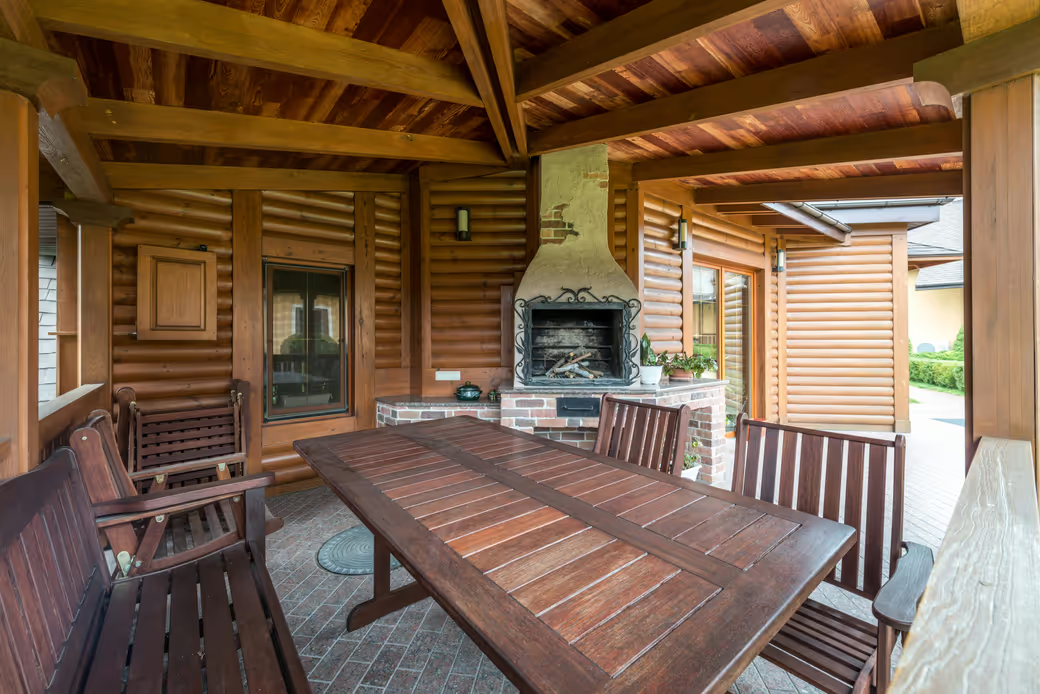
Red cedar belongs to the Cupressaceae family; its scientific name is Thuja plicata. Native to the west coast of the United States, like Douglas fir, and to Canada, it is also found in Great Britain and New Zealand.
Red cedar is known for its delicate and distinctive scent, which acts as a traditional, natural moth repellent. What is more, its many qualities, such as its appearance and its natural durability, make cedar wood an asset in construction.
Finally, different names are used for it depending on the country:
- Germany: Riesenlebensbaum;
- France : Cèdre rouge d'Amérique;
- Spain : Cedro Canadiense;
- United States : Western red cedar.
What are the characteristics of red cedar?
Red cedar is a type of wood renowned in Canada for its beauty and its durability. Its reddish-brown colour catches the eye and makes exceptional buildings possible.
Description of red cedar
- Colour : reddish brown;
- Sapwood (the soft, light-coloured part of the wood that forms each year under the bark): clearly distinct;
- Grain : medium;
- Grain direction or fibre orientation : straight;
- Interlocked grain or direction contrary to the axis : absent.
Description of the cedar wood log
- Diameter : between 50 and 120 cm;
- Thickness of the sapwood : between 2 and 4 cm;
- Preservation in the forest : good.
The physical properties of cedar
- Density (at 12% moisture content with 1 MPa = 1 N/mm²): 0.38;
- Hardness (at 12% moisture content with 1 MPa = 1 N/mm²): 1.1;
- Volumetric shrinkage coefficient : 0.29%;
- Total tangential shrinkage (TS): 5.5%;
- Total radial shrinkage (RS): 2.2%;
- Ratio between TS and RS : 2.5;
- Fibre saturation point : 24%;
- Stability in service : moderately stable to stable.
The natural durability and treatability of red cedar
- Resistance to fungi: class 2, durable;
- Resistance to dry wood insects : durable;
- Resistance to termites : class S, susceptible;
- Treatability : class 3-4, poorly treatable or not treatable;
- Use class: class 3, for indoor and outdoor use, out of contact with the ground.
Drying red cedar
- Drying speed: normal;
- Risk of distortion : absent or very low;
- Risk of case-hardening (accidental hardening): none;
- Risk of checks (splits): low;
- Risk of collapse (waviness, separation of the wood): present.
Sawing and machining red cedar wood
- Blunting effect: normal;
- Sawing teeth : stellite-tipped teeth;
- Machining tools : ordinary;
- Suitability for peeling : good;
- Suitability for slicing : good.
Assembling western red cedar
For the assembly of red cedar or western red cedar, two steps are important:
- Nailing and screwing: poor holding; pre-drilling is essential and we advise you to use stainless steel screws because of the acidity of the wood .
- Gluing : satisfactory.

One form, several offers.
- Two minutes, no account
- Direct, no middleman
- Your identity stays private
Cedar wood: what is it used for?
Cedar wood has characteristics that are of great interest to the construction field. With its reddish-brown colour and a natural durability of class 3, red cedar lends itself to a variety of uses, indoors as well as outdoors.
- External cladding: western red cedar has a natural ability to fight insects and mould thanks to its distinctive scent. A natural moth repellent with good durability, it is ideal for the cladding of your house.
- Interior and exterior joinery: durable and good-looking, red cedar is a lightweight wood with good dimensional stability and can therefore easily be used in joinery.
- Mouldings: attractive and soft, cedar is perfectly suited to mouldings.
- Musical instruments: western red cedar has interesting acoustic qualities; it limits the transfer of vibrations and is therefore an asset in the making of musical instruments.
How do you maintain red cedar wood?
Red cedar wood requires no particular treatment, so there is no need to give it a pressure treatment since it already has very satisfactory natural durability. That said, you can still apply a finish such as a saturator to your red cedar in order to preserve the beauty and durability of your wood properly.
Like many species, western red cedar will turn grey over time if you do not apply a saturator. In that case, you can use a wood brightener to restore its natural shade easily.

Other questions about western red cedar
What is the price of cedar wood?
The price of cedar wood will vary according to the intended use and the supplier chosen. However, for quality red cedar cladding, you should expect to pay around 100 euros per m2.
How does red cedar age?
Like all woods, red cedar tends to turn grey over time, unless you apply a saturator beforehand to protect it. Nevertheless, you can easily bring back the original colour of your red cedar by applying a wood brightener.
Red cedar is a wood of incomparable nobility, much sought after in the construction field for making cladding, for example. You now know everything about red cedar thanks to WoodPartners.