
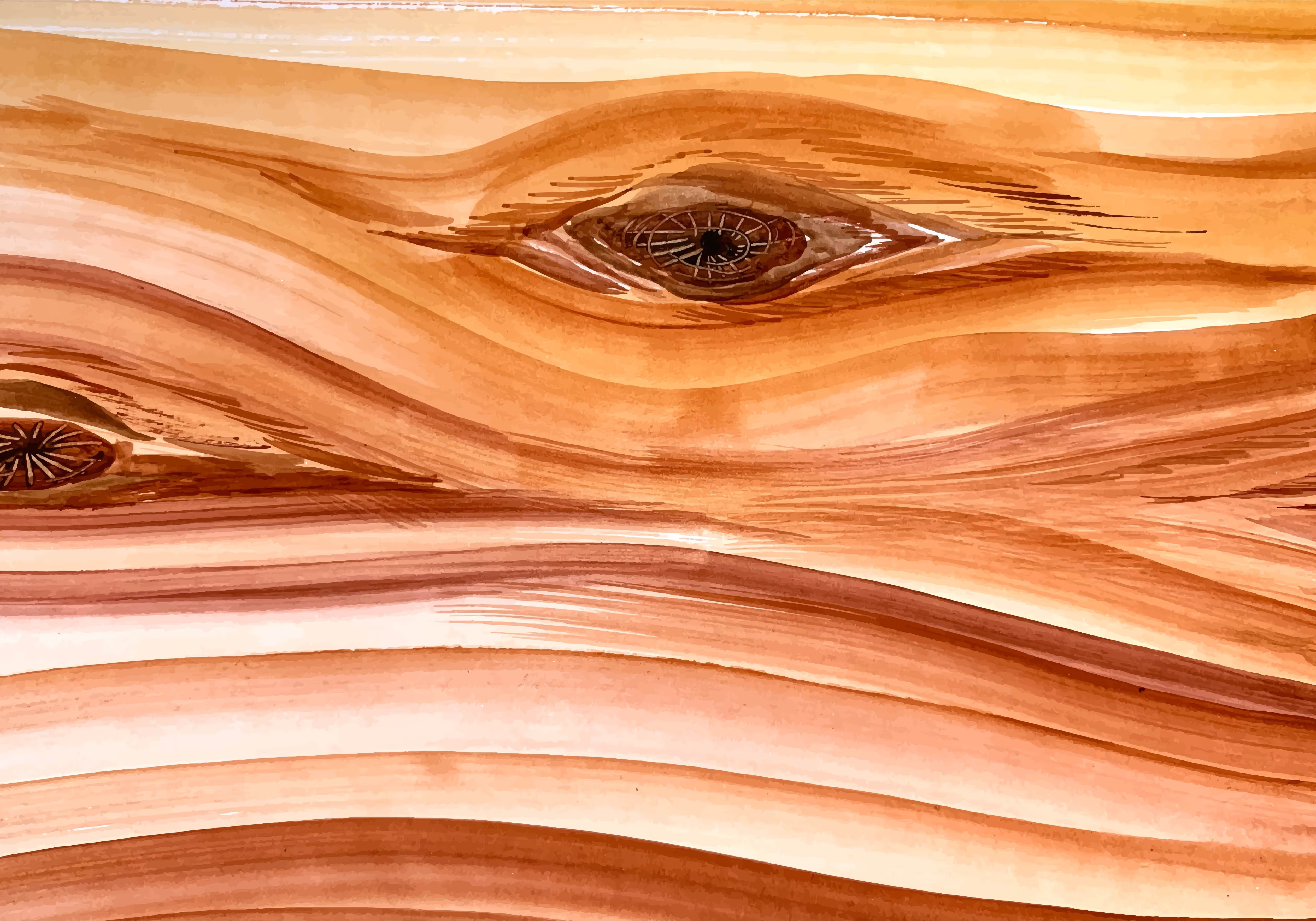
Merbau is an exotic species native to Asia and Oceania. This durable, heavy and hard wood is often used in projects requiring hard-wearing materials, such as sleepers or hydraulic works.
Would you like to learn more about merbau? WoodPartners explains everything you need to know about merbau wood:
- What is merbau wood?
- What are the characteristics of merbau?
- Merbau wood species: what is it used for?
- How do you maintain exotic merbau wood?
- Other questions about merbau

What is merbau wood?
Merbau wood is from the Fabaceae-Caesalpinioideae family and has several scientific names: Intsia bijuga, Afzelia bijuga, Intsia palembanica. Native to Asia and Oceania, it is found in various countries such as Malaysia, Australia, the Philippines and Indonesia.
Merbau exotic wood is durable, hard and heavy, which makes it a versatile species for various uses such as interior or exterior joinery, hydraulic works or the making of sleepers.
Finally, different names are used for merbau depending on the country:
- Australia: Kwilau;
- Fiji : Vesi;
- Madagascar : Hintsy;
- Malaysia : Merbau, Mirabow;
- Papua New Guinea : Kwila;
- Philippines : Ipil Laut, Ipil;
- Vietnam : Gonuoc;
- China : Kalabau;
- Indonesia : Merbau;
- New Caledonia : Kohu;
- Thailand : Lum-Paw.

What are the characteristics of merbau?
Merbau has various characteristics of interest, such as its orange-brown to reddish-brown colouring, its clearly distinct sapwood which increases resistance to wood insects, and good durability.
Description of merbau wood
- Colour of merbau : orange brown to reddish brown;
- Sapwood (the soft, light-coloured part of the wood that forms each year under the bark): clearly distinct;
- Grain : coarse, like ash;
- Grain direction or fibre orientation : straight or interlocked;
- Interlocked grain or direction contrary to the axis : slight.
Description of the merbau log
- Diameter : between 60 and 120 cm;
- Thickness of the sapwood : between 5 and 8 cm.
The physical properties of merbau wood
- Density (at 12% moisture content with 1 MPa = 1 N/mm²): 0.83;
- Hardness (at 12% moisture content with 1 MPa = 1 N/mm²): 8.8;
- Volumetric shrinkage coefficient : 0.39%;
- Total tangential shrinkage (TS): 4.4%;
- Total radial shrinkage (RS): 2.7%;
- Ratio between TS and RS : 1.6;
- Fibre saturation point : 24%;
- Stability in service : stable.
The natural durability and treatability of merbau
- Resistance to fungi: class 1-2, very durable to durable;
- Resistance to dry wood insects : durable;
- Resistance to termites : class M, moderately durable;
- Treatability : class 4, not treatable;
- Use class: class 4, for use in contact with the ground or with fresh water.
Drying exotic merbau wood
- Drying speed: slow;
- Risk of distortion : low;
- Risk of case-hardening (accidental hardening): absent;
- Risk of checks (splits): low;
- Risk of collapse (waviness, separation of the wood): absent.
Sawing and machining the merbau wood species
- Blunting effect: fairly considerable;
- Sawing teeth : stellite-tipped teeth;
- Machining tools : tungsten carbide;
- Suitability for slicing : good.
Assembling merbau
For the assembly of merbau, two steps are important:
- Nailing and screwing: good holding, with pre-drilling required, otherwise there is a risk of splitting;
- Gluing : satisfactory.

One form, several offers.
- Two minutes, no account
- Direct, no middleman
- Your identity stays private
Merbau wood species: what is it used for?
The merbau wood species is fairly versatile and lends itself to a variety of uses. Its characteristics, such as its durability, its hardness and its weight, make merbau a wood often used in projects requiring solid materials, such as sleepers or heavy timber frames.
- Heavy or industrial flooring: because of its high resistance to abrasion, merbau is often used in this type of construction.
- Heavy timber framing: benefiting from good durability and considerable hardness, merbau wood is of interest for making heavy timber frames. The materials used will be of good quality and hard-wearing, able to bear the weight of this species.
- Sleepers: hard, heavy and of use class 4, able to withstand direct contact with fresh water, exotic merbau wood is suited to the making of railway sleepers.
- Hydraulic works: as with sleepers, merbau wood can easily be used in hydraulic works because of its technical characteristics: hardness, weight, resistance to fresh water.
It can, however, also be used in the making of merbau decks or floors because of its stability and its durability.
How do you maintain exotic merbau wood?
The maintenance of merbau is relatively simple. Used indoors, it will not necessarily need any particular maintenance and outdoors, for a merbau deck, you can easily apply a saturator or use a wood brightener according to your needs:
- Applying a saturator: you can apply a saturator twice a year in order to keep the natural shade of your merbau wood;
- Using a wood brightener : if your merbau deck has already greyed over time, you can easily bring back its original colour with a wood brightener. You simply apply this product in athick coat, leave it to work for 15 minutes and rinse thoroughly with a hose. Remember to apply a saturator if you do not want to repeat this task.
