
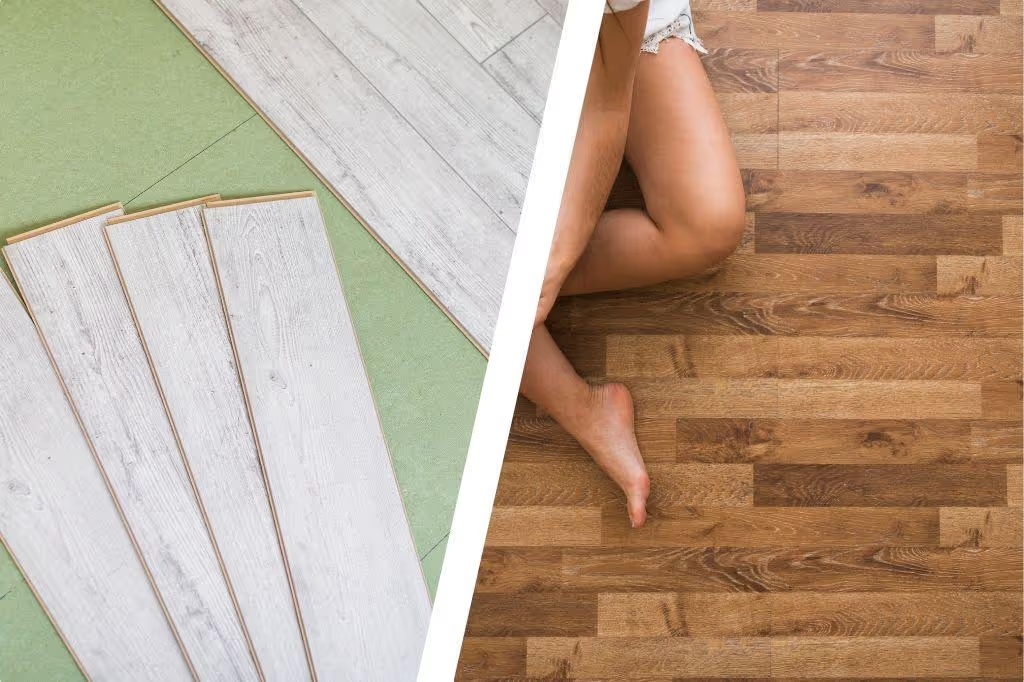
Floating parquet, also called engineered parquet, is a real wood parquet with a wear layer in noble wood. Laminate flooring, on the other hand, is a synthetic covering made up of fiber panels and a photographic print imitating wood. Although they may look similar, their composition, their durability and their price are different.
If, like many consumers, you confuse these two coverings, Woodpartners explains everything about the differences between laminate flooring and floating parquet to help you make the right choice suited to your budget and needs.
The difference between floating parquet and laminate in a nutshell
-
Floating parquet is a real wood parquet with a noble-wood wear layer of at least 2.5 mm, whereas laminate flooring is a synthetic covering with no real wood on the surface.
-
Floating parquet can be renovated by sanding 2 to 3 times over its lifetime, whereaslaminate must be replacedonce the wear layer is worn through.
-
Laminate flooring offers better value for money with prices between €10 and €40 per m², compared with €40 to €120 per m² for floating parquet.
What is floating parquet and laminate flooring?
Floating parquet, technically called engineered parquet, is a real wood parquet whose surface is made of a noble species such as oak, beech, walnut, ash, or other exotic species. The term “floating” refers to its installation method because the planks are neither nailed nor glued to the substrate; they rest on an underlay and are joined together by a click-lock system.
Laminate flooring is a synthetic covering that imitates the look of wood without having its properties. Unlike floating parquet, laminate contains no noble wood layer on the surface. It is a stack of composite materials bonded with thermosetting resins, designed to offer an economical and durable alternative to parquet.
Comparison table between floating parquet and laminate
To help you quickly visualize the difference between floating parquet and laminate, here is a summary table of the essential criteria

What are the differences between floating parquet and laminate?
Several criteria such as composition, ability to renovate, price, resistance, lifespan, or comfort make it possible to tell the difference between laminate flooring and floating parquet in order to choose the covering suited to your needs.
Composition: real wood vs synthetic
Composition is the main difference between laminate flooring and floating parquet :
-
The multilayer construction of floating parquet makes the floor more stable while retaining all the natural qualities of wood such as thermal and acoustic comfort as well as an authentic aesthetic.
-
Laminate flooring, on the other hand, contains no real wood on the surface, as it is a photographic print protected by a resin.
Good to know : This difference in composition explains why only parquet can benefit from the “NF Parquet” certification and the “Parquets de France” label. To legally use the term “parquet” in France, the noble-wood wear layer must be at least 2.5 mm thick. At Woodpartners, we recommend a thickness of 3.5 mm to 4 mm to ensure better durability and allow several renovations.
Renovation capability
Unlike a wood parquet, laminate flooring cannot be renovated :
-
Floating parquet can be renovated by sanding when the wear layer is thick enough (minimum 2.5 mm, ideally 3.5 to 4 mm). This operation removes scratches, stains, and wear marks to restore the parquet to its original appearance. Depending on the thickness of the top layer, it is possible to sand 2 to 3 times over the parquet’s lifetime.
-
Laminate flooring, on the other hand, cannot be sanded. If the overlay layer, which is the transparent protective resin layer, is pierced or damaged, the only solution is to replace the damaged plank or the entire covering.
Price and investment
Floating parquet is more expensive because it is made of real wood on the surface with prices between €40 and €120 per m². Laminate flooring is much more affordable for smaller budgets with prices between €10 and €40 per m² including installation.
However, this price gap must be put into perspective with the lifespan of parquet :
-
A well-maintained floating parquet can last up to 50 years and be renovated several times,
-
A laminate floor will need to be replaced after 15 to 25 years. Over the long term, investing in floating parquet may prove more cost-effective.
Maintenance and practicality
Laminate flooring is very easy to maintain, while floating parquet requires more attention.
For laminate flooring a vacuum cleaner and a slightly damp microfiber mop are enough for daily maintenance. It resists common household products well and requires no specific treatment. It is therefore suitable for intensive use and for people looking for minimal maintenance.
Floating parquet requires more attention sdepending on the finish chosen because it is a natural material that reacts to humidity and external aggressions:
-
Varnished parquet : standard maintenance but watch out for micro-scratches
-
Oiled parquet : requires an application of maintenance oil about once a year to nourish the wood and preserve its appearance.
-
Waxed parquet: requires regular polishing and remains more sensitive to water and stains.
Resistance to humidity
Laminate flooring generally resists humidity better than wooden floating parquet, provided you choose a water-resistant version suitable for wet rooms.
-
The noble wood of floating parquet is sensitive to humidity and can swell, warp, or stain when in contact with standing water. Only certain exotic species that are naturally rot-resistant, such as teak, ipe or black locust (classes 4 or 5), cope better with humidity.
-
Modern laminate floors known as “water-resistant”, have an HDF core treated against water and reinforced click-lock systems. They can be installed in kitchens or bathrooms, provided you choose a range specifically designed for these uses.
Thermal and acoustic comfort
Wooden floating parquet offers better thermal and acoustic comfort thanks to the natural properties of wood. It is warmer to the touch, retains heat better, and provides a pleasant feel underfoot. Wood also absorbs some impact noise, which reduces resonance in the room.
Laminate flooring, denser and less insulating, quickly transmits heat, making it efficient with underfloor heating. However, it tends to amplify footsteps and impact sounds. Installing a quality acoustic underlay is therefore essential to improve acoustic comfort.

One form, several offers.
- Two minutes, no account
- Direct, no middleman
- Your identity stays private
How to recognize floating parquet from laminate flooring?
To visually tell the difference between floating parquet and laminate, our Woodpartners experts share 5 foolproof clues:
-
The edge of the plank : if you see stacked layers like a “mille-feuille,” it’s laminate. If you can distinguish the wood grain on the top layer, it’s real parquet.
-
Pattern repetition : on laminate, the photographic print repeats about every 16 elements. On parquet, each plank is unique.
-
Weight : at equal volume, parquet is about twice as heavy as laminate due to the density of noble wood.
-
Touch : parquet has a natural texture and an organic warmth. Laminate, despite embossed textures, retains a more “cold” feel.
-
Certifications : the “NF Parquet” certification and the “Parquets de France” label are exclusively reserved for real wood parquets.
How to choose between laminate flooring or floating parquet?
The choice between floating parquet or laminate flooring depends on 2 main criteria :
-
The room’s use
-
The available budget
Choice by room type
The choice between floating parquet and laminate flooring depends above all on how the room is used :
-
Bedrooms: floating parquet is ideal for bedrooms because it is a low-traffic room where thermal comfort and air quality are essential. Noble wood emits few VOCs (Volatile Organic Compounds) and helps regulate humidity.
-
Living room and lounge : if your budget allows, floating parquet brings incomparable warmth and improves acoustics. If you have large pets (dogs over 30 kg), a Class 33 laminate will better resist scratches while maintaining a nice appearance.
-
Hallways and entryways : laminate flooring is the go-to option in these high-traffic areas because abrasion from sand, small stones, and heels quickly wears out noble-wood parquet. Choose at least a Class 23 laminate (intense domestic use) or Class 33 for maximum resistance.
-
Kitchen: water-resistant laminate is the most reasonable choice for a kitchen, with an HDF core treated against moisture. If you absolutely want parquet, opt for a rot-resistant exotic species such as teak or ipe, but the budget will be 2 to 3 times higher.
-
Bathroom : only a laminate specifically designed for wet rooms can be considered. Parquets, even exotic ones, are still not recommended unless installed with “ship deck” joints and rigorous maintenance.
Choice according to budget
-
Tight budget (less than €30/m²) : laminate flooring is your only option. Choose an appropriate use class (minimum 23 for domestic use) and a quality underlay to compensate for sound resonance.
-
Mid-range budget (€30 to €60/m²) : you can consider an entry-level floating oak parquet with a 2.5 mm top layer, or a high-end laminate with excellent performance.
-
Comfortable budget (more than €60/m²) : opt for a quality floating parquet with a 3.5 to 4 mm top layer that will allow several renovations and an optimal lifespan. It’s a long-term investment that adds value to your property.
Woodpartners experts’ opinion
Lucas Garel, our timber construction expert, insists : "Never choose your floor based only on a catalog or photo. Ask for samples, touch the materials, test them under different lighting in your interior. A floor is a commitment for at least 20 years. Take the time to think it through."

Your checklist before buying
-
Check the composition : require at least 2.5 mm of noble-wood top layer for parquet, and the thickness of the overlay for laminate.
-
Verify certifications : NF Parquet for parquets, suitable use class (23 or 33) for laminates.
-
Assess the flatness of your subfloor : plan for leveling if necessary.
-
Choose a quality underlay: it determines acoustic and thermal comfort.
-
Calculate the total cost : material + underlay + preparation + installation + maintenance over the lifespan.
Floating parquet offers the authenticity of noble wood, the possibility of renovation, and added real-estate value, but requires a higher budget and regular maintenance. Laminate flooring appeals with its affordable price, its resistance to impacts, and its ease of maintenance, but cannot be renovated and has a more limited lifespan.
Do you have a renovation or fit-out project? The Woodpartners experts are at your disposal to advise you and help you choose the floor covering best suited to your needs. Contact us for a personalized quote and benefit from our expertise in timber construction and interior fit-out.