
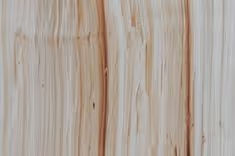
Beech is a European wood very widespread in the construction field. Whether in joinery, in cabinetmaking or in other DIY tasks, beech wood enjoys a certain success because of the diversity of its applications. So what are its characteristics, what is it used for and how do you maintain it?
To answer your questions, we will follow these steps:
- What is beech wood?
- What are the characteristics of beech?
- Beech wood: what is it used for?
- How do you maintain beech wood?
- Other questions about common beech

What is beech wood?
Beech wood, or common beech, is a hardwood that comes from Europe. It belongs to the Fagaceae family, and bears the scientific name "Fagus sylvatica". Very widespread in its region of origin, beech grows mainly in forests with a temperate, damp climate.
Beech wood is a shade-tolerant species that favours fairly deep, rich, well-drained soils. Thinning with a view to obtaining high forest gives slightly faster growth results. The beech tree can thus reach 30 or 35 metres in height. What is more, the optimal age for harvesting beech is between 90 and 120 years, and its lifespan can reach nearly 300 years.
Common beech has a range that covers a large part of western Europe, including 9% of French forests. In France, it is found in homogeneous stands, otherwise known as beech woods, or in mixed forests, often associated with other species such as fir or sweet chestnut.
Finally, beech has different names depending on the country:
- In France : Hêtre;
- In Germany : Buche;
- In Spain : Haya;
- In Italy : Faggio;
- In the United Kingdom : Beech.

What are the characteristics of beech?
Beech has various characteristics, such as a fine grain, a straight fibre direction and sapwood that is not distinct. Beech wood is homogeneous, of a yellowish or greyish white colour that can tend towards pink. Note that some trees are affected by a fungus that causes the heartwood to redden. The affected areas are then more fragile and more prone to movement.
Beech wood benefits from good flexibility and impact resistance. What is more, its fairly high density places it among the medium-heavy to heavy woods.
Description of beech wood
- Colour of beech : light brown, from creamy white to pale pink;
- Bark : thin;
- Leaves : deciduous, green or orange in colour during the autumn and oval in shape;
- Sapwood (the soft, light-coloured part of the wood that forms each year under the bark): not distinct;
- Grain : fine;
- Grain direction or fibre orientation : straight, sometimes wavy;
- Interlocked grain or direction contrary to the axis : absent.
Description of the beech log
- Diameter of the beech tree : between 40 and 90 cm;
- Preservation in the forest : poor, treatment is necessary.
The physical properties of beech wood
- Density of beech (at 12% moisture content with 1 MPa = 1 N/mm²): between 0.60 and 0.75;
- Hardness (at 12% moisture content with 1 MPa = 1 N/mm²) : 4.2;
- Growth : slow;
- Volumetric shrinkage coefficient : 0.54%;
- Total tangential shrinkage (TS): 11.6%;
- Total radial shrinkage (RS): 5.7%;
- Ratio between TS and RS : 2.0;
- Fibre saturation point : 32%;
- Stability in service : not very stable.
The natural durability and treatability of beech
- Resistance to fungi : class 5, not durable;
- Resistance to dry wood insects : durable heartwood but sapwood not distinct;
- Resistance to termites : class S, susceptible;
- Treatability : class 1, treatable;
- Wood class: use class 2, for indoor use with a slight risk of damp.
Drying beech
- Drying speed : slow;
- Risk of distortion : high;
- Risk of case-hardening (accidental hardening): present;
- Risk of checks (splits): high;
- Risk of collapse (waviness, separation of the wood): present.
Sawing and machining beech wood
- Blunting effect : normal;
- Sawing teeth : stellite-tipped teeth;
- Machining tools : tungsten carbide;
- Suitability for peeling : good;
- Suitability for slicing : good.
Assembling beech
The assembly of beech is done in two steps:
- Nailing and screwing : good holding, with pilot holes required;
- Gluing : satisfactory.
As regards the finishes, beech wood has considerable advantages. Its aptitudes for bending, turning and bending are excellent. What is more, the sanding stages make it possible to obtain very fine surface qualities because of the remarkable fineness of beech.

One form, several offers.
- Two minutes, no account
- Direct, no middleman
- Your identity stays private
Beech wood: what is it used for?
Beech wood is rather intended for indoor uses; the furniture industry is a major consumer of beech. Its homogeneity and its finishing qualities give it endless possibilities for fitting out.
Beech wood is thus found in various applications such as interior joinery, furnishing, mouldings, turned items such as toys, and floors.
- Beech wood for interior joinery : it is perfect for making bent items such as staircases or solid beech flooring. What is more, making wooden kitchen utensils is very widespread with this species because of how easy it is to work.
- Beech for furnishing : it can easily be stained, impregnated, varnished and polished, which makes it an ideal wood for making a beech piece of furniture. Its recognised visual appeal gives very satisfying results.
- Beech wood for mouldings : easy to handle and allowing quality finishes, it is often used for making mouldings.
- Common beech for turned items : whether for toys or for making oars, it is valued for producing turned items. Its workability offers wide possibilities for craftwork. Not being very hard-wearing in its natural state, however, it will need to be treated by pressure treatment of wood, for example, for certain pieces.
Beech wood is liable to crack and cannot therefore be used for building roof frames.

How do you maintain beech wood?
To maintain beech wood, certain tips are essential. This species is sensitive to moisture and not very hard-wearing in its natural state. The following advice may therefore be useful to you:
- Use a suitable treatment product : beech wood rots easily because of its sensitivity to moisture. It is therefore necessary to use the right products to avoid any early deterioration. You can, for example, use a chemical substance such as creosote. This distillate-based tar extends the service life and the resistance of this wood.
- Carry out an industrial treatment : high-temperature treatment, for example, makes it possible to preserve beech wood and to use it in more substantial work such as cabinetmaking.
- Clean beech furniture : cleaning with soapy water and a smooth cloth makes it possible to avoid leaving marks while preserving the material. Detergent should not be used, as it could seriously damage your beech furniture.
