
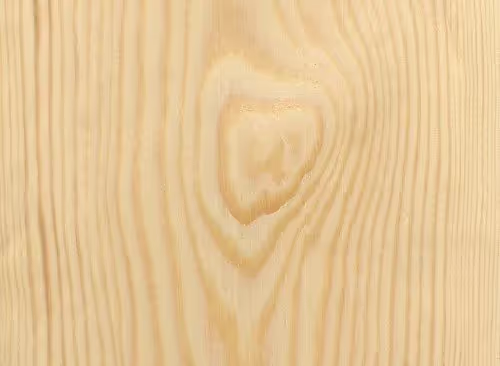
Northern redwood, a variety of Scots pine, is widely used in construction for its nobility, its appearance and its consistency.
In order to explain the uses and characteristics of northern redwood / Scots pine to you, we will go over the following points in this article:
- What is Scots pine / northern redwood?
- What are the characteristics of northern redwood / Scots pine?
- Scots pine: what is it used for?
- How do you maintain northern redwood / Scots pine?
- Other questions about northern redwood / Scots pine
What is Scots pine (northern redwood)?
Scots pine is also called northern redwood, as opposed to northern whitewood, which is spruce. Scots pine grows in cold regions such as Scandinavia or Russia, in areas above 57° North. This long-lived conifer is one of the botanical species Pinus sylvestris and is characterised by its orange trunk.
Several types of Scots pine exist, including northern redwood. This type of pine is the most widespread in the world; it is found throughout Eurasia. Different names are given to it depending on the country:
- In Germany : Fohre, Kiefer;
- In Spain : Lapland Pine;
- In France : Pin de Riga, Pin du Nord, Pin Sylvestre;
- In the United Kingdom : Northern Pine, Red Pine.
This light-demanding species, which likes the sun, is not fussy about the quality of the soil. Scots pine is therefore a straightforward wood species that makes do with little. Northern redwood withstands low temperatures down to -50°C. Homogeneous stands are mostly managed as even-aged and selection high forest. The even-aged high forest method consists of keeping trees of similar ages in a plot set aside for this purpose. Rotation frequencies are therefore around 80 years.
Scots pine (northern redwood) can reach a height of 30 to 35 metres and diameters of 0.8 m to 0.9 m. The straight trunk is more cylindrical than that of other pines. Northern redwood takes its name from its scaly reddish bark. Finally, its longevity is high, and can reach five centuries.

One form, several offers.
- Two minutes, no account
- Direct, no middleman
- Your identity stays private
What are the characteristics of northern redwood?
The characteristics of northern redwood are varied. The sapwood is not durable and the resistance of the heartwood is average. The sapwood of Scots pine is, however, very easily treatable and its heart can be pressure treated without difficulty to obtain use class 4.
Northern redwood shows little movement, is fairly elastic and stable in service. Nevertheless, like all conifer woods, it is fairly prone to splitting and can therefore crack easily. But its mechanical characteristics are among the best of the softwoods, whether in compression, in bending or in impact resistance.
Description of northern redwood
Northern redwood has pinkish to reddish-brown heartwood, often strongly grained. The knots are dark reddish-brown to blackish-brown. The sapwood, for its part, is yellowish and its grain is far less pronounced. The grain of northern redwood is fine, its fibre direction straight, soft and consistent.
- Colour of northern redwood : pinkish brown;
- Sapwood (the soft, light-coloured part of the wood that forms each year under the bark):clearly distinct;
- Grain of northern redwood : fine to medium with growth rings between 1 and 3 mm wide; the texture remains fine;
- Grain direction or fibre orientation of northern redwood : straight, soft and consistent;
- Interlocked grain or direction contrary to the axis : absent.

Description of the Scots pine log
- Diameter of the Scots pine tree : from 30 to 80 cm;
- Thickness of the sapwood : from 5 to 10 cm;
- Preservation of Scots pine in the forest : average, treatment is recommended;
- Sawing the logs : easy; only the large, hard, black knots can be problematic.
The physical properties of northern redwood
- Density of northern redwood : 550 kg/m3;
- Hardness : 2.6 (at 12% moisture content, with 1 MPa = 1 N/mm²);
- Volumetric shrinkage coefficient : 0.45%;
- Total tangential shrinkage (TS): 8.3%;
- Total radial shrinkage (RS): 5.2%;
- Ratio between TS and RS : 1.6;
- Fibre saturation point : 30%;
- Stability in service : moderately stable.
The natural durability and treatability of Scots pine
- Durability : moderately to slightly durable;
- Resistance to fungi : class 3-4, moderately to slightly durable;
- Resistance to dry wood insects : class D, durable;
- Resistance to termites : class S, susceptible;
- Treatability of Scots pine : class 3-4, poorly treatable or not treatable;
- Use class of Scots pine : class 2, for indoor use or under shelter. It becomes class 3 or 4 after pressure treatment.
Drying northern redwood
- Drying speed of northern redwood : fast to normal, fast drying requires clean, airy stacking in order to avoid blue stain. These problems are generally eliminated by kiln drying, which is standard practice in Scandinavia, while taking care to begin the schedule at fairly high temperatures;
- Risk of distortion : low;
- Risk of case-hardening (accidental hardening): no particular risk;
- Risk of checks (splits): low;
- Risk of collapse (waviness, separation of the wood): no particular risk.
Sawing and machining Scots pine
- Blunting effect : normal;
- Sawing teeth : ordinary or alloy steel;
- Machining tools for Scots pine : ordinary;
- Tools for planing : requires well-sharpened tools in order to obtain excellent joinery quality;
- Suitability for peeling : good, moderate steaming is preferable and makes it possible to obtain plywood;
- Suitability for slicing Scots pine : poses no problem.
Assembling northern redwood
- Nailing and screwing : good holding, the pull-out resistance of screws and nails is adequate;
- Gluing northern redwood : satisfactory, all adhesives can be used as long as drying is carried out above 70°C, which stabilises the resin.
The finishing stages on northern redwood pose no problems: every surface treatment gives satisfaction (paints, woodstains, varnishes). Woodstain is nevertheless recommended outdoors, because it is more hard-wearing and easy to renovate.

Scots pine - northern redwood: what is it used for?
Scots pine - northern redwood can be used for any type of application. It is a class 3 wood, which can be used outdoors as long as it has no direct contact with the ground. In view of the specific characteristics of northern redwood, however, some applications are more appropriate than others:
- Scots pine for roof frames and house frames : it has good mechanical properties, which give it a major advantage for making roof frames and house frames in Scots pine.
- Northern redwood for joinery : its fineness and its consistency make northern redwood an asset for joinery.
- Scots pine wood for interior coverings : this softwood species is ideal, after treatment, for panelling and mouldings.
- Northern redwood for outdoor use : it can be used, after treatment, for windows, shutters and cladding.
How do you maintain northern redwood?
Maintaining northern redwood will take little effort on your part. Maintaining Scots pine proves very simple
- Cleaning with a pressure washer : once a year at low pressure, to let the wood grey naturally.
- Using a saturator : to preserve its natural shade, you can apply a saturator twice a year.
- Using a wood brightener : if you want to bring back the natural shade of Scots pine wood after it has greyed, you simply need to use a wood brightener.
