
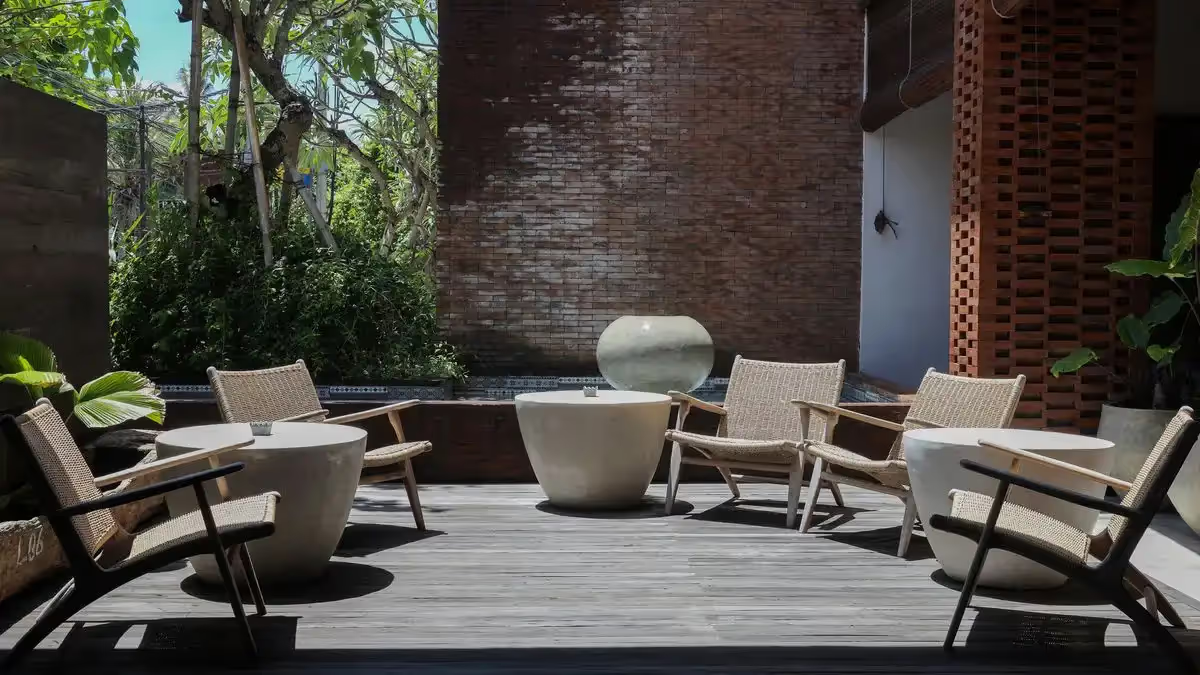
Here are the secrets of a perfect timber deck, with the invaluable advice of Bruno Dusser, an outdoor landscaping expert for two decades. Discover how to combine durability, good looks and respect for the environment to create your ideal outdoor space.
Choosing the perfect timber for your deck: expert advice
When it comes to creating a timber deck, the choice of material is crucial. For two decades, Bruno Dusser, manager of the company Autour du Bois and a renowned specialist in timber decks, has been sharing his rich experience in selecting the ideal decking timber. Discover his invaluable recommendations for durable and attractive outdoor landscaping.
Which use class for your decking timber?
The choice of timber for a deck depends on its use class. According to Bruno Dusser, a timber with use class IV is optimal for outdoor exposure, as is the case with black locust, massaranduba and merbau. This classification guarantees resistance to direct contact with the ground and with fresh water, while protecting against fungi and wood-boring insects. Certain class III timbers, however, such as Douglas fir and sweet chestnut, can be used for well-ventilated decks. Class V timbers, for their part, are suited to seaside decks and to pontoons1.
One form, several offers.
- Two minutes, no account
- Direct, no middleman
- Your identity stays private
The timber families for your deck
Softwood decks
Pine decks offer several options, from treated pine to red cedar. Pressure-treated pine, recognisable by its greenish tone, is an economical choice with a service life of around fifteen years. Its protruding knots can be a drawback, however. Red cedar, a softwood from North America, is naturally resistant and ages beautifully. As for Douglas fir, also called Oregon pine, it is popular for its mechanical strength and its unique salmon colour1.
Tropical timber decks
Tropical timbers such as padauk, ipe and cumaru come from Central Africa or South America. Bruno Dusser particularly recommends padauk, a dense timber resistant to splintering, with exceptional durability. Ipe is denser and tougher still, ideal for spaces exposed to water. Although tropical timbers are expensive, their durability makes them worth it1.
Heat-treated timber decks
Local timbers, such as ash and poplar, can be used for decks if they are treated by retification, a high-temperature hardening process. Heat-treated timbers are more resistant to insects and fungi, as well as to variations in humidity. Bruno Dusser points out that heat-treated pine is an excellent alternative to tropical timbers, offering both durability and good looks1.
Composite decks
Composite timbers, made from wood flour and resin, offer a modern alternative. They are valued for their consistent appearance over time and for the absence of visible fixings. These materials are still relatively new, however, and Bruno Dusser advises caution in choosing them1.
Maintaining and cleaning timber decks
All timber decks tend to go grey naturally over time. If you prefer to keep the original tone, professional wood brighteners are available. Maintenance generally consists in washing the deck with a pressure washer once a year. To remove moss and other dirt, environmentally friendly products such as white vinegar or oxalic acid are recommended1.
The informed choice for a perfect deck
Choosing the ideal decking timber calls for in-depth knowledge of the different species and their characteristics. Thanks to the expertise of Bruno Dusser, you can now take informed decisions to create a deck that combines durability, good looks and comfort. Share your experiences and discoveries in the comments below and inspire the community of outdoor landscaping enthusiasts.