
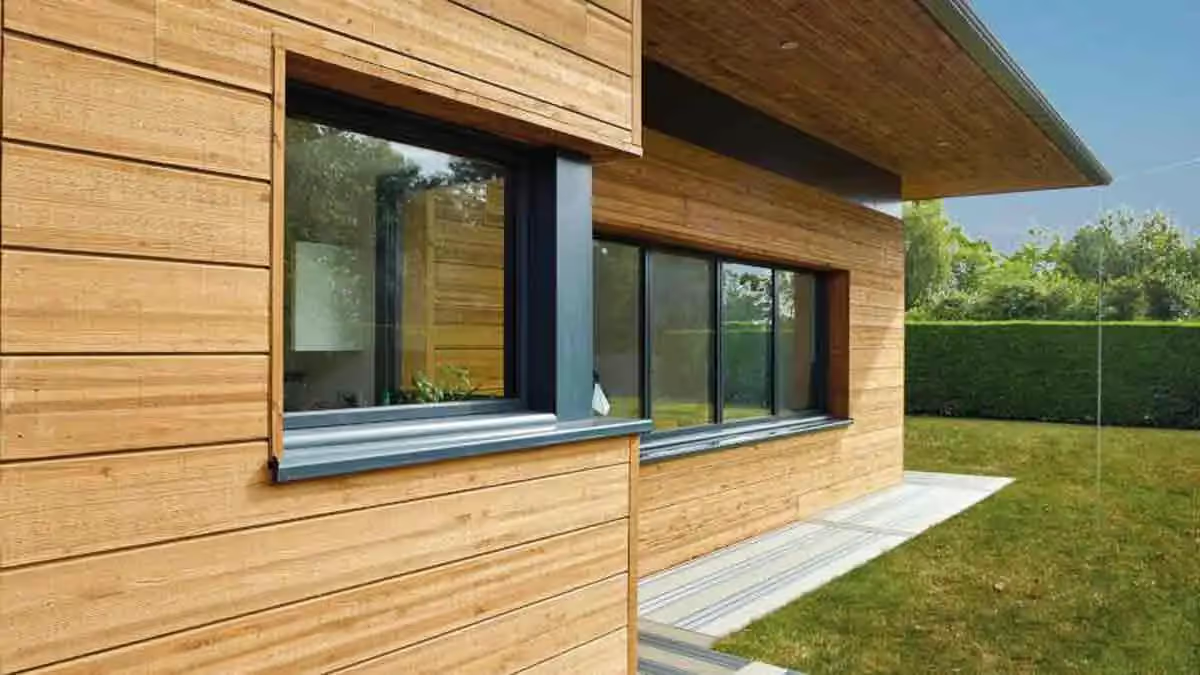
Every building has a history, a role and an architecture of its own. When it comes to protecting them and giving them a unique appearance, cladding has been the solution favoured by experts for decades. Through its looks, its functionality and its diversity, this external covering has carved out a place of choice in the world of construction.
Cladding: an external covering with many faces
Cladding: definition and specific features
Cladding is far more than a simple external skin. It is a genuine second skin for the building. Whether in wood, stone, terracotta, composite or PVC, this external covering is laid on a framework, often in wood or metal, to give the structure optimal protection against the elements. But that is not all: it also gives an undeniable visual character thanks to its many variations. This process is not only decorative. In fact, when it comes to low-energy construction, cladding is associated with the wrapped-wall concept, which allows thermal insulation from the outside. This method of insulation is both high-performing and moisture-regulating, contributing to better thermal regulation of the building.
Weatherboard cladding: tradition and modernity combined
Weatherboard cladding has proved to be a favoured choice among professionals and homeowners. Historically, wooden cladding was made up of rough-sawn boards. These were laid so as to overlap slightly, thereby giving a visually harmonious effect. With the evolution of techniques, the modern weatherboard was born, profiled on all four sides or sometimes just along its length.
Why such enthusiasm for this type of cladding? Weatherboard cladding is not only attractive, it is also functional. It is suited to all types of construction, whether in brick, stone, concrete, or even on a timber frame. It is a miracle cure for older buildings, allowing them to regain their youth and a uniform look by masking their irregularities. One of the greatest advantages of this covering is its role in the thermal regulation of a structure. The thickness of the framework creates a space between the façade and the weatherboards, known as the air gap. This gap plays a crucial role in managing the temperature of the building.
Weatherboard materials: a waltz of choices
The abundance of materials available for weatherboards is living proof of their evolution and their adaptability. From solid wood, by way of composite, through to PVC, each material has its own charm and its own distinct advantages.
- Solid wood: Red cedar, larch, black locust and sweet chestnut are valued for their timeless looks and their durability. Treated naturally or through specific processes, these wood species effectively withstand the various forms of external attack. Pressure-treated or heat-treated wood, such as spruce or Douglas fir, needs regular maintenance to guarantee its longevity. A special mention for heat-treated wood which, thanks to a transformation at high temperature, offers resistance to moisture comparable to that of exotic species.
- Composite wood: Environmentally friendly, durable and needing little maintenance, it combines the advantages of solid wood without the constraints of caring for it. Made from recycled wood and polymers, it is ideally designed for outdoor use, with resistance to the weather and ease of cleaning.
- PVC: This synthetic material offers a durable covering with no maintenance. It comes in the form of boards, offering wood imitations or render finishes, and can be fixed to a wooden or PVC structure.
Cladding, in all its forms and variations, is more than a visual choice. It is a functional, environmentally friendly and durable solution for any building. Whether for a new build or to breathe new life into an old one, cladding offers a promise of protection, thermal efficiency and good looks. Before you start, however, do not forget to find out about local planning and façade appearance rules and regulations.
Cladding: beyond simple appearance
Cladding, far more than a simple decorative element, plays an essential role in preserving and improving the energy efficiency of a house. Over the years, its use has evolved, today offering a variety of options that meet current needs in terms of durability, environmental impact and appearance.
One form, several offers.
- Two minutes, no account
- Direct, no middleman
- Your identity stays private
The evolution of cladding
Over time, cladding has gone from a simple protective layer to an essential design element in modern architecture. Thanks to technological advances, cladding materials are now more hard-wearing, offering better insulation and a longer service life.
Cladding and sustainable development
Environmental impact is at the heart of contemporary concerns. Many manufacturers have responded to this demand by offering environmentally responsible cladding solutions. By choosing recyclable materials or materials from renewable sources, they guarantee not only a reduction in the carbon footprint, but also increased performance.
Cladding and technology
With the rise of home automation, some cladding now incorporates advanced technologies. Whether sensors to monitor moisture or built-in solar panels, cladding has turned into a multifunctional element of the modern home.
The future of cladding
The future of cladding looks promising. Constant innovation in materials and techniques promises new solutions suited to the challenges of the 21st century. Whether self-sufficient buildings, intelligent cladding or avant-garde designs, cladding will continue to play a key role in the architecture of tomorrow.
Innovations in materials
As nanotechnology makes its entrance into the field of construction, cladding materials could benefit from improved properties, such as self-cleaning, the ability to purify the air or increased resistance to the elements.
Integration with nature
A growing trend is the integration of cladding with natural elements. Whether through the use of vertical gardens or the incorporation of biological materials, cladding is becoming an element that supports biodiversity.
The transforming role of cladding
Cladding has come a long way since its beginnings. It has become an indispensable element for any house or building. With its ability to protect, insulate and beautify, it will without any doubt continue to evolve, pushing back the boundaries of what is possible and shaping the future of architecture.