
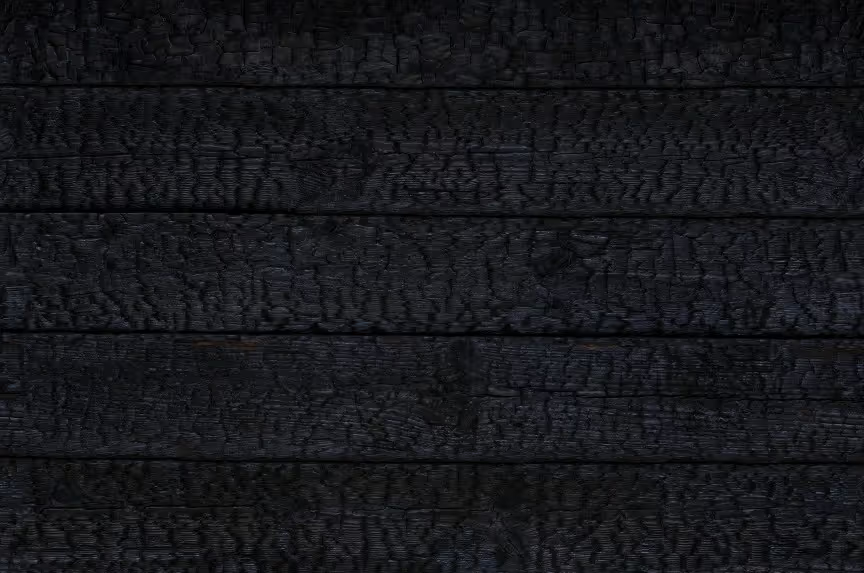
Black facade, scaled or brushed texture, wood grain revealed by fire: burnt wood cladding is increasingly making its way into architectural projects. Behind this highly identifiable aesthetic lie solid technical performance, a Japanese origin dating back several centuries, and a few points of vigilance that every professional or installer should know.
In this guide, WoodPartners explains in detail what burnt wood cladding (or Yakisugi) is and where it comes from, why its durability and resistance properties make it an interesting material, and which species and finishes to choose depending on your project.
What you need to know about burnt wood cladding
-
Burnt wood cladding is obtained by controlled charring of the surface of a board: the carbon layer naturally protects the wood from insects, fungi and moisture, without chemical treatment.
-
Its service life is estimated at around 80 years with periodic maintenance, compared with 30 to 50 years for well-maintained conventional wood cladding.
-
In France, four species are commonly used: Douglas fir and larch, spruce and Accoya.
-
The price ranges between €70 and €150/m², and installation between €50 and €70/m²: a higher upfront cost, offset by the material’s longevity and low maintenance frequency.
What is burnt wood cladding?
Burntwood is a facade material obtained by controlled charring of the surface of a board. Fire creates a carbon layer that protects the wood from external aggressions, without resorting to chemical treatments. This is its main advantage, both technically and environmentally.
Yakisugi and Shou Sugi Ban: two names for a single technique
In France, people often refer to “burnt wood” or “Shou Sugi Ban”. The exact Japanese term is Yakisugi(焼き杉), which literally means “burnt cedar”. Shou Sugi Ban refers more specifically to cladding made from Japanese cedar (sugi). Outside Japan, the two terms are used interchangeably to refer to all charred wood claddings.
The origins of the technique
Yakisugi originated in the Seto Inland Sea region, notably on the island of Naoshima, in the 18th century. Japanese craftsmen burned the surface of cladding to make the wood more resistant to fire and weather, in densely built areas where fires spread easily.
Long kept relatively confidential in Europe, the technique has seen renewed interest since the 2000s. Contemporary architects such as Terunobu Fujimori brought it back into the spotlight, and it has gradually become established in residential and commercial projects around the world.
How is burnt wood cladding made?
Today, burnt wood cladding is produced in workshops by specialized manufacturers. Two main techniques coexist:
-
The traditional method, which consists of assembling three boards into a triangle to create a chimney effect and evenly burning their inner surface with a flame.
-
Industrial processes using a blowtorch or kiln, which enable more controlled charring and reproducible finishes on a large scale.
The technique can also be carried out manually with a blowtorch for small surfaces, but it requires real experience to achieve even charring and a neat finish.
In practice, for a cladding project, you buy ready-to-install burnt wood boards from a manufacturer, just as you would for any wood cladding.

What are the advantages of burnt wood cladding ?
Charring gives burnt wood four distinctive technical properties:
-
Longevity: service life estimated at several decades, without chemicals
-
Biological resistance: natural protection against wood-boring insects and fungi
-
Fire performance: the carbon layer slows the spread of flames
-
Environmental footprint: no biocides (chemical treatment), local species promoted, low replacement frequency
Durability estimated at several decades
The service life of burnt wood cladding is estimated at around 80 years by industry professionals, provided it is correctly installed and receives suitable periodic maintenance. This longevity is significantly higher than that of untreated conventional wood cladding. It is explained by the carbon layer formed during charring, which naturally protects the board without the addition of chemical treatment products.
Resistance to insects, fungi and moisture
Burnt wood is naturally resistant to wood-boring insects and wood-decay fungi. Charring eliminates cellulose, hemicellulose and starch from the surface layer, which are the main nutrient sources for these organisms. As a result, the charred layer no longer offers them a favorable substrate. In addition, when the board is oiled after burning, its surface becomes hydrophobic, which limits water absorption and reduces the risk of rot.
A counter-intuitive fire behavior
Burnt wood slows the spread of flames. A study by the Kansai Association for the Research in Traditional Housing showed that a Yakisugi facade takes longer to ignite than a plastered facade, and that its surface temperature rises more slowly. This slowing is explained by the fact that the carbon layer acts as a thermal barrier.
While this behavior is documented, it does not remove the need to check the regulatory requirements specific to each project.
A favorable environmental footprint
Burnt wood requires no synthetic chemical products for its manufacture or for routine maintenance. It promotes local species such as Douglas fir, produced in France, which limits transport and the associated carbon footprint. Its long service life also reduces replacement frequency and therefore resource consumption over the entire life cycle.

What are the points of vigilance to consider with burnt wood cladding ?
Three points should be anticipated before specifying or installing burnt wood:
-
Color evolution: the initial black changes toward gray or brown tones over time
-
Periodic maintenance: oiling every 10 to 15 years is recommended outdoors
-
Material cost: higher at purchase than conventional wood cladding
An aesthetic evolution over time
The charred surface of burnt wood naturally evolves over the years. Under the effect of UV, rain and wind, the initial deep black can give way to grayer or browner shades. This aging is often considered an aesthetic advantage (rooted in the Japanese wabi-sabi philosophy, which values the beauty of things that change over time).
However, it must be anticipated in the specifications, especially when the initial color is a key criterion of the architectural project.
Periodic maintenance to plan for
Anatural oil application every 10 to 15 years is recommended outdoors to maintain the surface’s waterproofing and slow color changes. Fortunately, this is maintenance that is simple and infrequent. Nevertheless, it must be mentioned from the outset: the idea of “zero-maintenance” burnt wood, often put forward in commercial arguments, should be qualified.
A higher material cost than conventional cladding
Allow between €70 and €150/m² for supply only, depending on the species and the chosen finish, i.e., a higher cost than standard wood cladding at purchase. Installation generally adds between €50 and €70/m². This initial extra cost should be weighed against the material’s longevity and low maintenance frequency, which can make the overall economics favorable over time.
One form, several offers.
- Two minutes, no account
- Direct, no middleman
- Your identity stays private
Which species to choose for burnt wood cladding?
For burnt wood cladding, softwoods with a well-defined grain produce the best results. In France, four wood species are commonly used, with very distinct characteristics and market positioning.
Douglas fir
Douglas fir is a French species commonly used for burnt wood cladding. Rated durability class 3 (naturally durable out of ground contact), it comes from certified French forests and offers good mechanical properties at an accessible cost. Its flamed grain, marked by a pronounced contrast between earlywood and latewood, produces a very expressive finish after burning. Charring emphasizes this ring alternation and gives a deep texture, particularly visible in a brushed finish. Its original pinkish tone can slightly influence the resulting shades.
A point to highlight to clients: Douglas fir may show resin exudation on the surface under the effect of sun during the first few years. This is a natural phenomenon specific to softwoods, with no impact on cladding performance.
Larch
Larch is rated durability class 3 (naturally durable) and has a higher density than Douglas fir, making it a choice of burnt wood cladding particularly suited to exposed sites (north-facing facades, coastal areas, altitude). Its texture after charring is generally more uniform than Douglas fir, with less contrasting grain.
A point of vigilance regarding sourcing: Siberian larch, very present on the European market before 2022, has been banned from import into the EU since Regulation (EU) 2022/576, adopted in response to Russia’s invasion of Ukraine. However, larch of Russian origin may still circulate via third countries (Turkey, Asia). It is recommended to request a certificate of origin from the supplier. European larch (Alps, Central Europe) remains available and is the preferred local alternative.
Spruce
Spruce is not naturally durable for outdoor use: its heartwood is not rated with sufficient natural durability for cladding without prior treatment. For facade use, it must be pressure-treated (autoclave) to class 3 or 3.1 before installation.
Once treated and burned,it offers a good-quality finish at an accessible cost, with a light surface that is easy to work with. It is suitable for projects where the material budget is constrained, provided installation is rigorous (ventilation, clearance from the ground, systematic re-treatment of cuts and drill holes).
Accoya
Accoya is radiata pine treated by acetylation, a process that modifies the wood’s chemical structure without hazardous products. It is rated durability class 1 (very durable, even in ground contact) and reacts particularly well to burning: its high dimensional stability limits wood movement during and after charring, which facilitates installation. Charring accentuates its grain more than with other species, for a refined aesthetic result.
It isthe premium burnt wood option, suited to highly exposed projects, demanding commercial developments, or clients who want to minimize any maintenance over the long term.

Finishes for burnt wood cladding
The level of charring and final oiling determine both the appearance of the cladding and its outdoor performance. A light burn will produce a subtle tone; a deep burn will produce a very pronounced texture. The choice is made above all in line with the intended architectural style.
For large-scale projects, preliminary tests on the selected species are still recommended to adjust burn intensity and brushing degree.
Lightly burnt
The flame passes quickly over the surface, bringing out the grain without deeply charring the board. The resulting shade is golden to brown, with a marked contrast between the rings. It is a subtle burnt wood cladding finish, which preserves the natural look of the wood while providing surface protection.
Brushed burnt
This is the finish most common in Europe. After charring, the board is brushed to remove the fragile surface carbon and reveal the wood grain in relief. The result is a smooth-to-the-touch texture, with a very characteristic flame pattern. The color ranges from deep black to anthracite gray depending on the species and burn intensity.
Scaled burnt
Charring is deeper, which causes the wood surface to crack and form irregular scales. This look, sometimes called the “crocodile effect” or “Suyaki”, is the most visually expressive. It is often associated with architectural projects with a strong contemporary character.
Oiling after burning
Whatever finish you choose,applying a natural oil (linseed oil or tung oil) after burning is recommended for outdoor cladding. It fixes the charred surface, reinforces waterproofing, and stabilizes the color over time. Without oil, the surface remains more permeable to water and ages more quickly.
Installation and implementation: what professionals need to know
The quality of implementation and cladding installation directly determines the durability of burnt wood cladding. Several points deserve special attention.
Ventilation of the air gap
A properly sized air gap behind the boards is essential. It evacuates moisture and prevents water from stagnating at the base of the facade. This is a critical point: even with well-charred wood, the unburnt part of the board remains sensitive to fungi if it stays damp for long periods.
Installation direction and suitable profiles
Burnt wood is installed according to the same principles as conventional wood cladding (horizontal, vertical or diagonal). The installation direction directly influences rainwater runoff and therefore the durability of the whole.
Fastening
Fasteners can be visible (stainless nails or screws), concealed(at the bottom of the board) or invisible (clips). For burnt wood, stainless fasteners are essential to avoid rust streaks that spoil the facade’s appearance. Some manufacturers offer invisible fastening systems specifically adapted to burnt cladding profiles.
Handling precautions on site
The charred surface is friable, especially before oiling. To avoid marking or flaking the carbon layer, a few simple precautions are required:
-
Wear gloves throughout installation
-
Avoid boards rubbing against each other during storage and handling
-
Store boards flat, under cover, avoiding any contact of the charred face with abrasive surfaces
-
Handle each board by its edges rather than by its face

What is the price of burnt wood cladding?
Burnt wood cladding supply costs between €70 and €150/m², plus between €50 and €70/m² for installation. These ranges vary depending on the species (Douglas fir, larch, spruce, Accoya), the finish (lightly burnt, brushed, scaled) and the complexity of the job (facade height, presence of cuts or complex trims, site accessibility).
While burnt wood costs more upfront than conventional wood or composite cladding, its low maintenance needs and estimated longevity change the long-term calculation. The table below summarizes the main criteria to present to a client.
|
Criterion |
Burnt wood cladding |
Conventional wood cladding |
Composite cladding |
|
Supply cost |
€70-150/m² |
€30-90/m² |
€50-120/m² |
|
Estimated durability |
~80 years (with periodic maintenance) |
30-50 years (with maintenance) |
25-30 years without maintenance |
|
Maintenance |
Oiling every 10-15 years |
Treatment every 2-3 years |
Cleaning with water |
|
Maintenance cost |
Low |
High |
Very low |
|
Chemical treatment |
None |
Required (stain, saturator) |
None |
|
Environmental impact |
Biodegradable, stores CO₂ |
Biodegradable, stores CO₂ |
Non-biodegradable |
|
Aesthetics |
Unique, charred grain |
Natural, warm |
Uniform, less authentic |
Where can you find products and manufacturers of burnt wood cladding?
WoodPartners lists manufacturers and distributors specialized in burnt wood cladding (Yakisugi / Shou Sugi Ban), available directly on our platform. Browse our selection of burnt wood claddings to identify the brands available, compare product ranges and get in touch with suppliers suited to your project.