
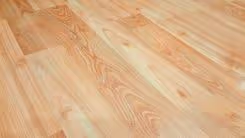
Spruce is widely found and used in the construction field. Indoors or outdoors, spruce wood is used for making roof frames, panelling and cladding alike. It takes treatments well, which makes it more resistant to the various forms of attack. What is more, its appearance makes spruce wood a sought-after timber.
To tell you everything about spruce, we will answer these questions:
- What is spruce wood?
- What are the characteristics of spruce?
- Spruce: what is it used for?
- How do you maintain spruce wood?
- Other questions about spruce
What is spruce wood?
Spruce belongs to the genus Picea; it can take two scientific names: Picea abies or Picea excelsa. Spruce wood belongs to the Pinaceae family. It is often wrongly taken for a variety of fir. This confusion comes from mistaken popularisation on the part of certain spruce importers. Unlike fir, spruce has fairly small, prickly needles. What is more, the cones hang down on a spruce, whereas they stand upright on a fir.
Some visual similarities between fir and common spruce are nevertheless worth noting. This species is also called Norway spruce or red fir and was long regarded as the Christmas tree par excellence. Northern spruce, for its part, comes from the forests of Scandinavia and mainly of Finland.
In France, spruce was long the most used species for reforestation, before being supplanted by Douglas fir.
Spruce wood grows mainly in three distinct zones:
- The Alpine zone: spruce is found in the Jura, the Vosges, the Alps and also the Dinaric Alps.
- Central Europe: it grows in the Carpathians, which stretch across eight countries: Austria, Poland, the Czech Republic, Hungary, Ukraine, Romania and Serbia. Spruce wood is also found in the German uplands, in the Tatras (a mountain range between Poland and Slovakia) and in Transylvania.
- The northern zone: spruce grows in the Baltic States, in Belarus, in European Russia, in Finland, in Sweden, in Norway and in northern Poland.
What are the characteristics of spruce?

Spruce has many characteristics: it has good stability, a certain visual appeal, good durability after treatment, slow growth, a straight fibre direction and a fine, regular grain. What is more, the spruce wood species is resinous and the tree has reddish-brown bark.
Description of spruce
- Colour of spruce wood : a very light shade ranging from whitish to cream;
- Sapwood (the soft, light-coloured part of the wood that forms each year under the bark): not distinct;
- Grain of spruce : fine and regular;
- Grain direction or fibre orientation of spruce wood : straight;
- Interlocked grain or direction contrary to the axis : absent.
Description of the spruce log
- Diameter of the tree : between 40 and 80 cm;
- Preservation in the forest : average, treatment recommended.
The physical properties of spruce
- Density of spruce wood : between 400 and 550 kg/m3 ;
- Hardness (at 12% moisture content with 1 MPa = 1 N/mm²) : 2, 2;
- Growth : slow;
- Volumetric shrinkage coefficient : 0.39%;
- Total tangential shrinkage (TS): 8.2%;
- Total radial shrinkage (RS): 3.9%;
- Ratio between TS and RS : 2.1;
- Fibre saturation point : 33%;
- Stability in service : moderately stable.
The natural durability and treatability of spruce wood
- Durability : poor but good after treatment;
- Resistance to fungi : class 4, slightly durable;
- Resistance to dry wood insects : susceptible, because it is used with its sapwood;
- Resistance to termites : class S, susceptible;
- Treatability of spruce : class 3-4, poorly treatable or not treatable;
- Wood class of spruce : wood class 1, for indoor use with no risk of damp. Class 3 after pressure treatment.
Since spruce wood is slightly durable and sensitive, it should be treated against insect attack and damp.
Drying spruce
- Drying speed : fast;
- Risk of distortion : low;
- Risk of case-hardening (accidental hardening): no;
- Risk of checks (splits): high;
- Risk of collapse (waviness, separation of the wood): no.
Sawing and machining spruce wood
- Blunting effect : normal;
- Sawing teeth : ordinary or alloy steel;
- Machining tools : tungsten carbide;
- Suitability for peeling : good;
- Suitability for slicing : good.
Assembling spruce
The assembly of spruce is done in two distinct steps:
- Nailing and screwing : to be carried out with care, poor holding with a risk of splitting when nailing;
- Gluing : good.
One form, several offers.
- Two minutes, no account
- Direct, no middleman
- Your identity stays private
Spruce: what is it used for?

In the construction field, spruce can be used for different purposes such as the structure, the envelope, interior coverings or outdoor fitting-out. It is also used, however, for related activities and in boat and aircraft building. Let us look at these uses in more detail:
-Spruce wood for the frame of a house : its strength allows it to be used for the structure of a house, as in traditional and industrial roof frames;
- Spruce for the cladding of a home : its durability after treatment gives it considerable assets for the cladding of your house;
- Spruce for outdoor fitting-out : how easy it is to work makes it attractive for outdoor fitting-out; it simply has to be treated in order to be used in making garden furniture or a deck, for example;
- The spruce wood species for boat and aircraft building : its light weight and its great lengths are valued for masts in boat building and for making gliders;
- Spruce for related uses : combined with other sawmill products, spruce is used to make particle panels, paper pulp for newspapers, violin backs, guitar soundboards and resonance wood for pianos and harps.
How do you maintain spruce wood?
Maintaining spruce wood will take little investment on your part. Only watering, feeding and treatment are necessary:
- Watering the spruce : we advise you to be regular in the first few years. After that, you can simply water during severe drought.
- Fertiliser for spruce wood : adding well-rotted compost or a fertiliser specially designed for conifers during the first three springs is enough.
- Treating spruce wood : it is necessary in order to make the wood more durable and to protect it from possible diseases and pests. Spruce is sensitive, for example, to red spider mites. In that case, you will have to water the needles regularly and generously to avoid any problem.
Pruning spruce wood is not necessary, and is even not recommended. Only restorative pruning can be carried out, to remove damaged branches.
Blue spruce or common spruce: what are the different species and varieties of spruce?

Different species and varieties exist among spruces; blue spruce and common spruce are among them. Here are a few examples of spruce varieties:
- Common spruce : a spruce often confused with silver fir because of its green foliage and its height, which varies between 8 and 30 metres;
- Blue spruce or Colorado blue spruce : this spruce has silvery blue foliage and measures between 8 and 12 metres;
- Dwarf Colorado spruce : a spruce with silvery foliage used in pots or in the garden and measuring about 1 metre;
- Serbian spruce : this spruce with green, compact foliage measures between 3 and 30 metres;
- Dwarf Serbian spruce : a spruce with short bluish-green foliage used in pots or in a small garden and measuring between 80 centimetres and 1 metre;
- White spruce : this very compact dwarf spruce with light foliage is also used in pots or in a small garden and measures about 1 metre.
Other questions about spruce
What is the natural colour of spruce?
The natural colour of spruce is very light. The shade can vary between whitish and cream.
How does spruce wood age?
Spruce wood tends to yellow in the light. To avoid this, you can use protection such as indoor saturators so as to keep the natural shade of the spruce.